We have been visiting the Mariposa House Hospice over these last few months as construction progresses, and wanted to share a few of the pictures as it near completion.
While COVID did create some delays and difficulties for the team, everyone has pulled together to realize this very important project.
A hospice is almost like a mini-hospital, but we wanted to make this hospice evoke the feeling and proportions of a home or cottage, as opposed to an institutional building or hospital, so that patients and family-visitors would feel welcome.
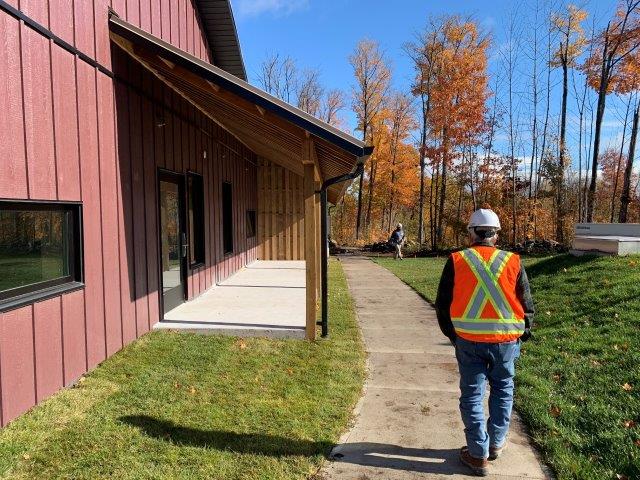
View down the South side of the Mariposa House Hospice showing the staff outdoor patio, grass berm, and concrete path to the rain garden and hiking trails through the property.
A view looking at the South-corner of the building, showing the staff office area with their patio and the grass berm. You can also see the steel butterfly just under the gable-end eaves, which is the logo for the Mariposa House Hospice.
Further south, you can see in-progress views of the patients rooms on the left. Each room has it’s own private porch with a door of suitable width that patients beds can be rolled onto the patio. They will have a view of the forests, and meadow . The glass railing need to be installed, and the dirt seeded with wildflowers as part of the wildflower meadow. The raingarden is just visible at the very end of the building. Eventually the Hospice plans for four-bed additional patient rooms at the rear of the building.
The clients wanted a large parking lot to host all of the cars for large events and gatherings. The rainwater run-off from the parking lot is directed to a naturalized swale and then to a raingarden, so the water is absorbed on-site. In front of the building there will be a garden hedge of forsythia, daylily, wildrose, juniper bushes, and other plants to help soften the transition.
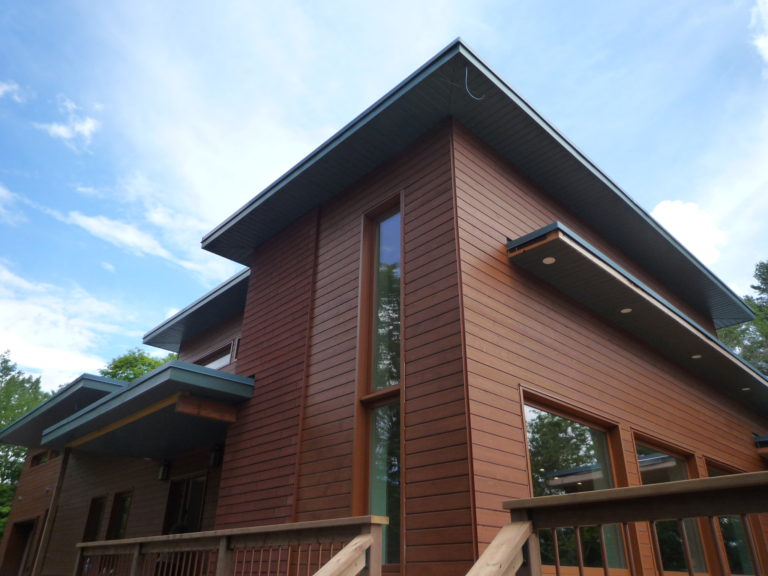
Another view of the front, showing the grass berm, as well as covered entry porch for vehicles and ambulances to access the entry under shelter. In front of the entry porch there is a garden with birch trees, Japanese maple, and other hedges and benches to create a moment of transition and place of reflection for those coming to, or leaving, the hospice. From this view you can see how we designed the building to look like a home or cottage, with traditional pitched roofs, and board-and-batten siding. It is a large institutional building, but with the overall massing and design we tried to make it feel residential.
Thank you to everyone who joined us for the Opening Reception of the show “Night Vision”, an exhibit by Richard Kuzniak as part of the Contact Photography Festival. The show will be up until May 31st — if you weren’t able to make it or would like to stop by and see it!
As part of Architecture Week in the USA, we participated in a Crowd-sourced video initiated by Enoch Sears in which 50 architects from 12 countries submitted clips as they went about their day. Check out the results below: Thanks to Enoch for organizing and editing this! – CAI
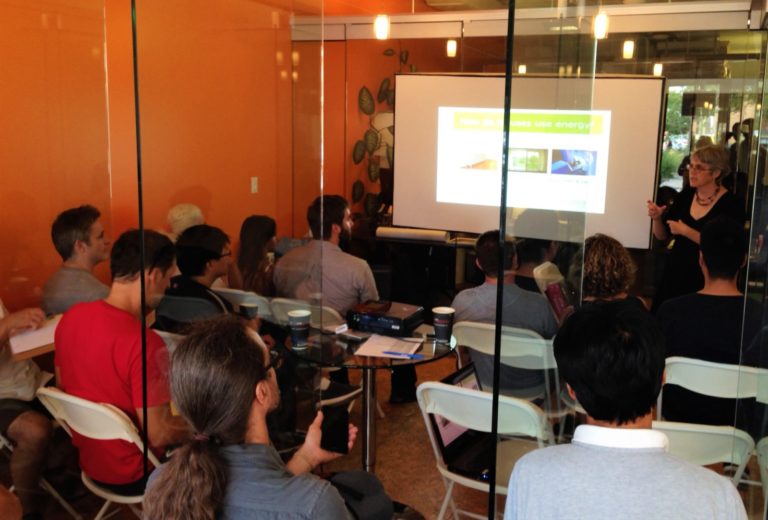
Thank you to everyone who made it out to the event we hosted as part of 2016’s Green Energy Doors Open. We were overwhelmed with interest and ended up giving three seminars instead of the planned two! We hope everyone found the seminars informative and helpful. A blog post on the event by Craig Stephens of…
The High-Performance house is almost complete, only counter tops, vanities and final details are missing. The electrical and mechanical systems are fully functioning and we are just waiting for the final inspection from the township to get the occupancy. Some landscaping has already started to happen. Here are some pictures of the empty house:
Get off Gas!! Yes, that’s our pledge in support of the #globalclimatestrike taking place this September. Highlighting the urgency of cutting carbon emissions, the young Swede and climate activist Greta Thunberg, sailed from England to NewYork rather fly, making it a zero-carbon journey. So a 16-year old can, why can’t we take a stand? Though…
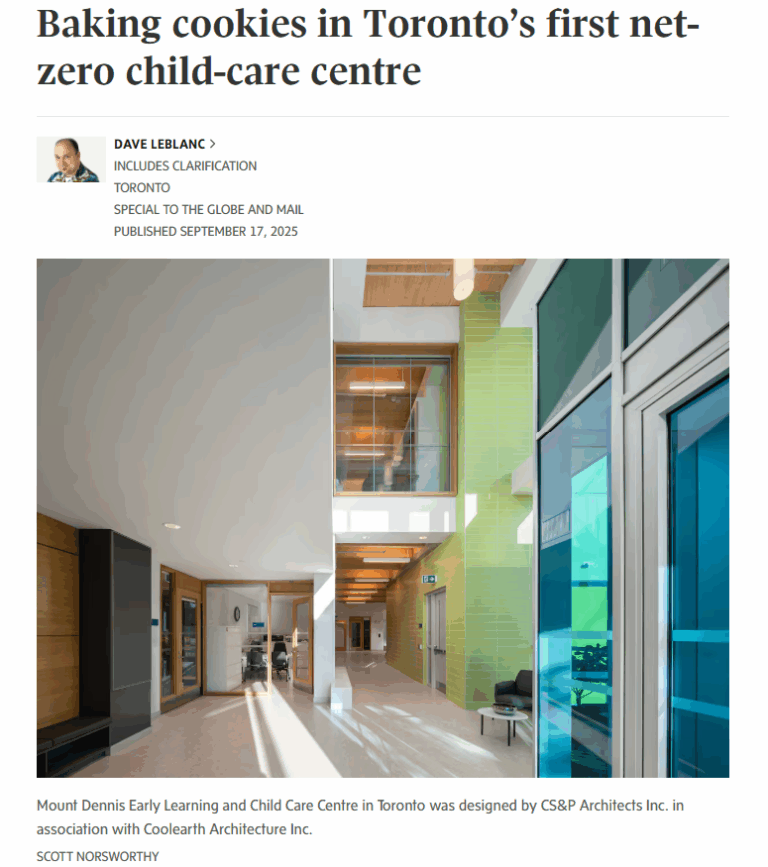
We’re proud to share that Coolearth Architecture was recently featured in The Globe and Mail as part of Dave LeBlanc’s Architourist column Baking cookies in Toronto’s first net-zero child-care centre (Sept. 17, 2025). The story highlights the new Mount Dennis Early Learning and Child Care Centre, designed by CS&P Architects in association with Coolearth Architecture….