
The clients for this project, a young family, wanted a home that is healthy, energy efficient, and closely connected to nature. They were drawn to simple proportions inspired by the rural vernacular, and to materials that are natural, low-toxicity, and durable. The design reflects these priorities with straw bale insulation, wood fibre, mineral wool, lime plaster, and stained wood siding, creating a home that is both modern in performance and grounded in timeless building traditions.
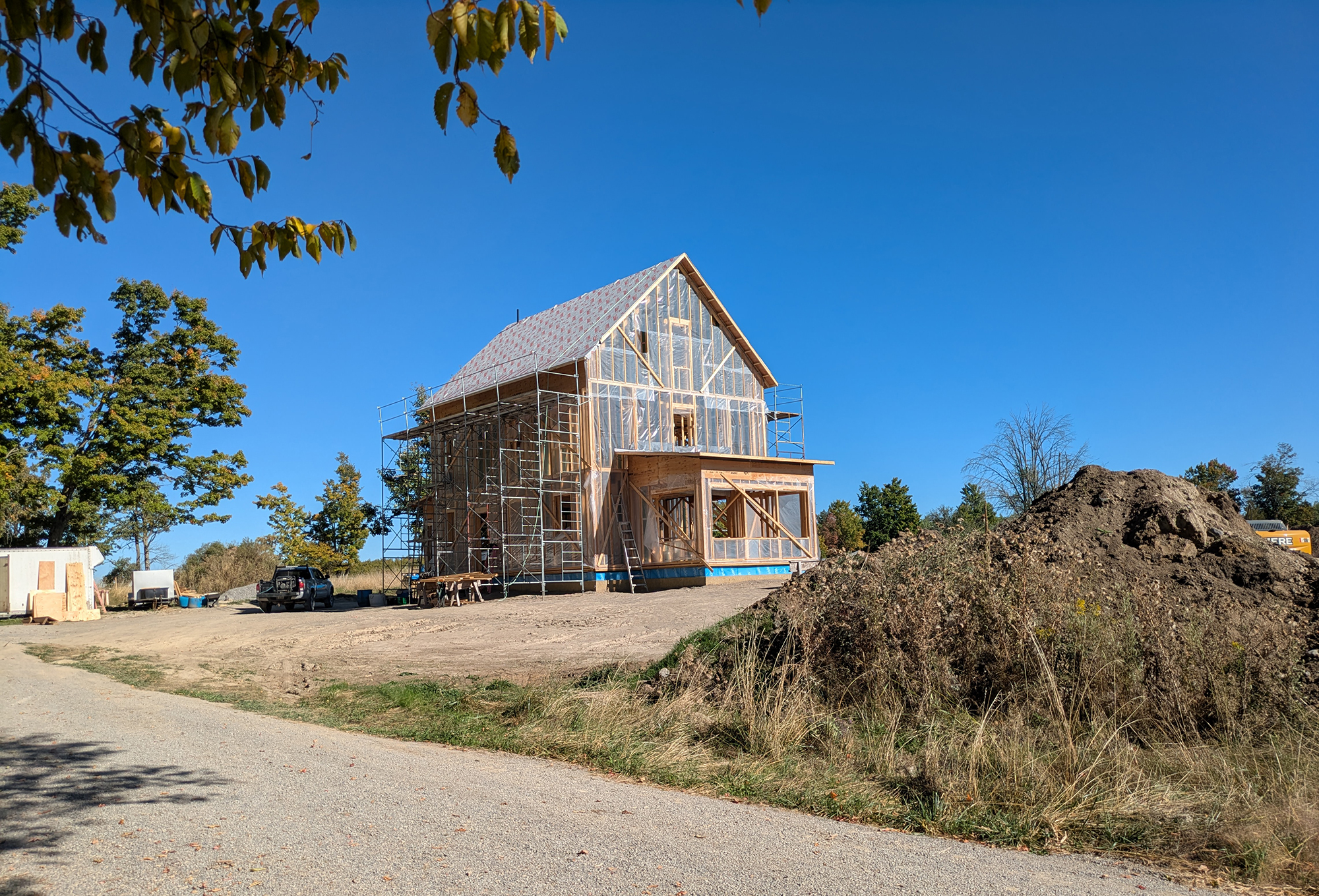
Work is progressing steadily on the Douro Fourth Line straw bale Passive House just outside of Peterborough. The structure is now fully framed and several key details of the building system are visible on site.
Passive House Principles and Straw Bale Benefits
The building systems are all-electric and designed for very low energy demand. Heating and cooling are provided by an air-source heat pump furnace. A high-performance ERV is paired with a supply-side ground loop for summer cooling and winter efficiency. The ERV ensures continuous fresh air supply and filtration. Equipped with a MERV-13 filter, it also protects the interior from smoke and outdoor air pollutants, an important feature as summer wildfire events become more frequent. Domestic hot water will be supplied by a heat pump water heater. There is no fireplace — reducing both cost and complexity while reinforcing the airtight, all-electric strategy.
This home is designed to the international Passive House standard, modeled in PHPP v10 with an estimated Energy Use Intensity (EUI) of 30 kWh/m²a (metric). Passive House focuses on five main strategies: very high levels of insulation, airtight construction, minimized thermal bridging, high-performance windows and doors, and balanced ventilation with heat recovery. Together these dramatically reduce heating and cooling demand, making it possible to achieve comfort with very small mechanical systems.
A common challenge in highly insulated buildings is summertime overheating. Windows are supplied by Vetta with triple glazing and Passive House certification, and operable exterior wood shutters will provide essential shading. Exterior shading can keep nearly 90% of solar heat outside before it reaches the glass, preventing overheating during hot weeks when mechanical systems alone can struggle to keep up. This is a core Passive House principle: controlling the thermal envelope first, rather than relying on active cooling.
Straw bale construction adds a further advantage. Unlike lightweight insulation materials, straw has significant thermal mass and unique hygrothermal properties. The thick walls slow down how quickly temperatures shift — a phenomenon known as thermal lag. This means the building is not only well-insulated but also less prone to rapid swings in temperature. On hot days, the straw walls absorb and delay heat flow, smoothing out peak loads and making the indoor environment more stable and comfortable. Combined with Passive House detailing, this results in a building that is both extremely efficient and naturally resilient.
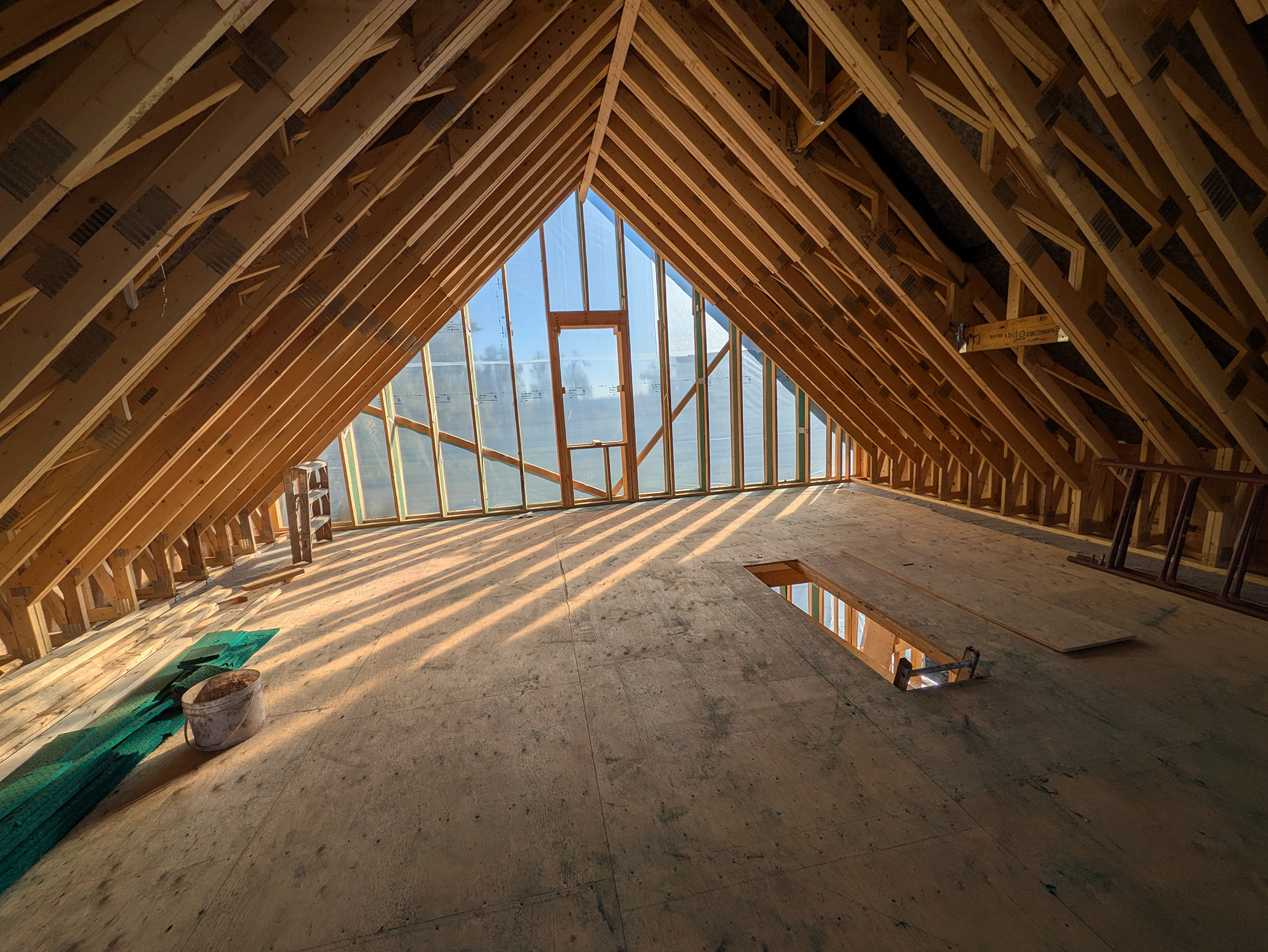
The roof is built with open web wood trusses that arrive on-site in four pieces. Uniquely, open web wood trusses act as ‘gusset plates’ and provide the structural connection, which means no ridge beam or collar ties are required — this create a beautiful open flex-space in the attic. The open webs also make it straightforward to route services without cutting through framing, and the 22″ depth will allow for an R-value over 70.
The walls are a double stud system, designed for dense straw bale insulation. Plywood gusset plates tie the inner and outer walls together. Between studs, wood fibre insulation fills the voids where the strawbales are not inserted. On the exterior, a continuous 2″ layer of mineral wool wraps the building, and the final cladding will be stained wood siding. This combination provides a very robust thermal envelope with continuous insulation and minimized thermal bridging.

Temporary plastic is currently protecting the building while the straw bale installation proceeds. Once complete, the bales will be plastered to form part of the airtight layer and interior finish. In addition to durability, plaster walls are breathable, helping regulate humidity naturally. They also absorb and release moisture, buffering interior conditions and reducing pollutants in the indoor air.
In addition to performance, the project emphasizes healthy materials. The palette is deliberately simple: straw for insulation, lime plaster and paint for finishes, solid wood for structure and cladding. There is no OSB, MDF, or other products containing formaldehyde or synthetic resins. These choices reduce indoor air pollutants, simplify recycling at end of life, and reflect the project’s commitment to a truly natural building.
The floor system is constructed with 14″ deep open web wood trusses. Unlike conventional joists, these trusses use a diagonal web pattern to create strong, rigid members that span long distances. This allows for an open floor plate without interior columns or bearing walls, giving the family flexibility in how rooms are laid out. Open web trusses also have a major advantage for mechanical systems: ducts, pipes, and wiring can pass easily through the web openings. This avoids drilling holes or notching joists, speeding up installation and reducing structural compromises. The trusses are fabricated entirely from solid wood with plywood gussets, without the glues or adhesives common in engineered products. The result is both durable and straightforward, aligning with the project’s preference for natural and low-toxicity materials.
While there are many straw bale homes in Ontario, this project will be one of the few designed to meet Passive House low energy building performance levels while also combining natural materials. The use of materials will create healthy interiors with low pollutants, while the design supports comfort through insulation, shading, ventilation, and thermal mass. The house will also connect to its landscape, with space for gardening and permaculture, and its simple proportions and minimal detailing will reflect a quiet, nature-based way of living that also evokes the surrounding traditional architectures.
At Coolearth, our interest is in showing how projects like this can bring together performance, ecology, and health in ways that are practical and replicable.
The builder is Straworks — special thanks to Deirdre, Sol, Myles, Mike for the great work!
Next steps are adding the straw bales into the stud spacing, installing the windows, and roofing and getting ready for the interior phase of the project.