Planning Delay Invoice Generator
Across Ontario, the average Site Plan Approval now takes 23 months (Source: OAA Report, 2024). For affordable and community projects, those months aren’t theoretical. They translate into lost financing, missed grant applications, missed construction seasons, and higher rents.
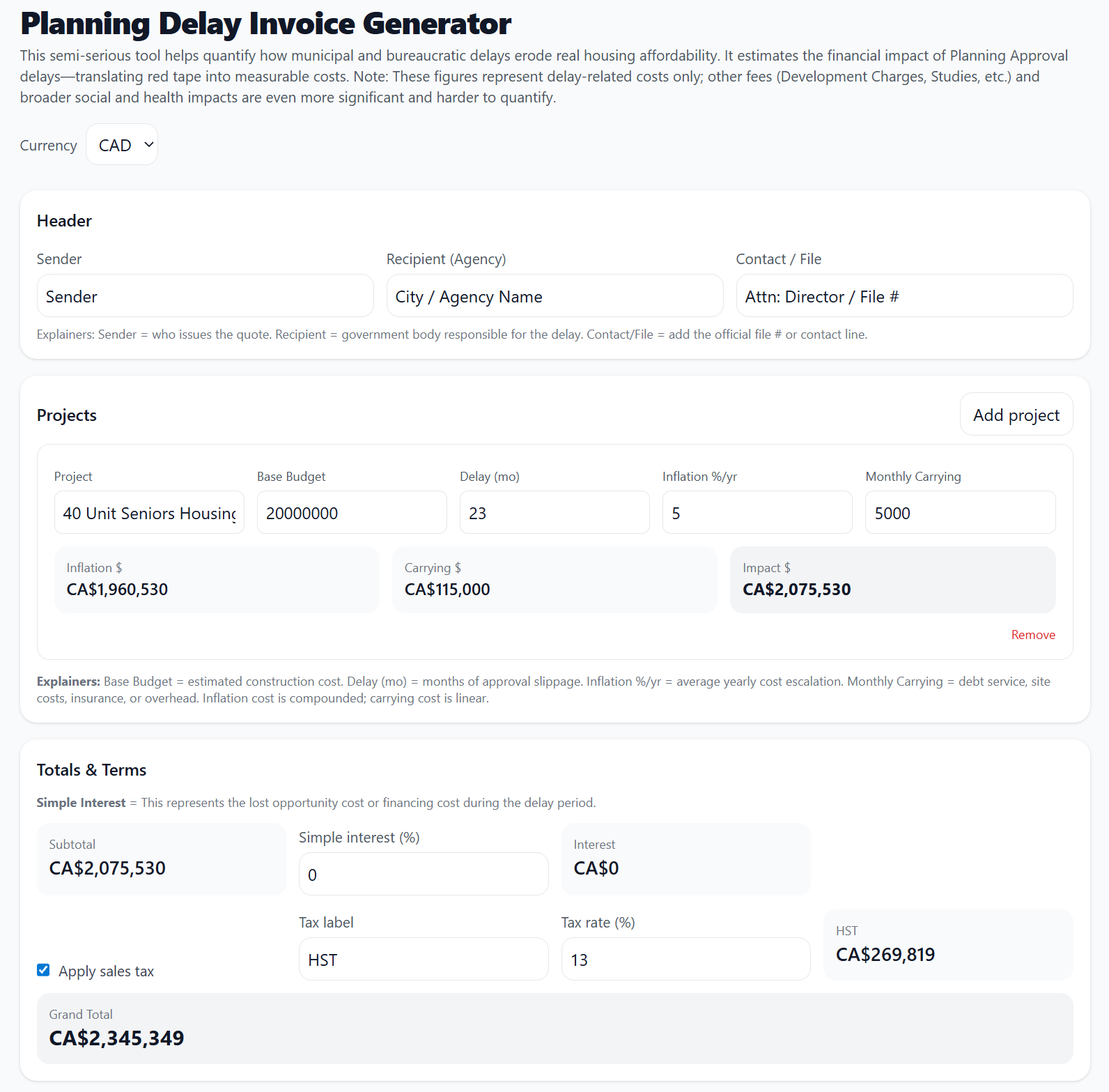
That’s why we built the Planning Delay – Invoice Generator, a web app that lets anyone calculate the financial impact of approval delays to send to their Municipality as a “quote”.
It’s satire, yes — of course you can’t actually bill your municipality for delay — but the numbers are real, and the truth they reveal is plain: every month of delay adds up. These costs are tangible, and ultimately borne by clients, communities, and the public itself.
This is not a matter of a single municipality. It is cultural. As noted at the start of this post, according to the Ontario Association of Architects (2024), the average Site Plan Approval process now takes 23 months. The statutory timeline is 60 days. That limit is not occasionally exceeded. It is universally ignored.
The gap between 60 days and 23 months is not administrative nuance. For affordable and community-oriented projects, those months are not theoretical. They mean lost financing windows, missed grants, missed construction seasons, rising interest rates, escalating material costs, internal team turnover, and in some cases, complete project destabilization. Delay is not neutral. Delay reshapes viability. Delay determines what gets built and what does not. And yet: delay has no consequence for the reviewing authority.
Every additional month in review adds interest costs, consultant fees, inflation exposure, and opportunity cost. These are not absorbed by municipalities. They are borne by clients, future residents, and the broader public. Over time, this invisible infrastructure of delay becomes an economic drag on the province itself.
That is why we created the Planning Delay – Invoice Generator, a simple, satirical web tool that calculates the financial cost of approval delays and formats it as a mock “invoice” to send to a municipality — we want to surface these hidden costs.