From Lyon to Toronto: A French engineering intern’s perspective on design practice in France and Canada
About me My name is Benjamin Charliac, and I am an engineering student at CESI in Lyon, France. As part of my engineering degree, I have to complete a mandatory three-month internship, and I chose to spend mine abroad at CoolEarth Architecture in Toronto. During my time here I have been supporting the project teams as an assistant project manager, with a focus on building performance: hygrothermal modelling, thermal bridge calculations, and the technical documentation behind high-performance building envelopes.
Why Canada, and why CoolEarth
Doing my internship abroad was a deliberate choice. I wanted to step outside the French engineering environment I had trained in, sharpen my English in a professional setting, and see how buildings are designed and delivered in a very different regulatory and climatic context. Canada, with its demanding cold-climate construction and its strong culture of sustainable building, was a natural place to do that. CoolEarth stood out to me in particular: the firm’s commitment to low-carbon, high-performance and Passive House design lined up closely with my own interests in thermal performance and building envelopes. It was a chance to contribute to real projects while learning from a team that treats energy performance as a priority rather than an afterthought.
Five differences that stood out to me
Working in a Canadian design office after training in France has been genuinely eye-opening. Here are five differences that struck me the most.
1. Regulations and standards
In France, technical design revolves around a highly codified framework: the RE2020 environmental regulation, the DTU technical standards, the Eurocodes and ISO norms. In Ontario, the reference points are different, from the Ontario Building Code and the National Energy Code for Buildings (NECB) to ASHRAE standards, alongside a strong Passive House culture that is central to the way CoolEarth works. Beyond the documents themselves, the underlying priorities are also different. In France, many renovation projects are driven by minimum energy performance requirements that determine whether a dwelling remains eligible for rental. As a result, the goal is often to improve the building enough to reach a required energy class. At CoolEarth, I have instead worked on many new-build projects, where the focus is on achieving high levels of performance from the very beginning of the design process.
2. Units and drawing conventions
France works almost entirely in metric. In Canada, the construction industry mixes metric and imperial units, and it is common to see feet and inches on drawings. Thermal performance is often expressed as an R-value here, whereas I was used to reasoning in U-values, which is also how the tools I work with, such as Ubakus, are built. These differences come up constantly in day-to-day work in Revit and AutoCAD, and they take a bit of getting used to.
3. How a project is run
This is where I expected the biggest difference, and found almost none. A project moves through much the same steps as in France: an initial site survey, feasibility studies, review of the technical documents and cost estimate, the call for tenders, selection of the trades, and finally site supervision and management. The vocabulary changes from one country to the other, but the sequence itself is essentially the same.
Figure 2 Loi MOP (Maîtrise d’Ouvrage Publique): the French law that structures how a public project is commissioned and run
4. The focus on thermal bridges
The one thing that surprised me most was how central thermal bridges are here. In France I had already delivered Passive House projects that reached certification without a single structural thermal break, relying on careful detailing instead, so I did not expect thermal bridging to receive quite this much attention. The colder Ontario climate raises the stakes on thermal bridge design, since it heightens the risk of interior condensation and mould and makes every bridge weigh more heavily, a shift in emphasis striking enough to push me to study these details far more closely than I had before.
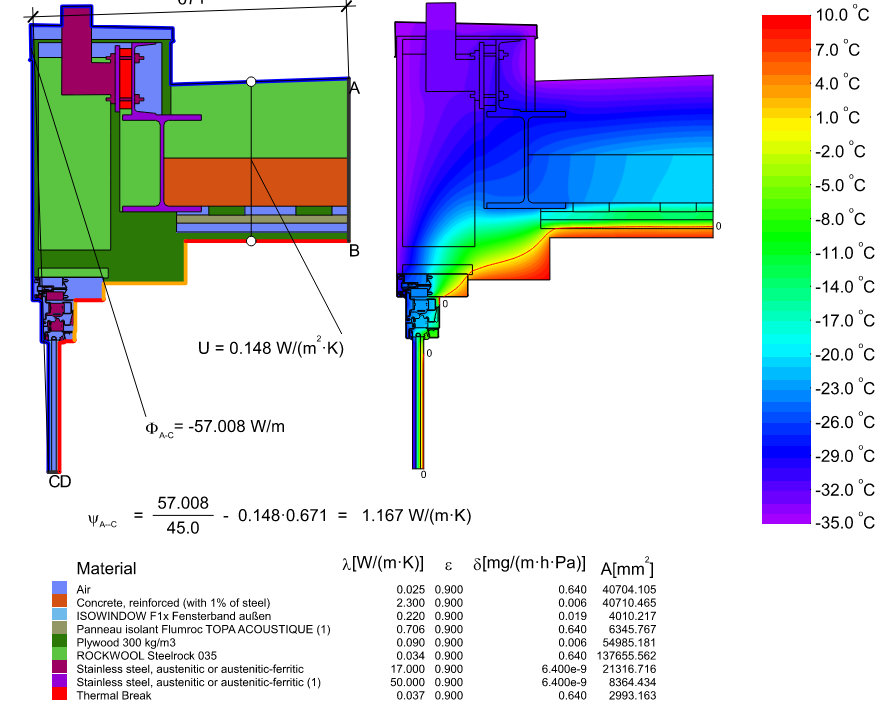
Figure 3 – Thermal Bridge Modelling of complex areas for design optimization.
5. Working culture
Finally, the working culture felt more horizontal and direct than what I was used to. In France, it is more common to address colleagues as “Monsieur” or “Madame” followed by their last name, especially when meeting them for the first time or in more formal settings. In Canada, people usually switch to first names almost immediately, which creates a more relaxed atmosphere.
Looking back
Overall, this internship has given me a much broader view of what building design can look like, and a real appreciation for the strengths of both approaches. I am grateful to the CoolEarth team for their welcome and for making these three months such a rich learning experience.
— Benjamin