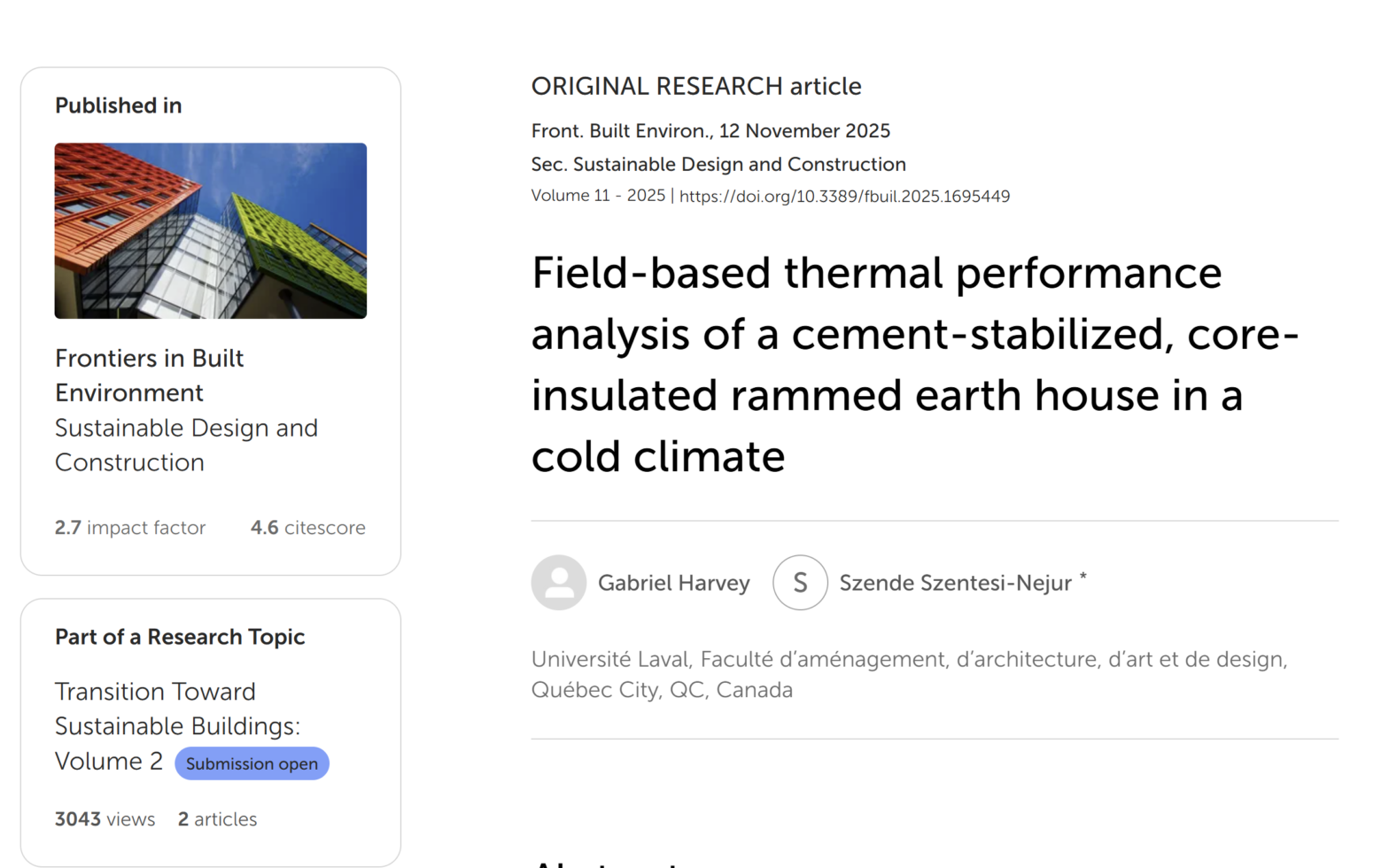
Coolearth recently had the opportunity to see the guesthouse of our Cherry Valley Rammed Earth project in Prince Edward County independently studied and published in Frontiers in Built Environment (Harvey & Szentesi-Nejur, 2025). Titled “Field-based thermal performance analysis of a cement-stabilized, core-insulated rammed earth house in a cold climate,” the paper by Gabriel Harvey and Szende Szentesi-Nejur is valuable because it moves beyond modelling and theory: it documents how an insulated rammed earth envelope behaves under real winter conditions using multiple field-measurement methods in a cold climate.
Rammed earth is increasingly promoted for its low embodied energy, non-toxic material profile, durability, and its “thermal mass” ability to store and release heat slowly. But the paper notes a key gap: rigorous cold-climate field validation is rare, and simulations can overestimate performance compared to measured reality. In cold regions, moisture and freeze–thaw concerns further increase the need for real-world data.
Project context: Cherry Valley Rammed Earth Home + guesthouse
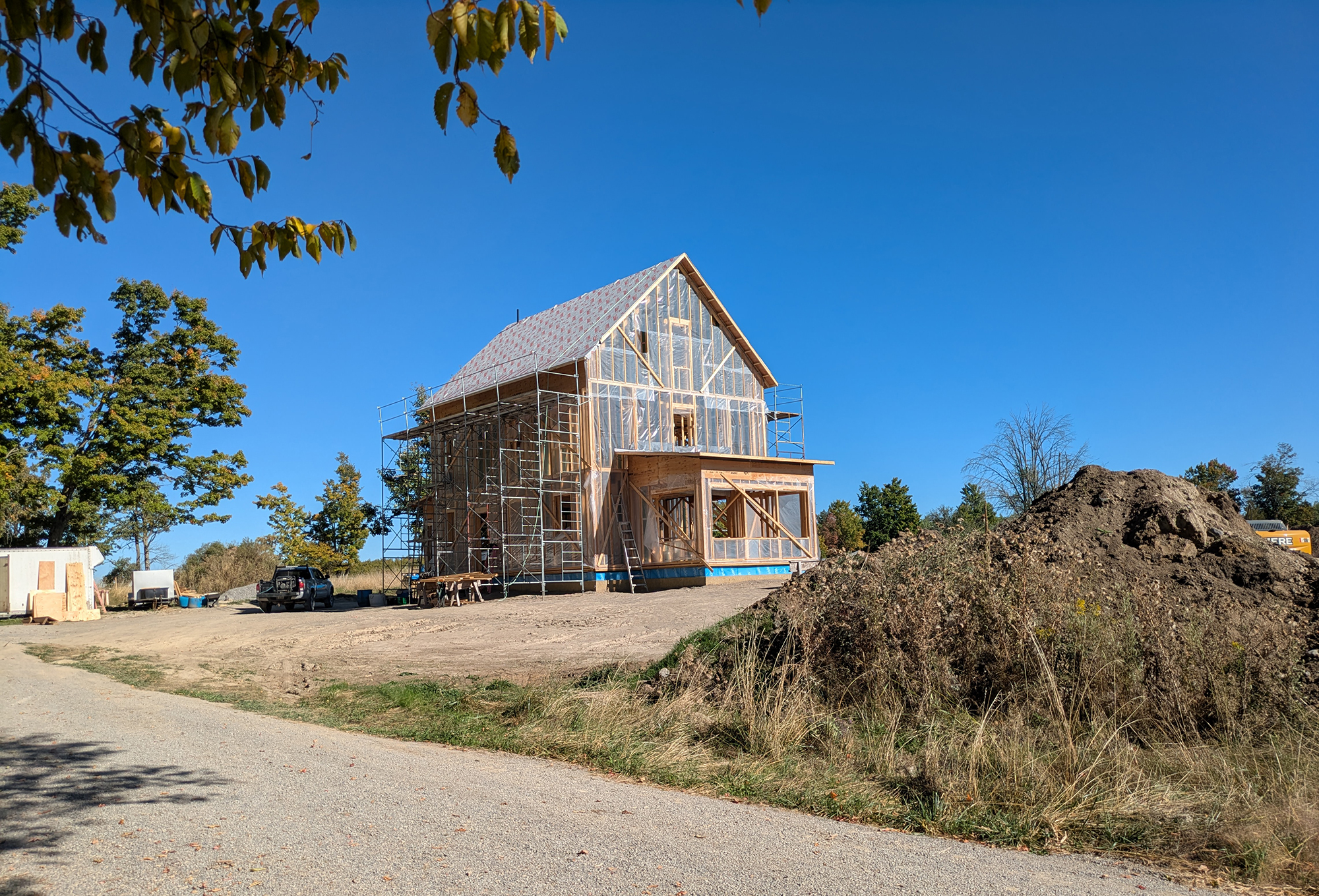
The guesthouse is part of a residential home designed by Coolearth in Prince Edward County, Ontario. The overall design draws on the client’s goals of minimalism, beauty, and high performance, and on the timeless presence of monolithic masonry and earthen structures. Stabilized rammed earth in variegated light cream tones gives the building its solid, enduring character, while abundant daylight—through carefully placed glazing—keeps the interiors bright and calm. The main house and guesthouse are separated by a covered breezeway/carport and a three-season screened porch, creating a sheltered transition space.
The building envelope is a core-insulated rammed earth wall system: a thick assembly with a 152 mm rigid foam insulation layer sandwiched between inner and outer rammed earth layers. This core-insulation approach is common in North America because it preserves exposed rammed earth on both the interior and exterior.
What the researchers studied and how
The case study monitored the guesthouse during the winter under “free-running” (unheated) conditions over three days (March 16–18, 2025). The methodology combined three complementary approaches:
- Infrared thermography (IRT): repeated scans of interior and exterior wall surfaces throughout each day to map surface temperatures and identify anomalies.
- Surface heat-flux sensing: sensors on interior and exterior faces to measure directional heat flow through the walls.
- Temperature and humidity monitoring: indoor/outdoor logging to assess thermal and moisture stability.
Key findings: stable interiors, strong solar response, and thermal lag
Across the monitoring period, the guesthouse demonstrated a clear thermal-mass signature. Exterior wall surfaces — especially on the south façade –showed strong responsiveness to solar exposure, with the sunniest day producing the highest exterior surface temperatures and a slow evening cooldown. In contrast, interior wall surface temperatures stayed comparatively steady, indicating that the core insulation effectively decoupled indoor surfaces from outdoor swings.
Heat-flux results supported the same story: exterior fluxes varied more dramatically with weather and sun, while interior heat flux remained low and stable, suggesting limited short-term heat transfer into or out of the occupied space. Indoor air conditions were similarly consistent during the unheated period: interior temperatures remained within a tight comfort band while outdoor conditions fluctuated from below freezing to mild daytime peaks. Indoor relative humidity also stayed stable (mid-range comfort levels) despite major exterior humidity variation associated with snowmelt and changing weather—evidence of meaningful hygrothermal buffering, even with cement stabilization.
Thermography did reveal localized thermal bridges at typical junctions (floor-to-wall transitions and around openings). These were limited in area and did not appear to undermine overall stability during the short study, but they point to the value of careful detailing as performance expectations rise.
Takeaway for Coolearth’s work
While the monitoring window was short, the paper provides rare, high-resolution field evidence that a core-insulated, stabilized rammed earth guesthouse in a cold Ontario climate can maintain notably stable indoor temperature and humidity under passive operation, while still benefiting from solar-driven thermal mass behavior.
Reference: Harvey, G., & Szentesi-Nejur, S. (2025). Field-based thermal performance analysis of a cement-stabilized, core-insulated rammed earth house in a cold climate. Frontiers in Built Environment, 11:1695449. https://doi.org/10.3389/fbuil.2025.1695449