Ojibway Quillwork – Toronto Offsite Design Festival 2017 – Opening Reception

2017-tlp-web-cover


As part of the Toronto Offsite Design Festival 2017 we invite you to see Boshdayosgaykwe Pawis’s work from the G’zaagin Art Gallery’s work at 386 Pacific Avenue, Coolearth Architecture from January 16th to February 16th.


img_2883


G’zaagin Art Gallery resourcefully uses all of its materials, and finds creative ways for people to experience natural products. The quill work featured in this exhibition has been harvested, cleaned, dried, and stored for the following years projects. It takes time and effort to gather all material, and five generations of learning to continually work toward teaching others this skill.


img_2927


The show will feature quill boxes, photos and descriptions of the works.


The opening reception will be held on Wednesday January 18th from 7-9pm as part of the Junction-wide opening of the Toronto Offsite Design Festival.


Get your free tickets to the Opening Reception here: https://www.eventbrite.ca/e/ojibway-quillwork-toronto-offsite-design-festival-2017-opening-reception-tickets-30083810487


We look forward to seeing you there!

Making Net-Zero Commercial Buildings a Reality – @ Construct Canada

banner6

This Thursday Sheena Sharp, a principal at Coolearth, and Trevor Nightingale, the Program Leader, High Performance Buildings at National Research Council will present a seminar entitled “Making Net-Zero Commercial Buildings a Reality”.

From the Construct Canada Website:

For the early adopters, it is typically not a simple ROI but rather there are often less tangible outcomes and benefits. In this session, the National Research Council Canada (NRC) will present information on the incremental cost of the NZEB to begin building the case. The speaker will discuss the business case as well as technical issues, including those associated with retrofit and energy positive. The session will also include an examination of real and hypothetical scenarios to identify the considerations and implications and to show the delta between traditional energy systems and Net-Zero.

Dec 1, 2016 9:00 AM – 10:15 AM
Code: T100
Location: South Building

You can see more about the talk from the Construct Canada website.

We hope to see you there!

High Performance House – Construction Photos

20161128_083208   20161128_0830402

img_4363


The construction of a clients high performance house, near Parry Sound is coming along quickly!  The walls and roof are up and the enclosure will be protected soon to receive the upcoming winter weather.
At this stage, when the walls and roof are being constructed, it is exciting to see the design becoming a reality.  Our clients were inspired by Frank Lloyd Wright and think the impressive overhangs with their bare bone structure look stunning: they already have begun imaging themselves in the spaces, relaxing, cooking, and entertaining.
p1130120-st  interior-to-living-area-floor-tinted

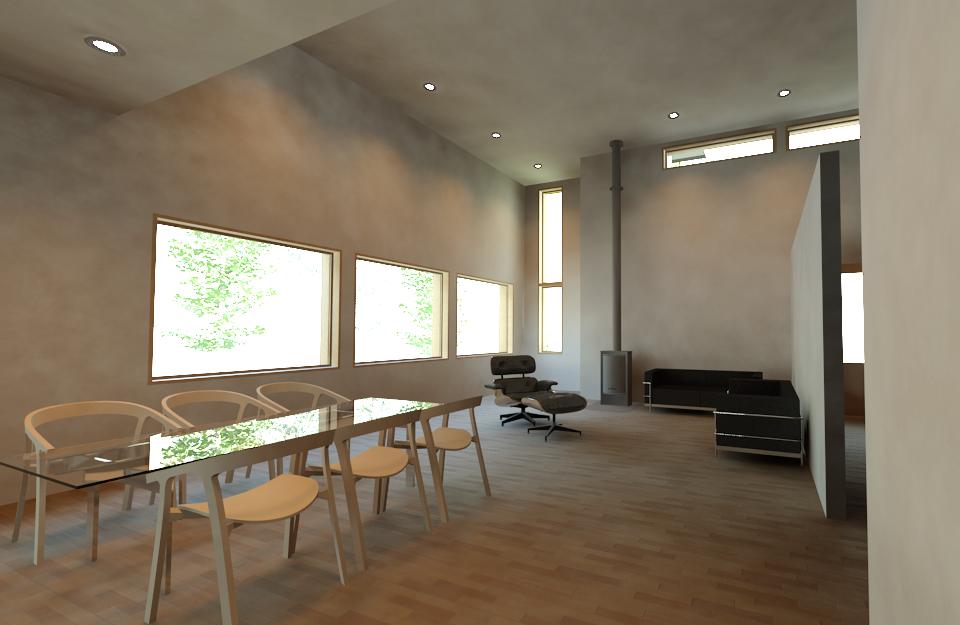
Elements envisioned back in the design stage are starting to materialize, like the three picture windows facing the lake that provide a fantastic view (see below). The location is pristine and we wanted to maximize the visual interaction between the interior and the exterior.
p1130165  p1130166


The tall window on the side frames an oak tree in front of it.  The 14′ high ceiling in the central living space is impressive and bright.


p1130123-bis  p1130169
We have four high performance wall assemblies that we have designed at the firm.  But we know that each client-contractor have their preferences, so we were  able to accommodate different options according to site or their labour availability. We explored the use of prefab walls and SIP  (Structural Insulated Panels of OSB sandwiched between Extruded Polyestyrene), but the contractor felt comfortable with the double stud walls and these also provided the better cost. We are loving the double stud walls and the contractor is fully on board with the non conventional detailing to minimize thermal bridges, air leaks, and durable.  For example the contractor suggested having the studs staggered which will maximize the effective r-value of the walls.
p1130143  p1130107

Due to the slope on the site, 3/4 of the house is on TJI  (truss joists) floors sitting on piers. The rest of the house is on a slab on top of the rocky “Canadian Shield”, as our client loves to say. The TJIs will be filled with insulation, but the perimeter concrete wall of the slab needed a more intricate detailing to reduce the heat losses. The interior wall of the double stud wall is non-load bearing and to break the thermal bridge 6″ of high compression strength insulation was added below the wall sill plate. You can see the gravel and lime layer exposed awaiting the insulation before pouring the slab.
img_4360
 img_4361

The detailing of the enclosure is key to achieve a high air tightness levels and the continuity of the Air Control Layer (OSB board) on the exterior of the wall is properly connected with high quality tape as you can see on the image above. Once the roof trusses are installed, the Air Control Layer will continue at the interior with an OSB ceiling properly connected to the OSB extension above the top plate. The air control layer will hold the loose insulation down enough to leave a vented cavity between the insulation and the roof keeping it dry.
  p1130187  p1130081

The roof was a challenge because we had to accommodate 16″ of insulation, the low slope, and the continuity of the air and thermal control layers. The open web roof trusses provide very low thermal bridging and long spans make the interior column free. These trusses also provided strength for the long overhangs that the design required. The photos below show the high quality tape and spray foam insulation applied at difficult locations. The contractor is looking closely at all the nooks and crannies to guarantee the lowest amount of thermal bridges. It is important to the have the contractor on-board when creating a high performance house design!
p1130079   p1130063

If you would like to begin construction your dream home this spring contact us soon to start the process. Give us a call for a free consultation 416-868-9227 or email us to info@coolearth.ca
High Performance House

Visit Coolearth at Construct Canada

net-zero-upgrade-to-toronto-semi


Coolearth will be presenting a seminar on our net-zero conversion of a semi-detached residential building as well as hosting a booth as part of the Passive House Canada Pavilion on November 30th.


Our seminar will take place on November 30 from 9-10:15am. Look for us in the South Building (code w300).  The brief for the seminar is:


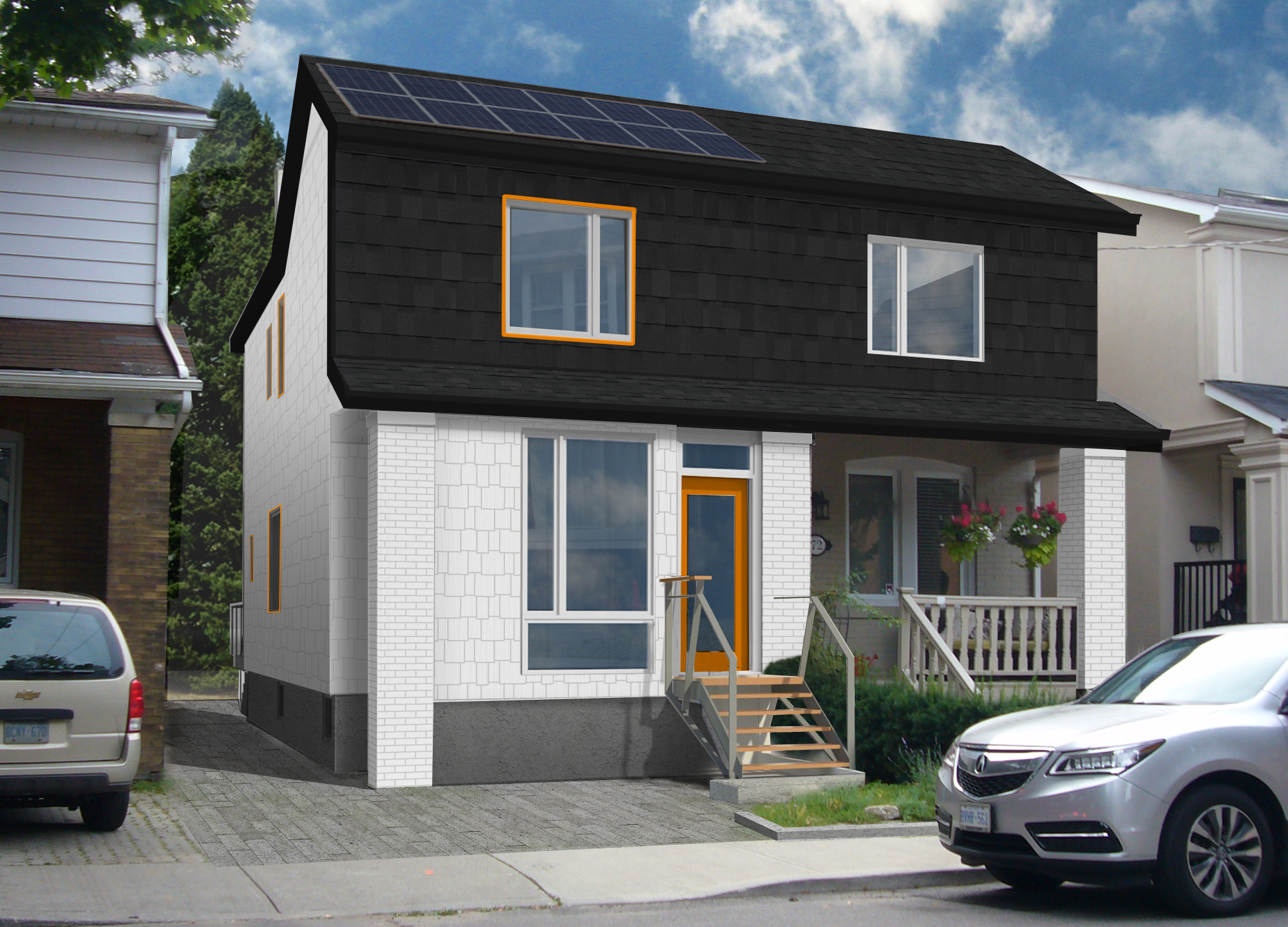
Ontario’s climate action plan seeks to improve the energy efficiency and performance of buildings in order to reduce Greenhosue Gas Emissions. The province has identified that we need to take all buildings to Net-Zero or near Net-Zero Energy Use. This means upgrading the leaky, badly insulated homes which pre-dominate much of Toronto and were built after World War 2. We will present a Toronto semi-detached home that we are doing an envelope upgrade on with the aim of making it Net-Zero. We are doing this by adding external insulation, making the home air tight, replacing the original single-pane windows with new high performance windows and doors, installing efficient heating and ventilation equipment, and mounting solar panels on the roof. The upgrades to the home will make it more comfortable, improve the appearance of the home, and reduce energy consumption and therefore lower Greenhouse Gas Emissions.


We hope to see you there!

SBE16: Toronto – Arborus Consulting – Low Carbon Heating using Off-peak Electricity

The second post in our series re-capping the Sustainable Built Environment Conference September 19th and 20th in Toronto will feature a presentation by Arborus Consulting group’s R. Hutcheson, S. Jorens, and D. Knapp on  “Low carbon heating for commercial buildings using grid-supplied electricity during Off-peak periods.”  It is a very fascinating idea that holds a lot of potential (as our notes below show).  You can download the full presentation here.
 

cover


-“Design approach to achieving affordable low-carbon heating solution and reap the significant economic benefits of a high quality indoor environments”

– “De-carbonizing” requires switch from fossil fuels > usually means switching to electricity.  Heating in a northern climate requires a lot of energy. On-site generation is often too expensive for heating.

– Ontario’s electrical grid has mixed generation: hydroelectric, nuclear, natural gas, renewables, bio-gas.  The overall “Carbon Intensity” of the grid varies according to the “mix of generators on-line” at any given time.

-The off-peak period uses little to-no natural gas, therefore it has a lower carbon intensity.

– The first step in a low-carbon building solution is a high performance envelope. This also improves occupant comfort by reducing the cool radiation from the exterior surfaces.

– With a high performance envelope the possibility now opens to heat using “low water temperature heating”… this is the highest efficiency heating delivery approach. I.e. generation via condensing boilers and delivery via radiant slab.  This is the second step to a low-carbon building.

– “Ventilation is the most significant component of the building heating requirements.  Using a Dedicated Outdoor Air System (DOAS) reduces volume of supply air. DOAS can be connected to CO2 monitors to shut of ventilation during un-occupied hours.  Additionally they can be combined with a Heat Recovery system.

– Off-peak periods have the lowest Greenhouse Gas emissions. But using off-peak electricity requires a method of storage to meet on-peak demand.  Thermal storage (i.e to use for heating later) is a good way of storing the off-peak energy.

– Water and/or other mass is a good thermal storage option.  In the case of water it would be heated to eventually supply the radiant floor.  Ceramic bricks can be heated to higher temperatures and require less volume (see Steffes Electric Thermal Storage system — warning the site is quite superficial)

– If all of the above options (i.e #1 High Performance Envelope, #2 Low Temperature Water Heating, #3 Dedicated Outdoor Air System + Heat Recovery, #4 conversion to off-peak electricity) it is possible to reduce the heat load by almost 64% (in a base building), but most importantly reduce the GHG emissions by almost 90%!


results


– The benefit is two-fold, a reduction in energy use and increased occupant comfort. If this is framed in terms of improving employee productivity, then the costs of these features will be rewarded with a very good return on investment.


Overall we feel that this idea warrants a lot more thought and ultimately we hope to integrate the idea of using off-peak electricity and thermal storage into our high efficiency retrofits (i.e we already implement the first two-three features.  🙂