Decarbonizing the Operation of a Building

This past July an article Sheena wrote was published in the “In Touch” magazine by the REIC (Real Estate Institue of Canada) on Decarbonizing the Operation of a Building” (pdf).  The article is reproduced completely below.


Decarbonizing the Operation of a Building 

by Sheena Sharp

We have all heard about the need to stop climate change and adapt to the changes that we have observed, which are likely irreversible. We have seen images of vast stretches of continents turning to deserts, species dying out, crops failing, displacement of vulnerable populations, and widespread tragedy. What most of us have not found is a handle on what we can do about it, practically and right now.
The intergovernmental panel on climate change (IPCC) collects research on climate change from around the world, and filters it through a consensus process to determine strategies for nations to consider. Current recommendations from the IPCC suggest that we aim to limit the global rise in temperature to 1.5 degrees C. This may be considered an arbitrary number, but when we look at the predicted consequences that might occur above 1.5 degrees C, we see the costs to nations will be immense, and at least equal to what it would take to decarbonize the economy. Global temperature rise currently sits just under 1 degree C, so we have to move quickly.
In order to achieve this goal, the IPCC says that carbon emissions must peak this year, 2016, and then need to steadily decline to an 80% reduction by 2050. Ontario and Quebec have both adopted these targets in hopes of doing their part to stabilize climate change. But consider that over 25 years, between the baseline year 1990 and 2015, Ontario has reduced its emissions by only 6%. This is good progress, but means that in the next 35 years Ontario needs to reduce emissions by another 74%. The one thing that is certain is that we need to change our approach if we are to meet these goals.
Ralph Torrie, a physicist who has been analyzing energy models for Ontario for 30 years, has noted that no single energy-user-type can make sufficient changes to meet Ontario’s goals alone – not personal transport, nor buildings, nor industry. In every scenario Torrie has evaluated, buildings must effectively disappear from the demand for energy.
Why buildings? Buildings, unlike planes, can be run entirely on electricity, with technology that is already commercially available and relatively inexpensive. The electrical grid can be made carbon free with nuclear plants, although these are not without problems or expense. This is where conservation comes in – all of our buildings could run on less energy, and on green energy, to meet carbon reduction targets and avoid the need for more nuclear power.
There are 3 steps to decarbonizing the operation of a building:
1. Upgrade the entire building envelope including walls, windows, roofs, below-grade walls and basement floors. This reduces the average energy performance by two thirds, thus reducing the heating load. In the same process, cladding can
be upgraded to meet increased wind loads, aiding in adapting to climate change we are already experiencing.
2. Install smaller and more efficient electric heating, cooling, lighting, and ventilation systems. Depending on the building’s occupancy type, this may include geo-exchange systems, displacement ventilation, LED lights, and on-demand lighting and ventilation.
3. Install solar panels to produce energy on site and reduce loads on the existing power grid.
What we in the architectural community have found is that building owners are reluctant to make improvements that no one can easily see. It is often easier to “sell” an energy retrofit when co-benefits are considered, such as:
• Envelope retrofits can be used to update the appearance of a building, adding value.
• As energy disclosure extends to more building types, en ergy efficiency will have more value.
• Low-energy buildings have less drafts, more stable humidi ty, and are more evenly heated, resulting in better thermal comfort.
• Buildings with energy-efficient windows admit less street noise, increasing the ability to concentrate, or sleep.
• Low-energy buildings can hold heat in for days during power outages, meaning they require less back-up power from generators, if required, and prevent pipes from freez ing and potentially bursting.
The financial cost of decarbonizing buildings will be significant, but cheaper than dealing with floods, cladding failures, blackouts, and unforeseen consequences. The elephant in the room is that most people who are in positions of authority right now will not live to see 2050, and the beginning of the worst effects of climate change, so it does not really affect them. If we are doing this, we are doing it for future generations.

PHPP now accepted for SB-12 Compliance

This post is a follow-up to the previous post on the changes to the SB-12. 

sb-12


The OntarioPH team including Sonia Zouari, Andrew Peel, Greg Labbe and our own Sheena Sharp submitted a change request to the Ontario Building Code to allow for the PassiveHouse Planning Package (PHPP) — the software used to design to PassiveHouse standards which we use at the firm to test the energy consumption of all of our buildings — to qualify as an acceptable solution to prove compliance with SB-12 (Supplementary Standard SB-12: Energy Efficiency for Housing).


Congratulation to the team! This is great to see and will encourage more use of PHPP and energy modelling throughout new homes in Ontario.


Net-zero Upgrade to Toronto House – Case Study and Progress Report

eventbrite-cover-image


Coolearth Architecture welcomes you to come by our office as part of the 2016 Green Energy Doors Open. On Saturday September 10th from 11am to 5pm, we will share our progress to-date on making Toronto semi-detached homes Net-Zero buildings.


We will present two one-hour seminars, at 11am and 4pm, hosted in our office at 386 Pacific Avenue.


Grab your free tickets at: https://www.eventbrite.ca/myevent?eid=26927853936 


About the Event:


Ontario’s climate action plan seeks to improve the energy efficiency and performance of buildings in order to reduce Greenhouse Gas Emissions.  The province has identified that we need to take all buildings to Net-Zero or near Net-Zero Energy Use.  This means upgrading the leaky, badly insulated homes which pre-dominate much of Toronto and were built after World War 2.


In broad terms, we are making this Toronto semi-detached home Net-Zero energy by adding external insulation, making the home air tight, replacing the original single-pane windows with new high performance windows and doors, installing efficient heating and ventilation equipment, and mounting solar panels on the roof.  The upgrades to the home will make it more comfortable, improve the appearance of the home, reduce energy consumption and therefore lower Greenhouse Gas Emissions.


In the seminar we will outline the three phases of the renovation: envelope and window upgrades, mechanical system changes, and the installation of PV panels;  highlight the design aspects and calculations required for the retrofit; and chart the journey as we work through the process with contractors and city building and zoning officials.   The first stage is aiming to be complete in the Fall of 2016.


We will be open throughout the day Saturday September 10th to field questions about Sustainable Architecture and net-zero design.  Please give us a call at 416-868-9774 to learn more!


Grab your free tickets at: https://www.eventbrite.ca/myevent?eid=26927853936

Coolearth Summer Retreat

Last Thursday the Coolearth team held their Summer Retreat at our Parry Sound office.


PFFOCE


It was a brilliantly sunny and hot day on Georgian Bay as we gathered for the retreat.  We discussed how the year had gone, what was on each of our plates, shared ideas, and brainstormed for the future.

These retreats are important for the firm to gain knowledge about itself and come together to see how we can improve.


TEAM


We celebrated the day with ice cream along the lovely Parry Sound harbour!

Repost: OBC Stop the Foot Dragging on Air Leakage Testing

Our friends over at Blue Green Group made a post recently that highlighted how air leakage in high performance homes should be more closely integrated into the Ontario Building Code’s SB-12 Section, as well as how more training amongst professionals and builders is needed to implement already existing technology and techniques for air tightness.  See below for an excerpt and check out the full post here. 


Waiting for the Building Code to incrementally ratchet up efficiency every 5 year cycle is too long a wait for high performance housing. The new 2017 version of SB-12 still has a prescriptive package (A1) that merely permits a fiber insulated 2×6 stud wall cavity without air leakage testing – that’s so 1980′s! We’ve had the materials and building science know-how since the 70’s, and with the proven processes of the Passive House approach to designing and building the most efficient buildings, there’s no excuse for not building high performance homes – now.

Occupant Behaviour and Net-zero Design

The focus of this blog post is on how occupant behaviour effects designing buildings for net-zero. The topic of user-behaviour and net-zero design came up when we were analyzing the Passive House Planning Package (PHPP) energy modelling software for a net-zero energy envelope retrofit project this week.  We noticed that the clothes dryer used close to 20% of the plug-load of the house through the year. We thought: if the client air-dried their clothes they could cut dramatically increase their energy efficiency. But the key word is “IF”. If we design their house to be net-zero assuming they will make the switch to air-drying, and if they do not, then the home will not be net-zero.  This huge factor in the calculations opened up a conversation at the firm around both the limits and opportunities around modifying, promoting, encouraging user-behaviour.


Research on how occupant behaviour effects energy use shows that even with identical homes in the same place the energy use can vary substantially.  A study in Denmark of “five identically-built homes showed that heating energy use varied by as much as 365% – from 4,000 to 14,600 kWh/year – as a result of seemingly subtle thermostat and operable window use habits” via.  The impact of their variation on the lifetime energy-use of the building will be massive.


chartchart via

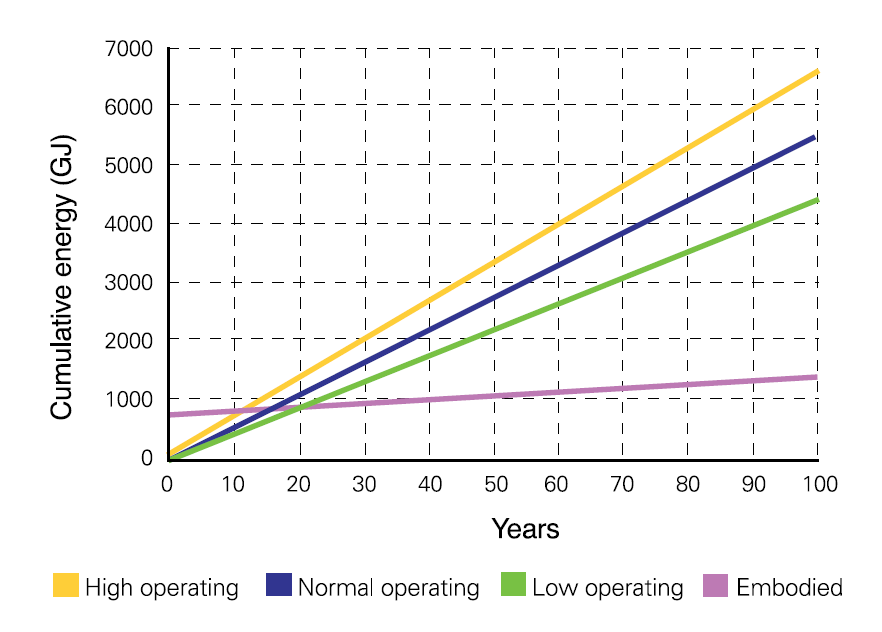
 About 10% of a typical homes Green House Gas emissions come from the initial construction and the remaining 90% come from the operation of the building (over a 100 year life span — see the chart above).  If the operational value varies by almost 365% then we could be looking at a huge difference in the energy efficiency of the building from what we planned for, modelled, and designed.


The variability in energy-use based on behaviour also highlights the question of whether having a higher embodied energy  (i.e using EPS foam as opposed to cellulose) in order to achieve better operational efficiency is okay because in the long run the operational costs will “pay” back the embodied energy in savings.  If user behaviour can alter the energy use of identical homes by 365% then the embodied energy may on the more conservative side be a significant factor, and on the liberal side become insignificant.  This would alter the traditional argument and lead us to assume that low-embodied energy initial construction combined with educated and sustainable user-behaviour is the surest way to achieve low-energy design.


There is a lot of room for architects to understand the clients and users needs and wants so that the building is designed properly and so that the energy model is accurate.  Secondly, it suggests that the Architect has a role in educating the client and users on how they can meet their needs and wants  through behavioural changes.  It is a very interesting topic for us because it combines both the quantitative and the qualitative.