Happy Holidays from Coolearth

Coolearth wishes to extend their thanks to all of the clients, engineers, tradespeople, architects, and everyone around the world a Happy Holidays!
 
IMG_0638-small
 
At the firm we designed these giant pop-up cards with the words Peace, Love, and Joy, in order to celebrate what is truly great and important in our lives.  Politicians and the Media paint a dark picture, trying to scare us or make us act out of fear.  We encourage everyone to think of peace, love, and joy before they act: holding in mind the golden rule of all religions: do unto others as you would have done unto yourself.
 
IMG_0642-small
 
Happy Holidays once again from Coolearth.


Thanks to Our Paper Life, who manufactured these giant pop-up cards for us.


Passive House Open House at Humber College

Coolearth’s Sheena Sharp was at the Passive House: Research Partnership Forum at Humber College on Tuesday December 1st.


IMG_5072 copy

It was a great event and Sheena had a lot to say about it.  We’re looking forward to working with Humber, Andrew Peel, and the others we met.


More information about the event can be seen here: http://humber.ca/research/node/1054
 
Or you can learn more about Passice House Architecture in Canada here:  https://www.coolearth.ca/passive-house/
 
Thanks to Oruba who sent us this picture the day of.

Sustainability of Typical Insulations, by Material

Sustainable architecture  encompasses the energy a building uses, as well as the materials used.  Any reduction in  Greenhouse Gas emissions required to product a building will contribute to the global effort to fight climate change, immediately.  This is the idea of doing things efficiently: accomplishing the same task with less energy allows us to either store, or do other things with that saved energy.


Lately we’ve been looking into the Green House Gas implications of certain types of insulation for buildings.  The main driver in GHG for insulation is the blowing agent that is used the make the foam. It is unclear at the moment the rate at which this leaks (off-gasses) from the finished product.


The impact that the production of insulation is measured by Global Warming Potential (GWP).  Aaccording to BuildingGreen: “Global Warming Potential is a measure of how much heat is trapped by a given mass of gas, contributing to global warming, compared with the same mass of carbon dioxide. Carbon dioxide has a GWP value of 1″.   Alex Wilson, from BuildingGreen have conducted research in to the impact of various types of insulation.  See below for a table showing various types of insulation and at the far right side, the Lifetime GWP to compare the energy impact of the material.


Looking at the data there is some interesting results:

  • – Mineral wool and SPF – closed-cell (water-blown) foam have almost equal lifetime warming potential.  They also have a high payback in years the more inches of insulation you add.
  • – Spray polyurethane foam (SPF) – closed-cell (HFC-blown) and Extruded polystyrene (EPS) have far and away the highest warming potential.
  • – Cellulose dense-pack has the least Global Warming Potential. Cellulose is made from plant fiber.  Cellulose also has the quickest payback at far and away the highest possible insulation.  Indeed, judging from the chart above, you could achieve R-100+ in walls with a 1 year payback on the investment.
  • – Fiberglass Batt insulation has the second least warming potential.


It is worth keeping in mind that if the overall goal is sustainability, design decisions which minimize long-term energy costs (such as air tightness, insulation, and continuity) will have a larger influence on a buildings Global Warming Potential.  The UN Inter-governmental Panel on Climate Change says:


“For typical standards of building construction, the embodied energy is equivalent to only a few years of operating energy, although there are cases in which the embodied energy can be much higher (Lippke et al., 2004). Thus, over a 50-year time span, reducing the operating energy is normally more important than reducing the embodied energy. However, for traditional buildings in developing countries, the embodied energy can be large compared to the operating energy, as the latter is quite low. “


A balance must be struck between the energy used to produce the building, the unique design considerations of the project, site, client, and the energy used to run the building.


Check out the full article here: http://www2.buildinggreen.com/blogs/avoiding-global-warming-impact-insulation

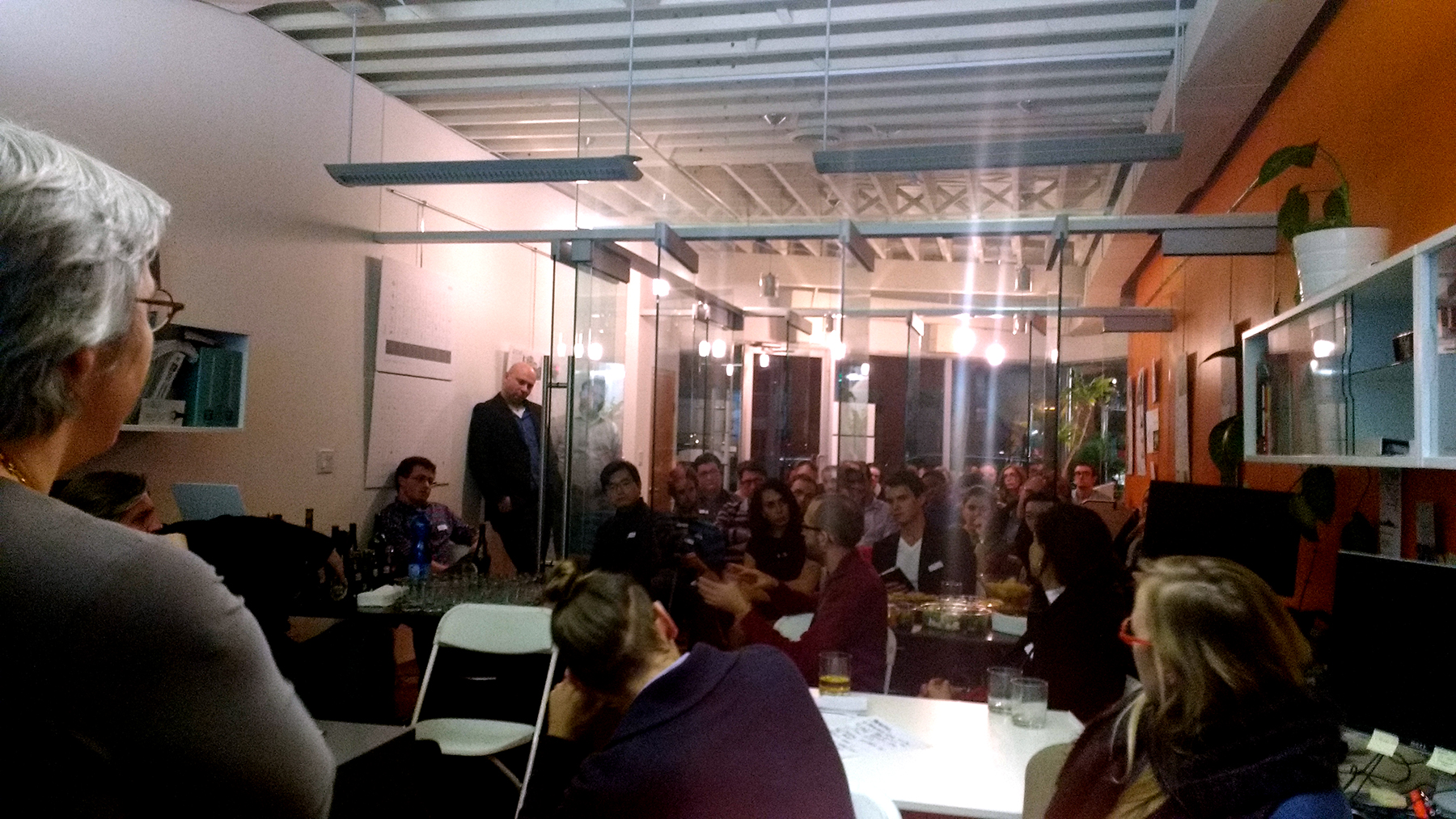
Thank you to Everyone who came out to our Roundtable last night!

A big thank you is necessary to everyone who came out to the Roundtable on Tuesday to Meet Ontario’s Next Generation of Passive House Designers.


IMG_20151117_194348030-edited


Students from Ryerson, Waterloo, and Humber College, as well as industry professionals (Contractors, Material Suppliers, Energy Consultants, and Architects) from across Ontario came together to listen to students presentations on their Passive House designs, meet like minded people, and enjoy stimulating conversation.


Thanks again to everyone who came out: and especially to the students who gave the presentation! More information about the projects can be found here.

Combining Renovations and Additions with an Overall Energy Efficiency Upgrade on your Home

Many of our clients own detached or semi-detached homes in Toronto from around the WW2 era and are looking to either renovate or add an addition. Today we were wondering whether it makes sense for our clients to combine a Renovation and/or Addition with an overall energy efficiency upgrade on their homes through the use of programs like the City of Toronto’s Home Energy Efficiency Loan Program (HELP). This blog post will drill into that a bit more.

20150714_145742_web

Renovating your home or adding new rooms always involves demolition and construction work. While it is is possible to minimize the disruption caused by construction and demolition through smart design and planning, often there will be disturbances from the normal flow of the home. In this time it makes sense to consider whether there are other improvements and quick-fixes that can be made on your house at the same time to improve it’s Energy Efficiency. Besides avoiding the inconvenience of having your home and life disturbed through multiple renovations, one reason to consider this is because you (the client), the design team, and the builder are already working together on the reno/addition the knowledge and capacity to do the energy efficiency improvements are at-hand and on-site.

A second reason is the City of Toronto’s Home Energy Efficiency Loan Program (HELP) which offer low-interest loans for energy improvements. In this way it is possible to add/renovate as well as install new windows, a high-efficiency furnace, boiler, water heater, toiler, or a heat recovery ventilator in the existing house. The unique part of this program is that the loan is tied to the property itself, and the monthly payments on the loan are done through property tax. In this way the energy improvements, and the cost, is tied to the home owner rather then you.


The following are examples of improvements supported by HELP:

  • High efficiency furnace/boiler/central air conditioner
  • High efficiency water heater
  • Window or door replacement
  • Air sealing (for example, weather stripping or caulking)
  • Basement/attic/exterior wall insulation
  • Toilet replacement
  • Drain water heat recovery system
  • Heat recovery/energy recovery ventilator

According to the City’s website, you may qualify for the HELP program if:

  • you own a detached, semi-detached, or row house;
  • all of the property owners on title consent to the program;
  • your property tax and utility payments to the City are in good standing; and
  • you obtain written consent from your mortgage lender, if applicable.

You can also take advantage of a $650 credit from Toronto Hydro for replacing your Furnace.

Overall we think that combining your renovation/addition with an energy efficiency upgrade on the existing home makes sense in order to avoid disruptions, save money, access a favourable long term loan program and tap into rebate and credits available through other Government Programs.

What do you think?  Would you use the HELP program?  Let us know!