AIA 2030 Commitment – Progress Report 2014

AIA-2015 Arch 2030 Commitment Report_Page_01

Across all projects — including those already aiming for carbon neutrality — reporting the 2030 portfolio anticipates a mean energy reduction of 36.9% from the national average.


At Coolearth we are proud to be committed to the American Institue of Architects 2030 Challenge.  The 2030 Challenge is a grass-roots effort by architects across North-America to reduce the energy use of the buildings we build.  The AIA has released their latest update on the 2030 challenge and how it is doing (download here). Overall the amount of firms participating, the amount of square footage included in the commitment and the performance of the buildings is increasing year-over-year which is a great result for all participants.


A unique aspect of this Commitment is how it is being done with standard budgets and materials.  Sustainable building does not need to cost more, use different materials, or import everything from Germany: smart design can work with what it is given.


Relatively few projects in this year’s report are pilot sites funded by researchers or philanthropists—meaning that most of them must compete, on cost and schedule, with conventional work.


The 2014 Report also stresses the importance of energy modelling for meeting sustainability targets, and regretable there is in fact a DECLINE in the amount of projects which are using energy models.   This may be due to a perception that energy models are used to test compliance rather then guide design.


Having a model in place at a project’s outset helps ensure that design teams will keep working on energy reduction throughout a project’s twists and turns.


To learn more visit our section on Energy Analysis, check out Sheena’s article in the OAA Perspectives on Energy Modelling or visit the 2030 Commitment page.


Roundtable: Meet Ontario’s Next Generation of Passive House Designers

Roundtable poster


On November 17th we are hosting an event entitled  “Roundtable: Meet Ontario’s Next Generation of Passive House Designers” on from 6-9pm at our office. This is an opportunity for six groups of architecture students, who are part of the Passive Building Show, from three of Ontario’s Architecture Schools as they present their work to the Ontario Passive House Group.


The students work directly addresses the issues and intricacies of Passive House design including solar exposure, construction detailing, and design-conceptual strategies. The presentations will cover a wide scale of work and thought by student who are the next generation of Passive House Designers. There will be sandwiches, beverages, and snacks from 6-7, then Pecha-Kucha format (20 digital slides with 20 seconds a slide) presentations by students from the University of Toronto, Waterloo, and Ryerson on their passive design projects, and a round-table conversation afterwards.   You and a guest are cordially invited to join us!


The event will include design professions from the The Ontario Passive House Group.  The group is composed of architects, passive house designers, contractors, and industry from the GTA and Ontario which meets regularly to foster conversation, provide support, and building connections between like-minded designers in the city.  This is a great opportunity to learn, discuss, and meet people involved in passive building design in Ontario and the GTA


Please let us know if you are able to attend!  See the event here: https://www.eventbrite.ca/e/roundtable-meet-ontarios-next-generation-of-passive-house-designers-tickets-19224487961


Information:

Much is made in the media of “smart” buildings which are wired and connected throughout, which move and twist in response to environmental stimulii. We propose that what makes a building “smart” is also how efficiently it uses energy.


Efficiency is the task of architects todays as we strive to mitigate the horrendous impact that the current operation of buildings have on our environment. Yet, what makes a building efficient is often invisible and passive: well insulated walls, an air-tight envelope, smart glazing, ventilation, and occupant behaviour, all contribute to making a building so efficient that it requires no input, and generates no output.


Passive Houses, Multi-Unit Residential, Commercial, and Instituational buildings are growing in popularity around the world yet in Canada we can count the passive buildings on one hand! Join the conversation around sustainable design and learn more about Passive House design.


Learn more here: https://www.coolearth.ca/2015/08/13/passive-building-show-on-now/

4 tips for choosing a Contractor to build your Dream Home

IMG_1979-80
 
Choosing a contractor to build your dream home can be an overwhelming prospect for many homeowners.
 
As architects we have worked with many contractors and have had great as well as horrible experiences. One of the main things we find is that contractors and homeowners can confuse each other via mis-understandings and poor communication. This results in “re-work” (think budget overruns).
 
While we can work with our clients to provide construction mangagement and support during a building to bridge the communication-barrier and ensure efficient and effective progress on a project, many homeowners want to oversee the construction themselves. We’ve prepared these 4 tips to help homeowners choose the right contractor for the job.


1.) References

 
The most important factor to consider in choosing a contractor to build your home or building is their references. This includes both the clients they have worked with as well as the architects. This may seem daunting to some, but making the calls and reaching out to their references is the sure way of learning how the contractor works and whether you will be a good fit.
 
Your home is not only a building, but it is also a team excercise between the contractor, architect, tradespeople, and manufactuers: a process that take months, and involve many people. Questions you may want to ask references include: how was for them to work with them and their team? How did the contractor do keeping the project on schedule and budget? What was the finished project like? How was the process overall to work with them? How did they structure the contract for the work?
 
If possible it is best to visit the contractors past projects and understand the scope of the project and the detailing of construction. And be sure not to visit just recently completed projects, but also projects that are older, to see how the contractors work stands up to the test of time.
 

2.) Review the Drawings in Detail

 
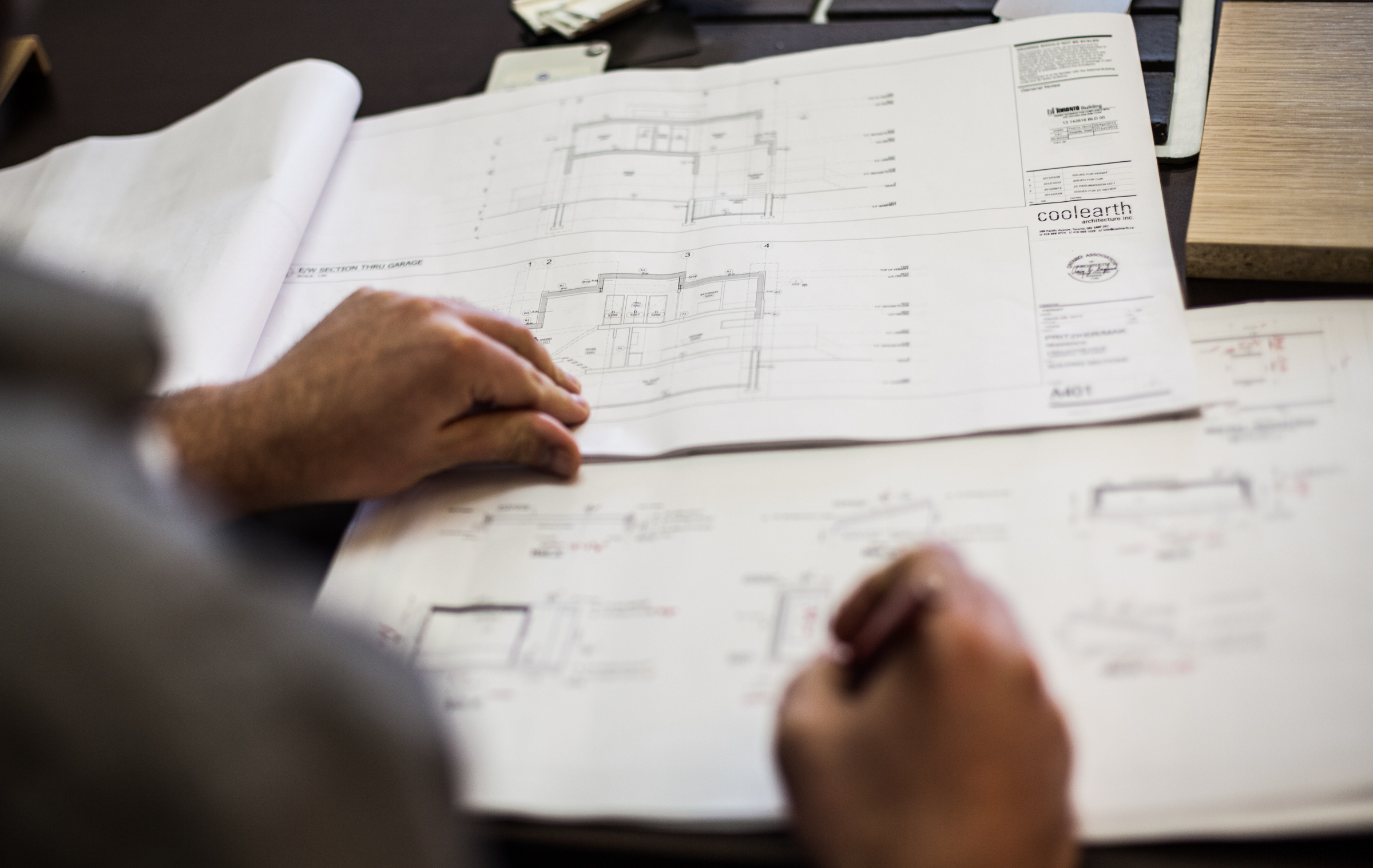
The drawings that the archtiect has prepared for you contain a wealth of details that all effect the performance, look, budget, and method of assembly for the house. Once these are given a building permit they are also certified by the city. These drawings are the key to a succesful working relationship with your contractor because they contain all of the instructions and details for how the home should be built. If you have chosen not to retain an Architect for Contract management and supervisions then it is essential that you review each and every note and line in the drawing in detail with the contractor to ensure that both of youand tey understand all of the aspects of the project. This should be done before they provide you with a quote or you agree to work with them.
 
Overall, by reviewing the drawings and discussing the project in detail you are trying to figure out whether the contractor “has their head in the game”, whether they know what they are talking about when it comes to the specifics of your project, and whether they seem interested in working with you. You can also begin to understand how you may work with the contractor.
 

3.) Ask Questions

 
The key is communication. You need to ask questions and keep askign questions until you understand the contractors answer. Nothing should be a mystery or confusing. Building a home has been done for tens of thousands of years, and there is no need for you to have any confusion or ambiguity about the process: it is well understood. The architect you have retained to prepare the drawings will have designed the home so that it meets code, is structural sounds, and performs as you expect. Remember: you hire the contractor to building your home and the architect to design it and supervise the construction.
 
Some specific questions you may want to ask include: What is your approach to this project? What are the phases you envisionn in the construction of this project? What trades are involved, when, and have you worked with them before? How is your core team or workers and carpenters? How will disagreements and disputes be handled?
 

4.) Understand the Contract and Budget

 
There are primarily two forms of contract you will form with a contractor. The first is a “fixed-fee” contract in which you are provided with an all-in price for the work requested. The second is a “time and materials” contract in which you agree to pay for the contractor and his teams time, as well as the material involved in building (plus the contractors co-ordination fee).
 
In the first instance, a fixed-fee can be beneficial if you have a strict budget and want to know all the projected costs up front. This is also incentive for the contractor to work efficiently and effecivtley towards the mutually agreed upon goal. However the concern with fixed fee contracts for homes is that the design, materials, and finishing can change as the project evolves which can lead to re-negotition on the price. Even if the changes fit within the scope of the fixed-fee previously agreed upon, if the changes will cost the contractor more time and money there is the possibility that they will try to extract this money in other wayrs in the future. While this doesn’t always happen, it can happen if a robust, well thought contract is not prepared. The vital thing is to have fixed fee contract tied tightly to detailed scopes of work for the various phases. If an element of the design is required but was not included in the fixed-fee then it will cost extra, and likely come at a premium. Disagreements will arise where the client says “I thought this was included” and having the proper scope of work will remove this possible point of friction.
 
In the second-instance, a time and material contract, the client pays the contractor and his team for the hours they bill, and the cost of the materials. The benefit of this approach is that it allows clients and contractors to agree on various phases of work with estimates of hours and costs, allows for dynamic changes to the project and can remove the hazard of contractors trying to “milk” the client of money via extra and changes later on in the project. The danger is that unless the client is supervising the contractors work closely it is possible for the hours billed to balloon out of control. Choosing a contractor whom you can trust is essential to combat this. This approach means that there is a more organic relationship within the team and allows for changes to the scope as the project evolves.
 
Ultiametly there is no “right” contract, but there are various options to meet your expectations and preference. Understand and imagine how each may work and/or not-work for you to see which you would prefer. You do have rights in either case, and both can work as long as clear communication is maintained throughout, and detailed scopes of work are prepared.


We hope these four tips will be helpful to you in selecting a contractor for your home. Please let us know if you have any questions.

Deep Green Home Renos: How-to

Thank you to everyone who came out to the seminars this past Saturday (Deep Green Home Renos: How-to). It was great to meet so many people from the neighbourhood who are also intersested in sustainability, making homes net-zero, and reducing energy consumption .  We’ll be posting the presentation in a couple of weeks.

main-slide2

If you’d like to learn more about sustainable architecture we have to white papers on the site which you can access at anytime.  The first is on Energy Benchmarking, which is a method of publicly recording a buildings energy consumption in order to create more informed tenants, prospective buyers, and the public.  It can be found here.  The second article is on Energy Modelling, and was published in the OAA’s “Perspectives” Magazine.  It can be read here.


Or if you have other questions, give us a call at 416-868-9774, and we’d be happy to discuss them.


Thanks again!

Green Energy Doors Open – next Saturday!

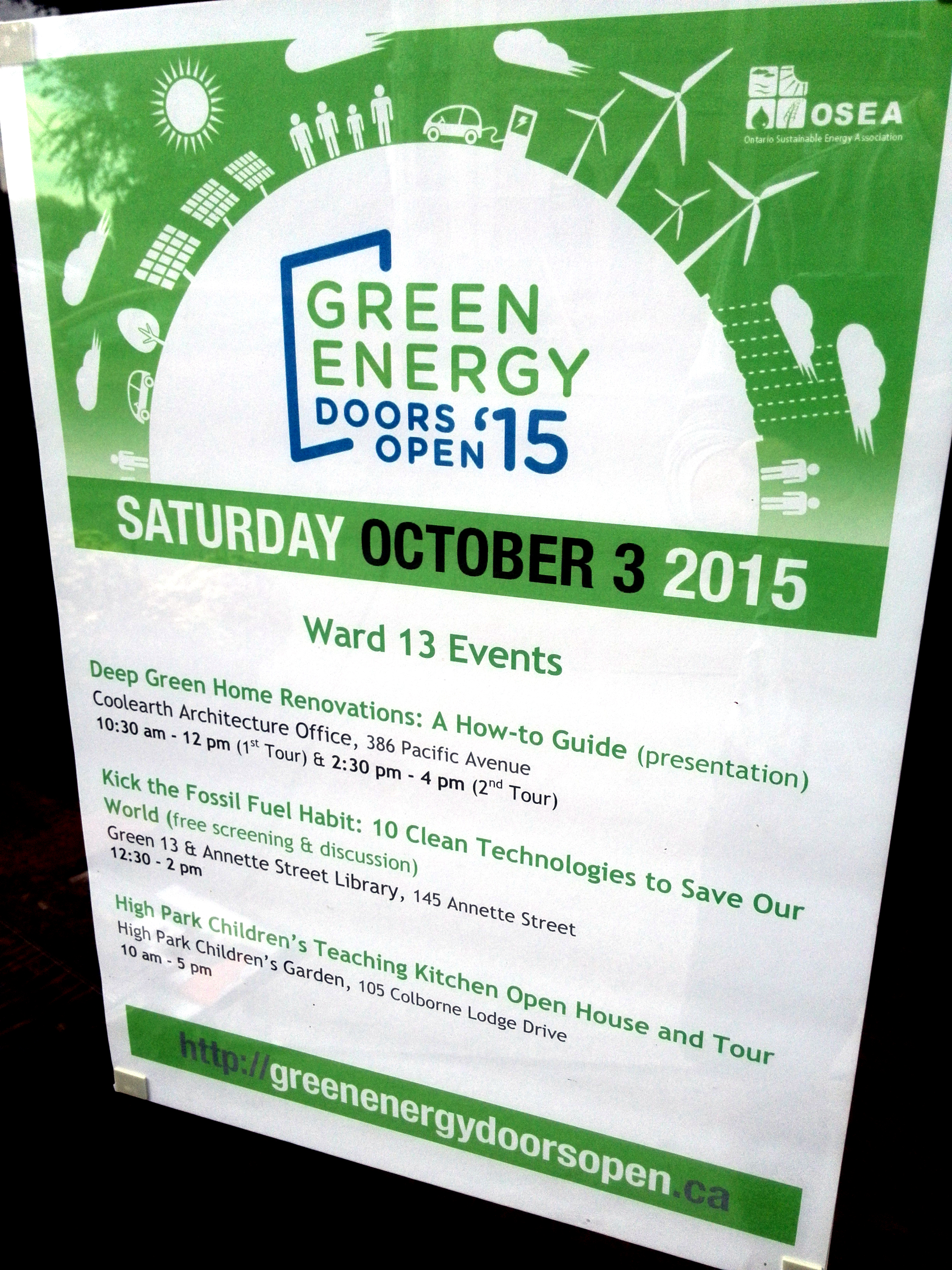
We are excited to be counting down the days to our event next weekend (October 3rd) as part of Green Energy Doors Open.  We hope you’ll join us!!


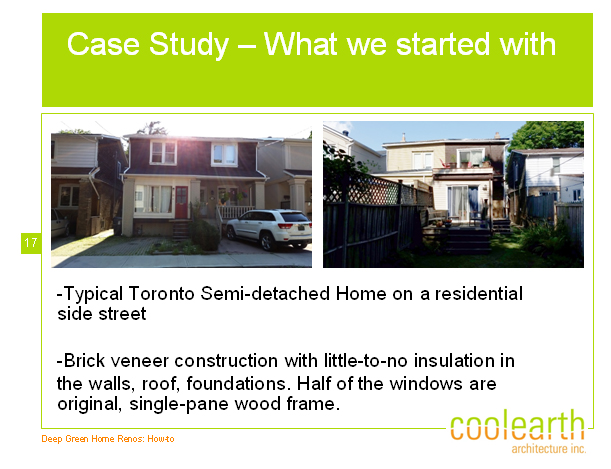
Sheena and Craig will present a case study showing how an existing Toronto brick home can be made net-zero. They will also be available throughout the day for questions about sustainable improvements, renovation, and net-zero homes.
 
ipp


The event will run from 10:00am to 5pm, with two presentations, one at 10:30am and one at 2:30pm. If you have any questions please give us a call at 416-868-9774.

 
For more information please check out http://www.eventbrite.ca/e/green-energy-doors-open-deep-green-home-renos-how-to-tickets-18151626002

Workshop at EcoFair at the Barns

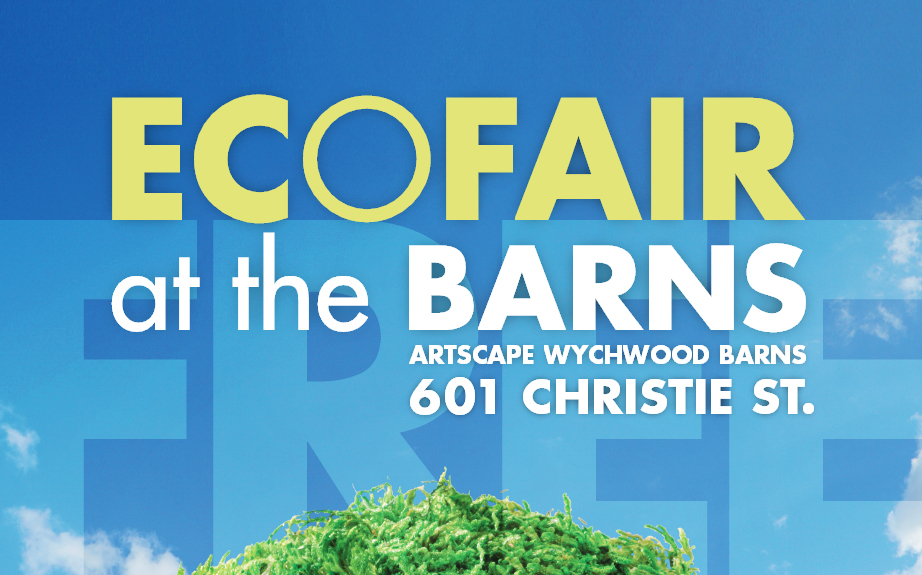
Craig England is going to give a 30 min workshop on the topic of Home Energy Efficiency, and making existing Toronto homes Net-Zero, at the EcoFair at the Barns on Sunday Nov 8th in the afternoon. It will be the 7th annual EcoFair at the Barns. Last year there was over 800 people at the Fair, and best of all the event and workshops are free.
 
ecofair
 
From the Ecofair site:
 
“The EcoFair is a FUN, family oriented event that informs and inspires people to make greener choices in their homes and communities. Last year, there were more than 25 exhibitors and eco kids activities. Over 800 people came out to learn about green initiatives and achievements in our neighbourhood and in our city, to explore new ideas, and to share green tips and tricks… This year’s event promises to be even bigger and better than ever with an anticipated 40+ eco friendly displays, interactive activities and amazing food from Toronto’s eco friendly food truck, Localista. From kids activities to electric vehicle test drives, garden advice and swaps, there is something to please everyone.”
 
Learn more here: http://ecofairtoronto.org/