Reminder: “Can Net Zero Meet Good Design in Lighting?” Seminar

iidex

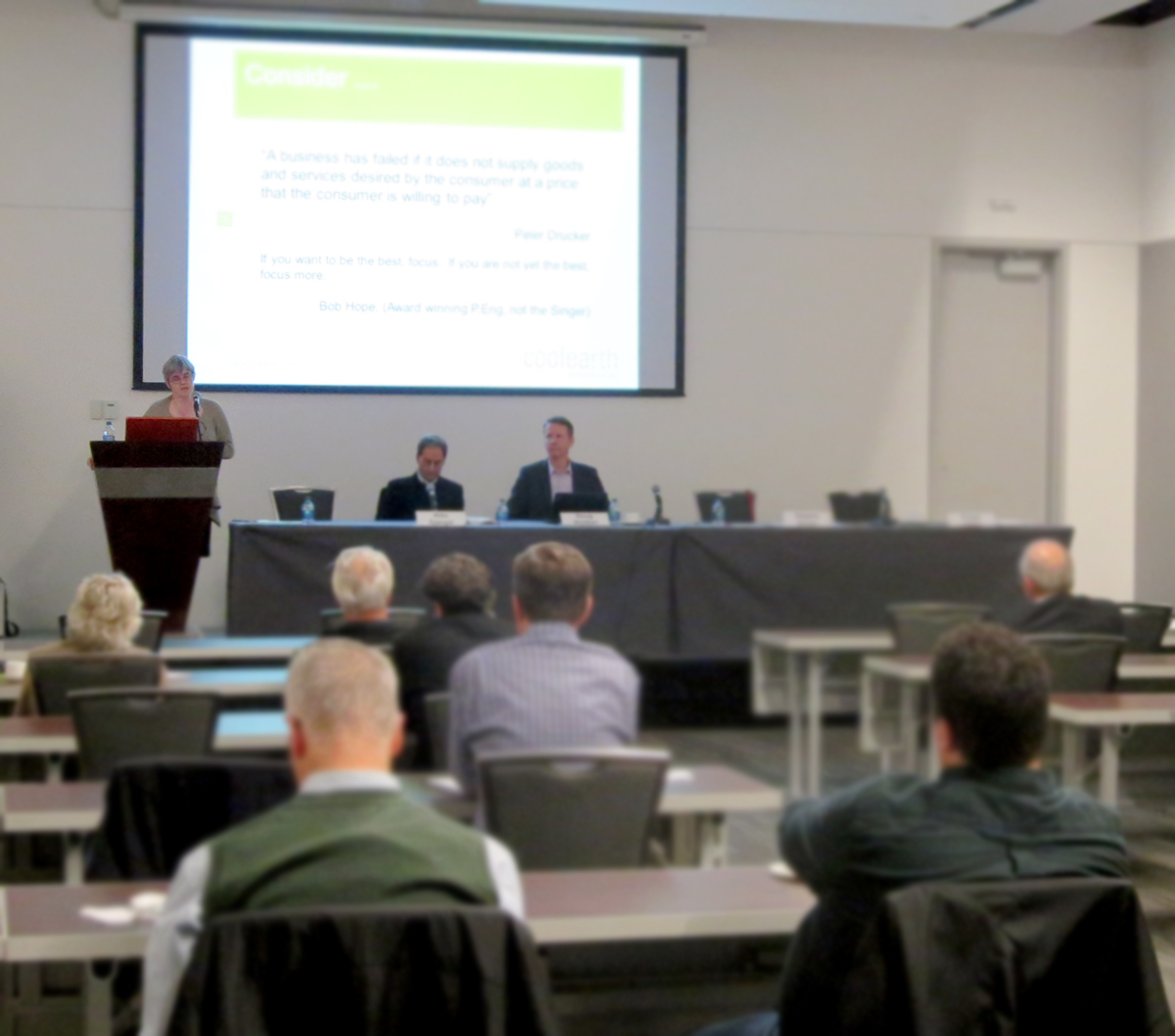
Sheena Sharp, a principal at Coolearth Architecture will be presenting a seminar at Toronto’s IIDEX Canada, on Thursday, December 4, 2014, 10:00-12:00 entitled: “Can Net Zero Meet Good Design in Lighting?” with Deborah Gottesman and Harold Murray.


“This seminar demystifies what it means to target net zero: what it is, where to start, and how to get there. There will be a detailed focus on the daylighting, electric lighting and lighting control design strategies, as they are a major contributor to achieving net zero. We will explore how to develop lighting concepts – a crucial step to achieving a quality visual environment with precision design. Finally, the learning is rounded out by a detailed look at the daylighting studies which demonstrate how it all comes together, including the financial implications”


More information can be found at the IIDEX site.   The first post is here.


If you are interested in learning more, but cannot make it to the seminar, please email us or give us a call.

Green Electricity and Upstream Sustainability

Analyses reveals that the vast majority of buildings which are currently built will still be standing in 20-30 years. Though we can expect some to be renovated, the performance and operational demands (heating, cooling, lighting) will remain the same. Initiatives and legislation which focuses on making new buildings more sustainable, such as Energy Disclosure and Benchmarking Laws, are important, but must be complemented with “up-stream” sustainability.

Upstream sustainability is found by the adoption of lower emission-based power sources by Energy Providers. Because the buildings which the energy providers will be providing energy to are mostly already built (at least in the Europe and North America), initiatives like the Architecture2030 Challenge which aims for carbon neutral new buildings and renovations by 2030, are, in this sense, downstream. Both complement each other and play a role in reducing the overall impact of building on our environments.

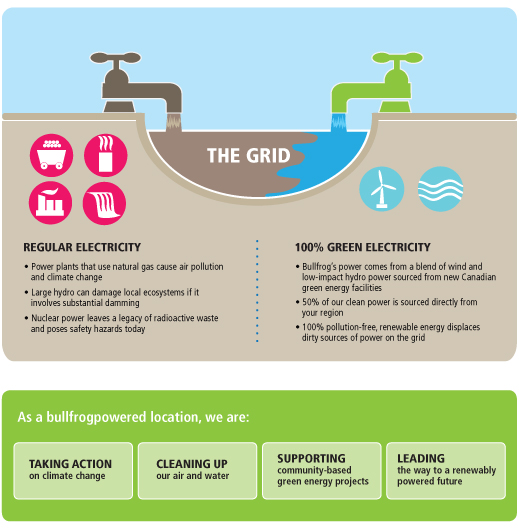
Bullfrog power is one energy provider whose power comes from a blend of wind and hydro power sourced from new Canadian green energy facilities. 50% of the power is sourced from a customers region and 100% is “pollution-free” renewables. It works by adding the amount of energy you use into the grid in the form of green energy.

Image via Bull Frog
Image via Bull Frog

“Through the Bullfrog Builds Renewable Accelerator program, Bullfrog customers are advancing local and community based renewable energy projects in their regions, and throughout the country. Bullfrog uses customer support to provide critical financing to help these smaller solar, wind and biomass projects through the construction and development phases—which can be the most difficult phases. ” – Bullfrog Builds Renewable Accelerator Program brochure.

By opting to use Bullfrog Power we can enable massive reduction in our building and firms emissions from operations. Let us know what you think of BullFrog power and if you have any ideas about upstream sustainability.

Net Zero & Good Design in Lighting @ IIDEX

iidex


Join us at Toronto’s IIDEX Canada, where Sheena Sharp will be presenting a seminar on Thursday, December 4, 2014, 10:00-12:00 entitled: “Can Net Zero Meet Good Design in Lighting?” with Deborah Gottesman and Harold Murray.

“This seminar demystifies what it means to target net zero: what it is, where to start, and how to get there. There will be a detailed focus on the daylighting, electric lighting and lighting control design strategies, as they are a major contributor to achieving net zero. We will explore how to develop lighting concepts – a crucial step to achieving a quality visual environment with precision design. Finally, the learning is rounded out by a detailed look at the daylighting studies which demonstrate how it all comes together, including the financial implications”

More information can be found at the IIDEX site.

Presentation at the OAA’s 2030 Course – Ottawa

Coolearth Principal Sheena Sharp speaking at the final session of the OAA 2030 Courses in Ottawa.

oaa_2030
 

The 2030 courses are designed to help Ontario Architects create buildings that meet the energy efficiency goals of the 2030 Challenge and offer strategies to reach 60% reduction in fossil fuel greenhouse gas emissions.  Sheena spoke at the final session of the 2030 courses in Ottawa. To learn more about the 2030 visit the 2030 Challenge site.


Also, be sure to visit Coolearth’s Resource section or visit the OAA’s “ to learn more!2030 Course” website.

Coolearth achieves LEED Silver for Commercial Interiors for Private Client

After extensive internal renovations our clients Toronto headquarters has achieved LEED Silver Certification for Commercial Interiors.


2014_LEED_Silver


Located in a heritage building in Toronto, the cbuilding underwent a major overhaul of their existing 4 storey  facility. As part of their corporate commitment to sustainability, it was determined from the outset of the project that LEED certification would be pursued.


Key highlights include improved Indoor Environmental Quality through the use of Low V.O.C. (Volatile Organic Compounds) Materials and furnishings; a commitment to locally sourced Materials (over 45% of materials were manufactured regionally!); and diverting construction waste from landfill (over 87% of construction waste was either re-purposed, reused or recycled).


The Owner, design team, and construction team all came together throughout the entire process to achieve this sustainability milestone. It was a pleasure working with everyone involved, and we are extremely pleased with the outcome.


To all the folks at Urbacon, Luc Wintzen Design, MCW Consultants Ltd, and our client, we thank you for your time and effort in a job well done!


OAA Perspectives – Sheena on Energy Models

blog_energymodels_oaa

 
.

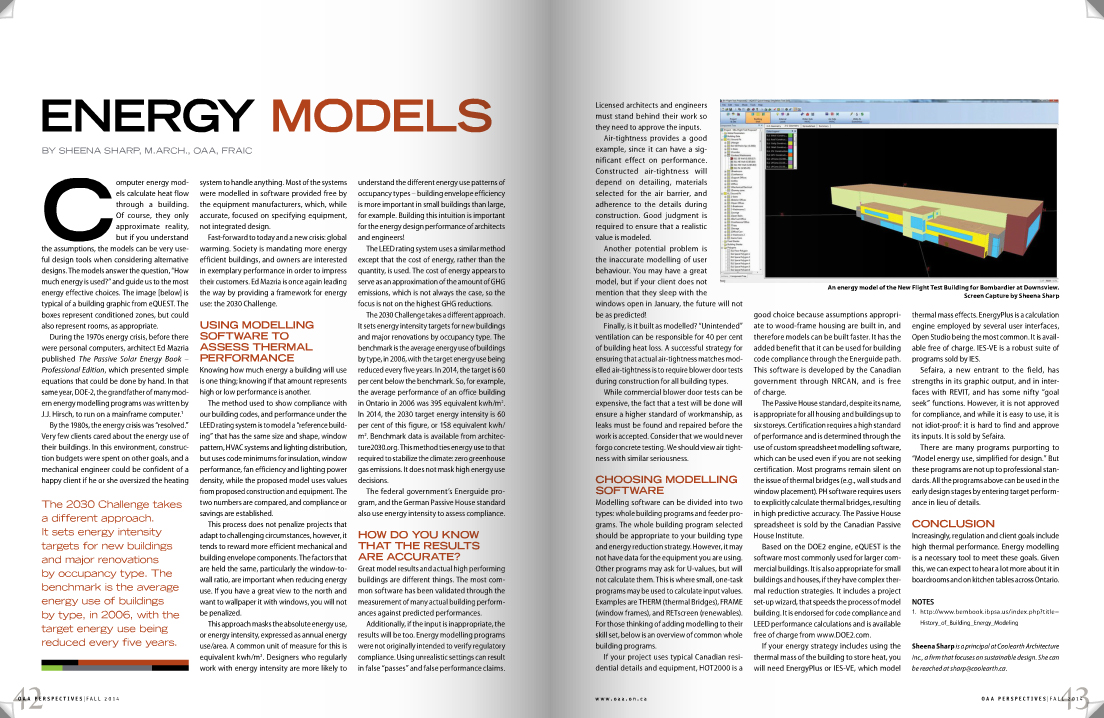
This fall’s OAA Perspectives, a magazine published by OAA for its members features an  article by Principal Sheena Sharp on Energy Models. In it, Sheena highlight the power of using energy modeling as a tool to drive design and decision making. She also discusses questions about the accuracy of energy modeling and outlines how to choose the right modeling program. See below for an excerpt, view the pdexcerpt, or see the whole issue.


“Computer energy models calculate heat flow through a building. Of course, they only approximate reality, but if you understand the assumptions, the models can be very useful design tools when considering alternative designs. The models answer the question, “How much energy is used?” and guide us to the most energy effective choices…” – Excerpt from OAA Perspectives, Volume 22 Number 3 Fall 2014, “The Sustainable Architecture 2.0”


At Coolearth we believe in data-driven design and so energy modelling forms an integral part of the work we do.


Understanding how much energy a building will consume over the seasons allows us to better develop the heating, cooling, lighting, and mechanical systems, as well as the overall design.  We can work to tighter tolerances within the design parameters and identify opportunities to increase efficiency in the most cost-effective manner.


Checkout our Energy Audits page for more information.