Net-Zero Eco-Cabins

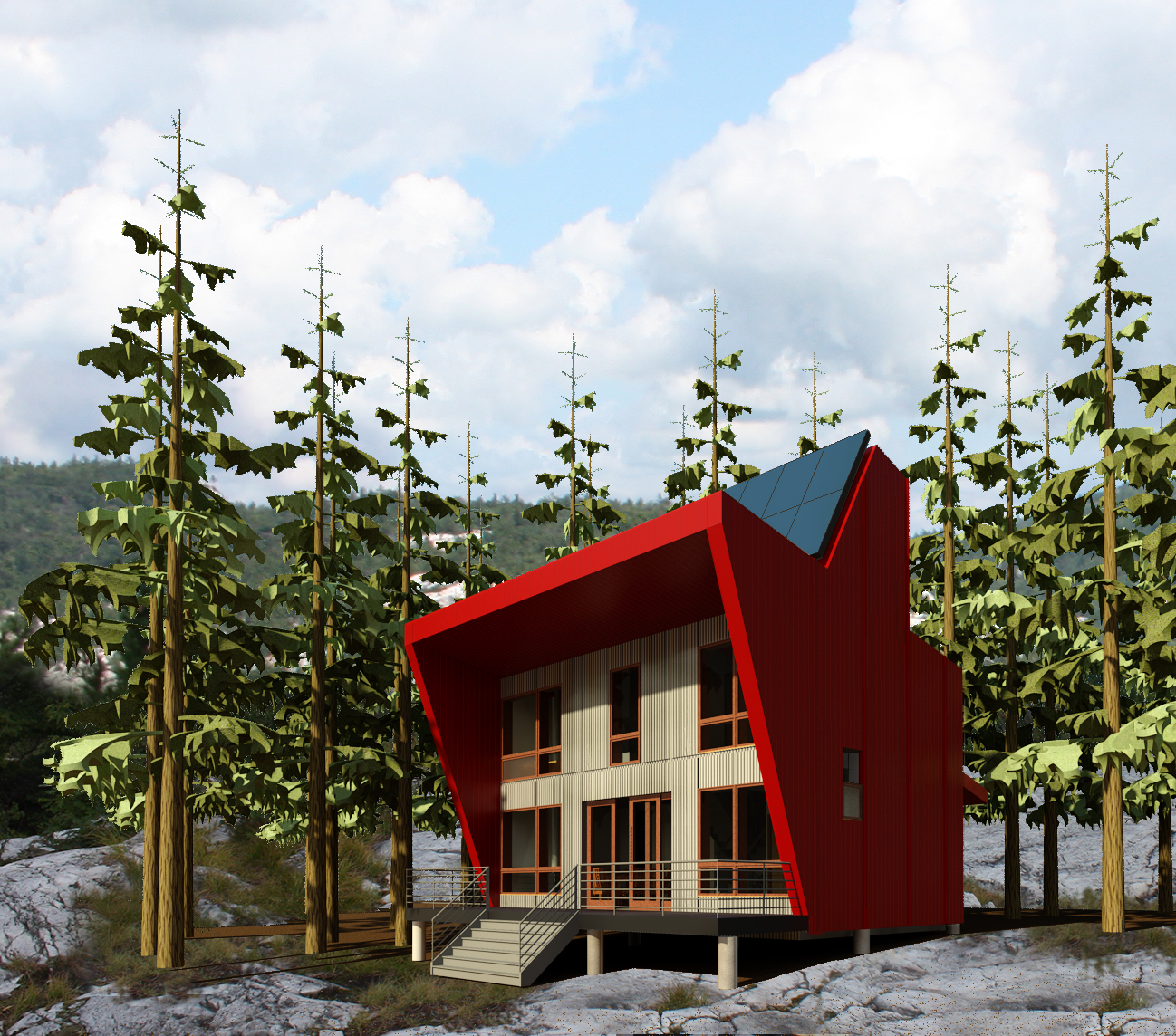
140919 rendering
 

We challenged ourselves to design off-grid cabins that function well and are comfortable throughout the year.


Cabins located in the secluded wilderness are great for resting, recovering, and enjoying nature, but servicing the site can be expensive. Our approach is to super-insulate the walls, minimize air leakage, optimize for solar gain, use a high efficiency energy recovery ventilator, heat with a high performance wood stove, and supply electricity via PV panels. The result is a cabin with a yearly heating cost equal to a face cord of wood, about a 6’ (1.2m) cube of wood.


Cabin features include:

  1. Modern style with large south facing triple-pane windows.
  2. Four options: One bedroom family style (600sf), two-bedroom (800sf), four-bedroom (1200sf), and Luxury four-bedroom (1200sf).
  3. Super insulation: R57.5 walls, R54 Floor, R67 roof, and R7 windows.
  4. Sturdy design: metal siding and metal roof
  5. English made Ironheart wood cook stove with overnight feed bin
  6. Sundanzer super-efficient refrigerator with Freezer for summer use available as an option.
  7. High efficiency lighting: compact florescent lighting or LED
  8. Solar panel photovoltaic system with battery storage and external generator hook-up.
  9. Oak stairs and engineered wood floors throughout
  10. Spacious exterior deck


The design is based on energy modeling with local weather data.  This weather data includes the locations, temperature, cloud cover, wind, and precipitation. We then design and simulate a model of the cabin as if it were being used by a family.  The challenge to overcome in off-grid buildings, is that studying merely the temperaure is not sufficient; the length of time, in days, that the cabin can function without sun must be considered.


The EcoCabins will have two modes: occupied and unoccupied. At the end of an occupied period, a weekend for instance, the building can be switched over to unoccupied mode.  When occupied, the cabins will be heated with an Ironheart wood cook stove that has 2 burners, an oven and hot water preheat.  The cabins will come with a refrigerator, hot water tank, lighting and high efficiency energy recovery ventilator.


The power supply will be sufficient to power a flat screen TV, a Blu-ray system, a stereo, laptop, coffee maker and toaster. When occupied in the summer, since Photovoltaic production is higher, a hot plate and freezer may be added to the appliance budget. When unoccupied the cabins are switched over to direct all power to heat tracing the well connection, topping up the batteries, and with the excess, powering baseboard electric heat.  As an extra safeguard, the system will be programed to contact the owners should the batteries become too low, which can be supplied by an external generator (for instance via an inverter from a car).


Normal power is supplied by roof-mounted solar panels hooked up to a battery bank sized to provide sufficient power to see the cabin through 3 weeks of low sun in the winter unoccupied mode, which is the most critical demand. The Cabins should keep comfortable temperatures when left for 2 weeks, and maintain safe temperatures throughout the year.


If you want to learn more about these cabins please get in touch via Email or give us a call at 416-868-9774.


_____________________________________________________________


“I went to the woods because I wished to live deliberately, to front only the essential facts of life, and see if I could not learn what it had to teach, and not, when I came to die, discover that I had not lived.”  ― Henry David Thoreau, Walden

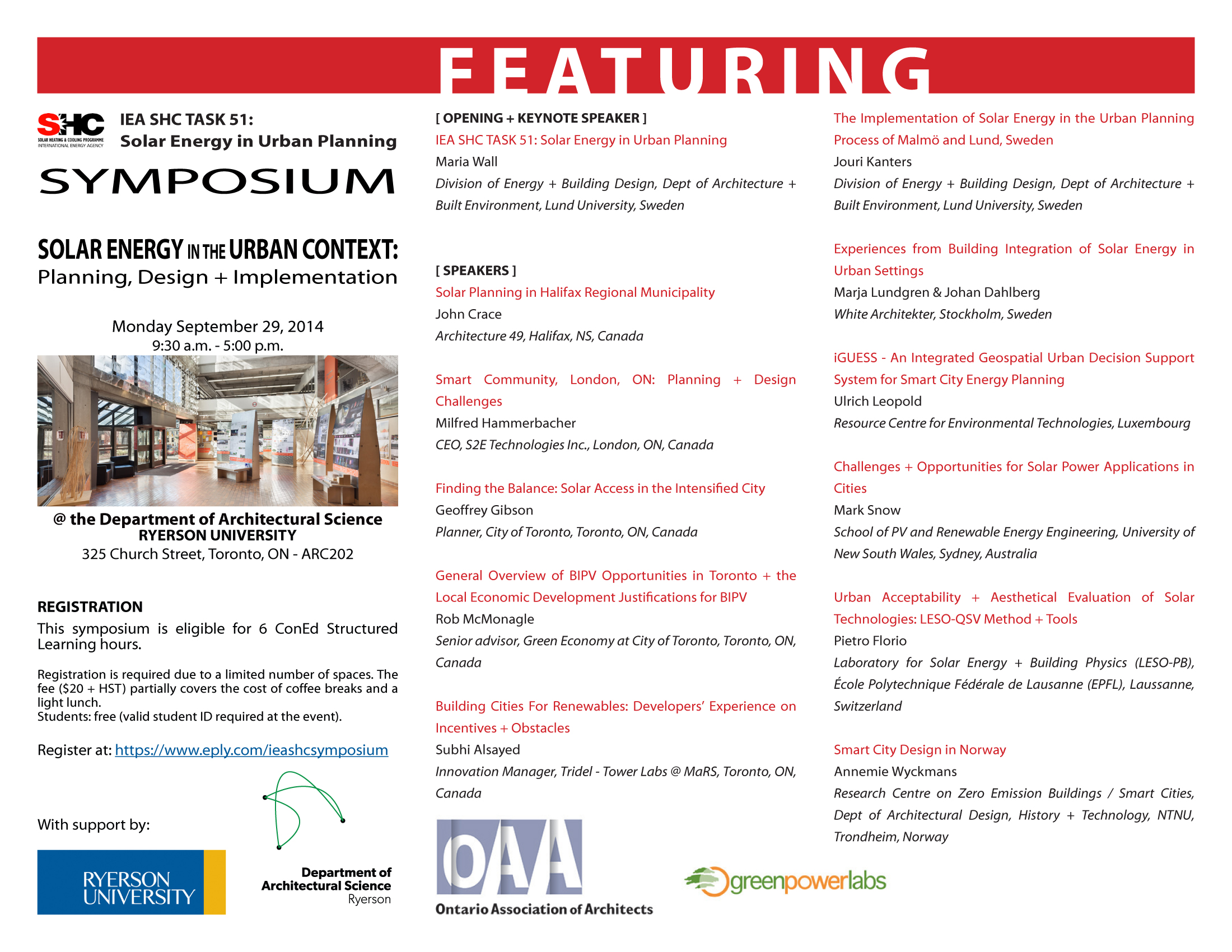
Solar Energy in Urban Planning: Planning, Design + Implementation


This Monday September 29th, the Architcture Department at Ryerson University is hosting a symposium on “Solar Energy in the Urban Context”

From the International Energy Associations site:

A large portion of the potential for energy efficiency in existing buildings and potential to utilize solar energy still remains unused. Globally, goals and specific targets are set up to reduce our environmental impact on climate and secure future supply of energy. The built environment accounts for over 40% of the world’s total primary energy use and 24% of greenhouse gas emissions. A combination of making buildings (refurbishing and new developments) more energy-efficient and using a larger fraction of renewable energy is therefore a key issue to reduce the non-renewable energy use and greenhouse gas emissions. Political statements and directives are already moving towards zero-energy buildings, communities and whole cities. An increased use of solar energy is one important part of the development ahead, where the urban fabric needs to utilize passive solar gains and daylight to reduce the energy use in buildings and for lighting outdoor environments, as well as to improve the inhabitants’ comfort indoors and in urban outdoor areas. Also, active solar energy systems integrated in the urban context will enable a supply of renewable energy primarily as heat and electricity, but also of solar cooling, helping cities reach sustainable solutions.

SolarandUrban


Perhaps we’ll see you there!


Ciao,

Geoff

People’s Climate March


Canada, along with many other nations, has signed on to the goal of  keeping global warming below an average of 2 degrees.  It is generally recognized that above this level, we will start to experience irreversible feedback loops that will lead to a planet uninhabitable for humans.  However, our politicians, of all stripes, are not taking the steps  necessary to achieve that goal.


Architects have a role to play by designing buildings which use less energy.   Many OAA members are taking the 2030 courses, and learning to design  net-zero buildings. The sold-out courses will be offered again next year.   They are not cheap, and require commitment. It is a good start!


If you want our politicians to address this, you have to show them that you want change.  To that end, a global march is taking place on Sunday Sept.  21st.  There is one in Toronto, starting at 1:00 at Nathan Philips Square.


The March is sponsored by sponsored by Toronto350.org, Avaaz.org,  Greenpeace Canada, Stop Line 9 Toronto, and the Toronto Raging Grannies.


On Sunday, let’s walk together, as architects.  Email Sheena Sharp,  sharp@coolearth.ca for more information.

The Video:
http://watchdisruption.com/

The march:
http://act.350.org/event/peoples_climate/9337


See below for an exerpt from  from the organizers, or visit their site for more information: http://tcan.ca/event/peoples-climate-march-toronto


We are an a collective of more than 250 volunteers from Avaaz.org, 350.org Toronto, Greenpeace, and other such organizations. We’ve united from Toronto, Markham, Mississauga, and other places to tell our leaders that we must divest from unsustainable fossil fuels and instead make our energy 100 per cent clean by 2050 for the safety and of our planet!


With a green heart as our unifying symbol, we’ll be joining the 200,000 people in New York City and millions of others marching in their communities around the world from our starting point in Toronto. We’ll get the crowd going with a few speeches before starting out of the Square with a very colourful display of green love. It’s time to wake up the world to the imminent crisis and to tell world leaders that the time for action is NOW!


THE ROUTE

Start in Nathan Phillips Square at the stage area. From there, we will go south to Queen St. W, west to University Ave, north to Dundas St. W, east to Yonge St, south to Queen St. W, and then westward to return to Nathan Phillips Square.

-x-

2030 Challenge

Buildings consume nearly half of the energy consumed in the USA and generate nearly half of the total yearly CO2 emissions according to the U.S. Energy Information Administration (EIA). In Ontario, “the building sector remained the third largest GHG (Greenhouse gas) emitting sector in 2012, representing just over 17 per cent of Ontario’s GHG emissions, and was exceeded only by transportation and industry” (via).


The 2030 Challenge is important because it empowers individuals to take action to address climate change, (Toronto Star article, Wednesday July 9th, 2014 and the Environment Commissioners “Looking for Leadership, the Cost of Climate Inaction“).  The challenge requires new buildings, developments and  renovations perform at 60% below the regional (or country) average/median for that building type.  This target increase to 70% in 2015, 80% in 2020,  90% in 2025,  and Carbon-neutral in 2030 (using no fossil fuel GHG emitting energy to operate).  These targets can be accomplished by implementing the sustainable design strategies found in LEED,  on-site renewable power and renewable energy.


From the perspective of our clients and building owners, choosing to participate in the 2030 Challenge will not only reduce the carrying costs of their building, but also will ensure that as new legislation is introduced at the Federal, Provincial, and Municipal level, that the building continues to be compliant.  For instance, in the Environment Commissioners report it is stated:

“A new or renovated building may last for well over 50 years. At the same time, technological innovations in such areas as on-site solar energy production (for electricity generation and space and water heating) and electric vehicles (EVs) are gaining momentum and could become mainstream technologies quite quickly if prices continue falling very rapidly. It makes sense, therefore, to prepare buildings in advance to take advantage of these innovations as they continue to enter the marketplace in greater numbers. In anticipation of these rapid developments, the federal and Ontario governments are assessing the technical implications of requiring that new houses be built solar ready to easily incorporate future connection of solar hot water systems or solar photovoltaic (PV) electricity panels.”

At Coolearth, we understand that we participate not only in the creation of buildings but also in the consumption of energy and the emission of greenhouse gas. The 2030 Challenge sets out goals for architects and builders to reduce these emissions.  More information can be found at the 2030 Challenge website, or here.


We’re making this post today because of our firms commitment to the 2030 Challenge and because we have just submitted our annual progress update to the American Instute of Architects 2030 Commitment program.


Faces in the Crowd

IMG_20140609_151738

Heda Sharifi’s exhibit Faces in the Crowd is being taken down this week after a succesful and well-received showing for the Contact Photography Festival.   Thanks to Heda for his great vision of the city’s residents.  The refreshments and delicious gourmet grilled cheese sandwiches by Randall from “Cut the Cheese“.

IMG_20140609_153308

We look forward to next years event!  See you then!

Ciao,

The Coolearth Team


Faces in the Crowd by: Heda Sharifi

You are cordially invited to a public reception hosted by Coolearth Architecture, for Faces in the Crowd an exhibition of Toronto street photography by Heda Sharifi on May 3rd from 6-9pm in the Junction.
 
Faces in the Crowd is a series of black-and-white photographs depicting scenes and portraits of people on the streets of Toronto. The portrait photographs were taken spontaneously, with the intention to capture human emotions and expressions.
 
A part of the CONTACT photography festival for the third year in a row, Coolearth Architecture invites you to join us on May 3rd from 9-12 for a private reception of Heda’s portraits.  You are also invited to join us for the Junction-wide opening reception from 6-9pm.   The Junction has over 21 venues participating in the festival, showing over 25 photographers and artists work.
 
cai_contact_poster_public
 
More information can be found at:
– http://thejunctionbia.ca/contact-2014-in-the-junction/
http://scotiabankcontactphoto.com


Hope to see you there,

Coolearth