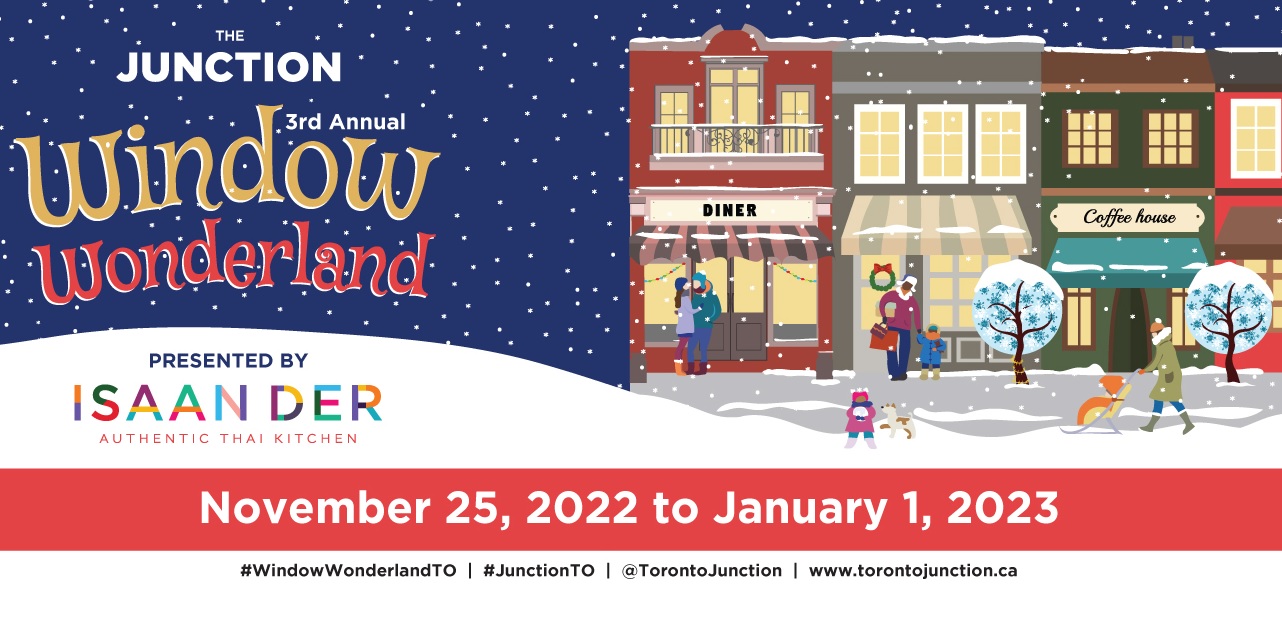
The artists we are hosting are Stephanie Avery and Ansh Kumar. Stephanie Avery is a Toronto-based multidisciplinary artist with a degree in visual art from York University. With an emphasis on interactivity and empowerment, Stephanie’s practice intervenes with familiar spaces, objects and imagery to imbue her subjects with new meanings and narratives. Ansh Kumar is an Artist focused on generative art, analog sculptures, and augmented reality installations. With a background in architecture, he combines his experience in space and media design to create interactive artworks.
The mural will be up from November 25th to January 1st, 2023. You can learn more about the event at the Junction BIA’s website, which has this to say about the event:
The first of its kind for the city of Toronto, Window Wonderland is presented in collaboration with Artivive, an internationally-renowned AR app that changes how art is created and consumed. Linking classical art with digital art, Artivive allows artists to create new dimensions with a digital layer, opening a new world of possibilities. Visitors at Window Wonderland can simply point their smartphones at the artwork displayed on the windows and voila – watch the artists’ creations come to life!
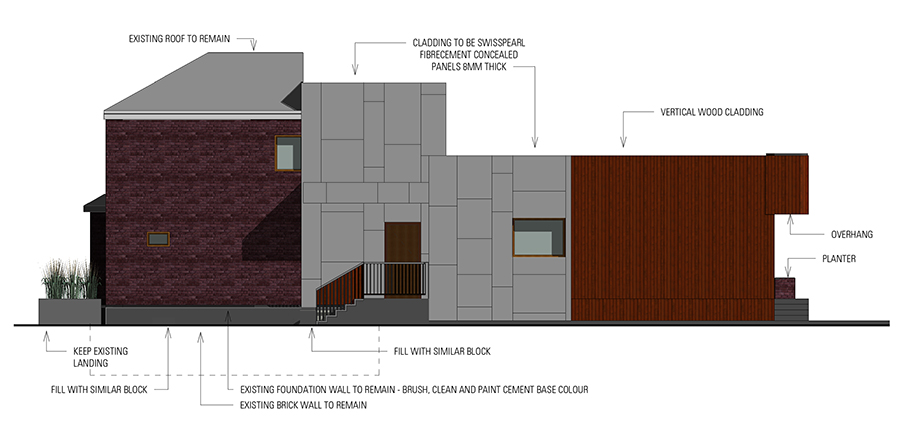
We are very happy to announce that the Sammon Passive House, the progress of which we have been documenting on this blog (here and here) has just received Passive House EnerPHit Classic Certifications. As far as we know, this is the first home in Toronto to receive EnerPHit Passive House Institute certification. Congrats to the whole team including German, Krupa, Sheena, the clients, and builders for their hard work!
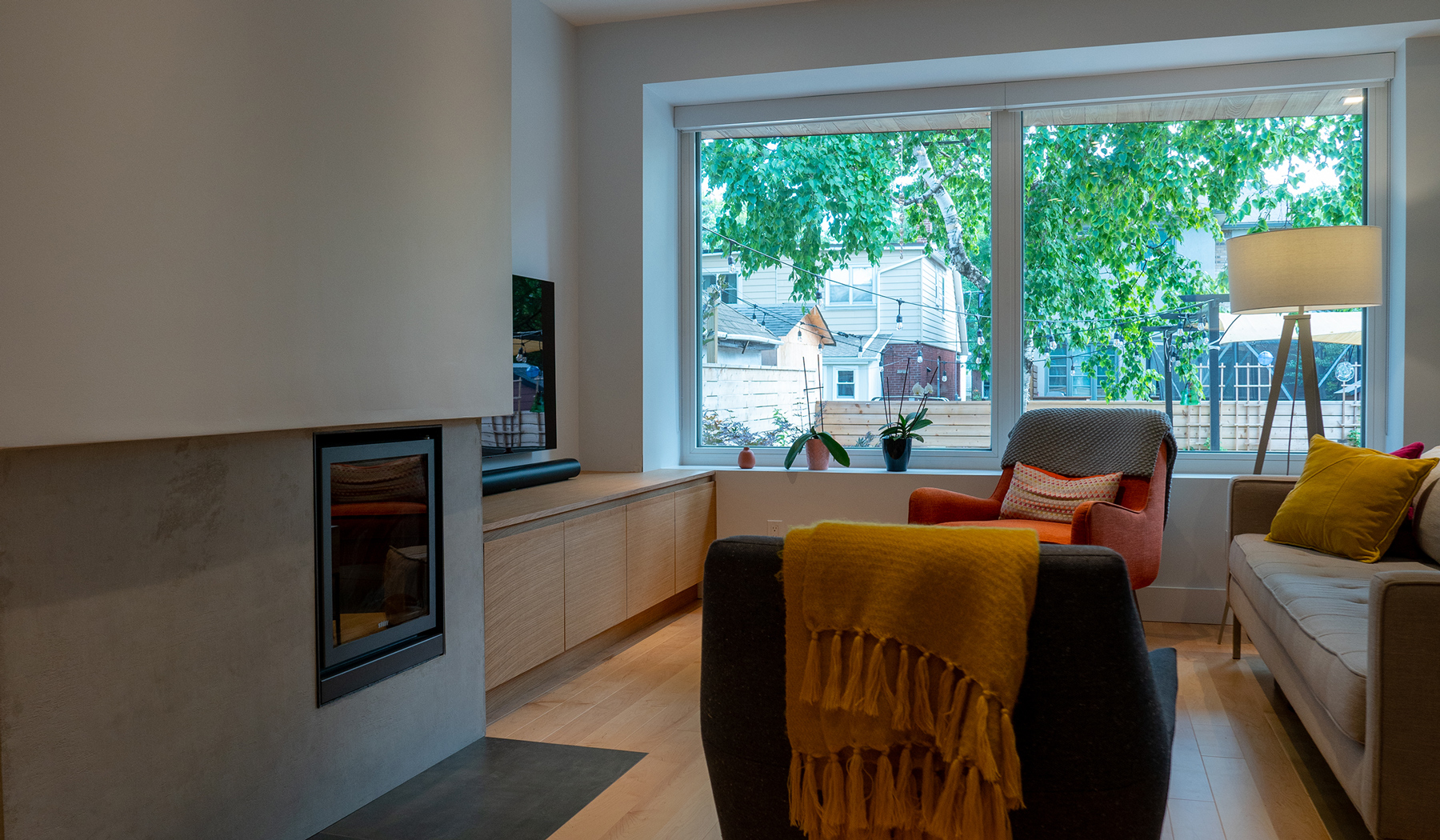
The project was just featured in the CAGBC Ontario Focus Fall 2022 magazine and Teagan McCanny took these awesome pictures for the magazine spread. The project has a bright open concept living area-kitchen, with large windows facing into a serene outdoor backyard social space and garden.
EnerPHit is the Passive House Institutes program for building retrofits. Coolearth has a lot of clients interested in retrofits, and EnerPHit is a great option for them to consider when they want to pursue certification for energy retrofits. The major difference between EnerPHit certification and Passive House “Classic” certification is that EnerPHit certification was specifically designed for retrofit projects. In order to hit our global climate targets energy retrofits will form a major component of our carbon costs. Energy Retrofits can also increase comfort, decrease energy bills, and create a resilient home.
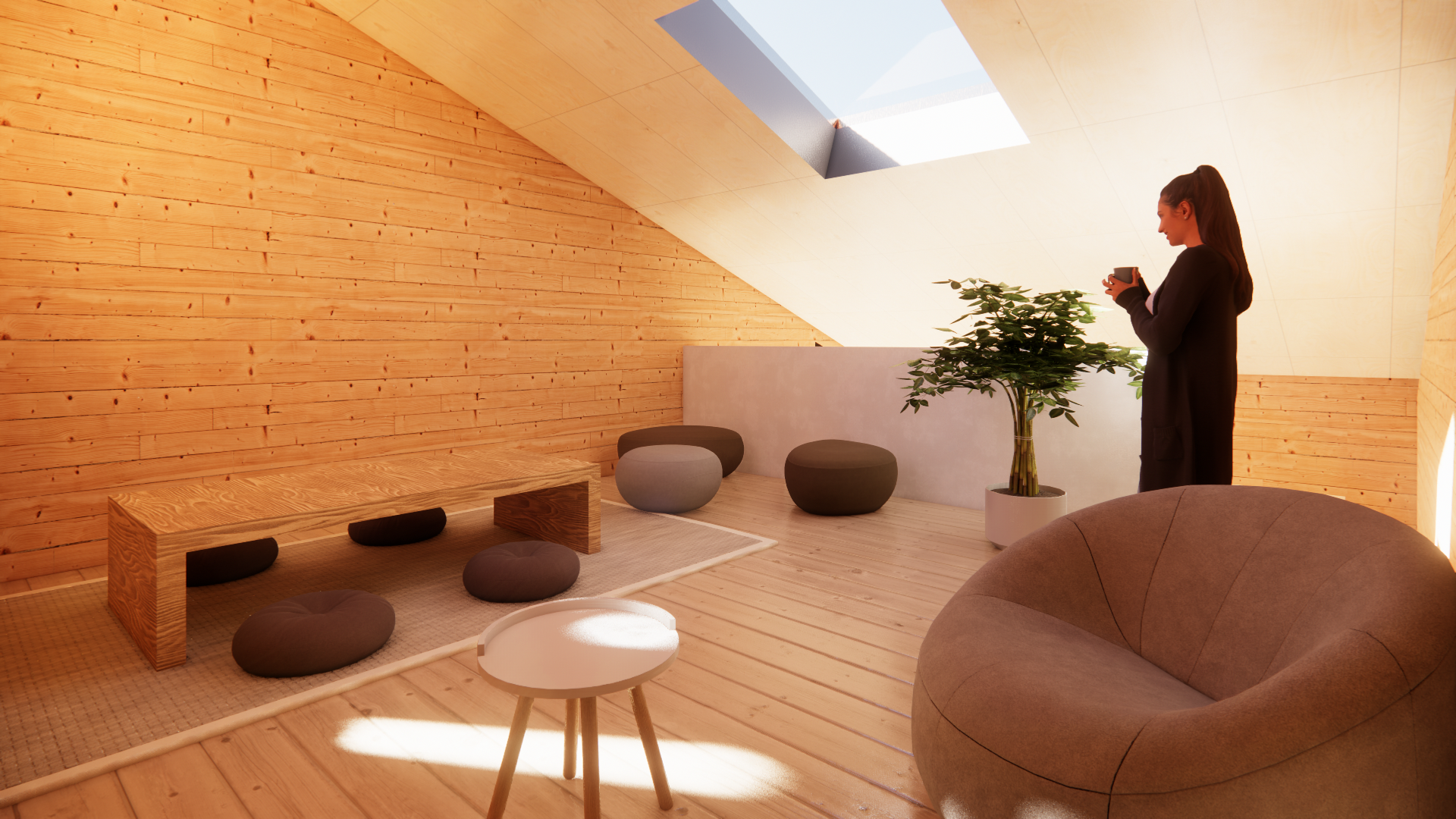
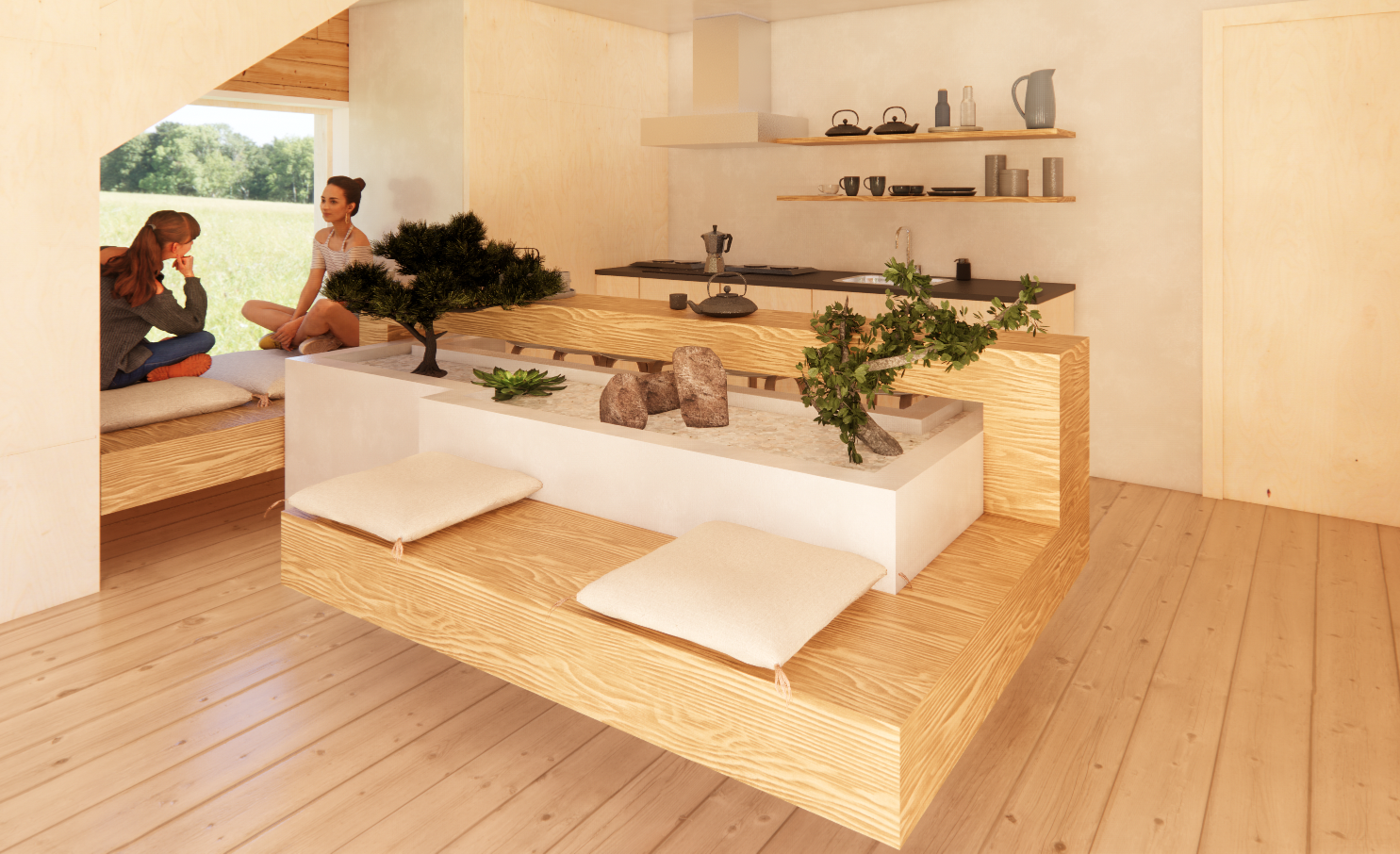
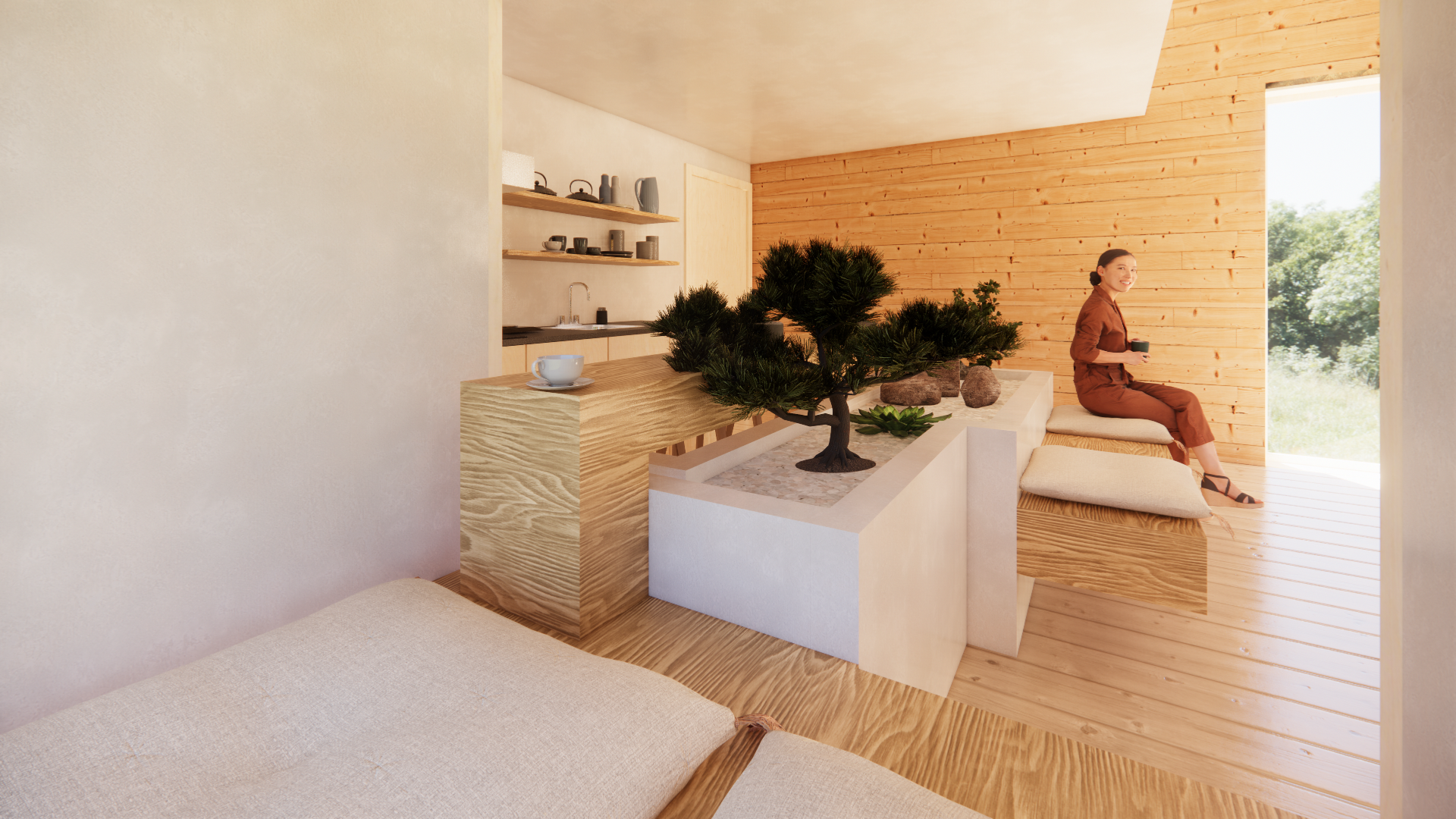
Architectural design is about iterating and testing new ideas to see if you can find a creative, pragmatic, beautiful solution given the myriad constraints of the project. Today we are going to share some in-progress 3D visualizations for the bar, kitchen, and lounge areas of a teahouse and meditation space we are designing for a client’s project outside of Huntsville.
The design uses simple, natural materials in a minimalist way, evoking, via the local materials, the spirit of the place. The wall and floors will be clad in locally milled wood, while the ceiling will be a low-VOC poplar-based plywood with a natural finish.
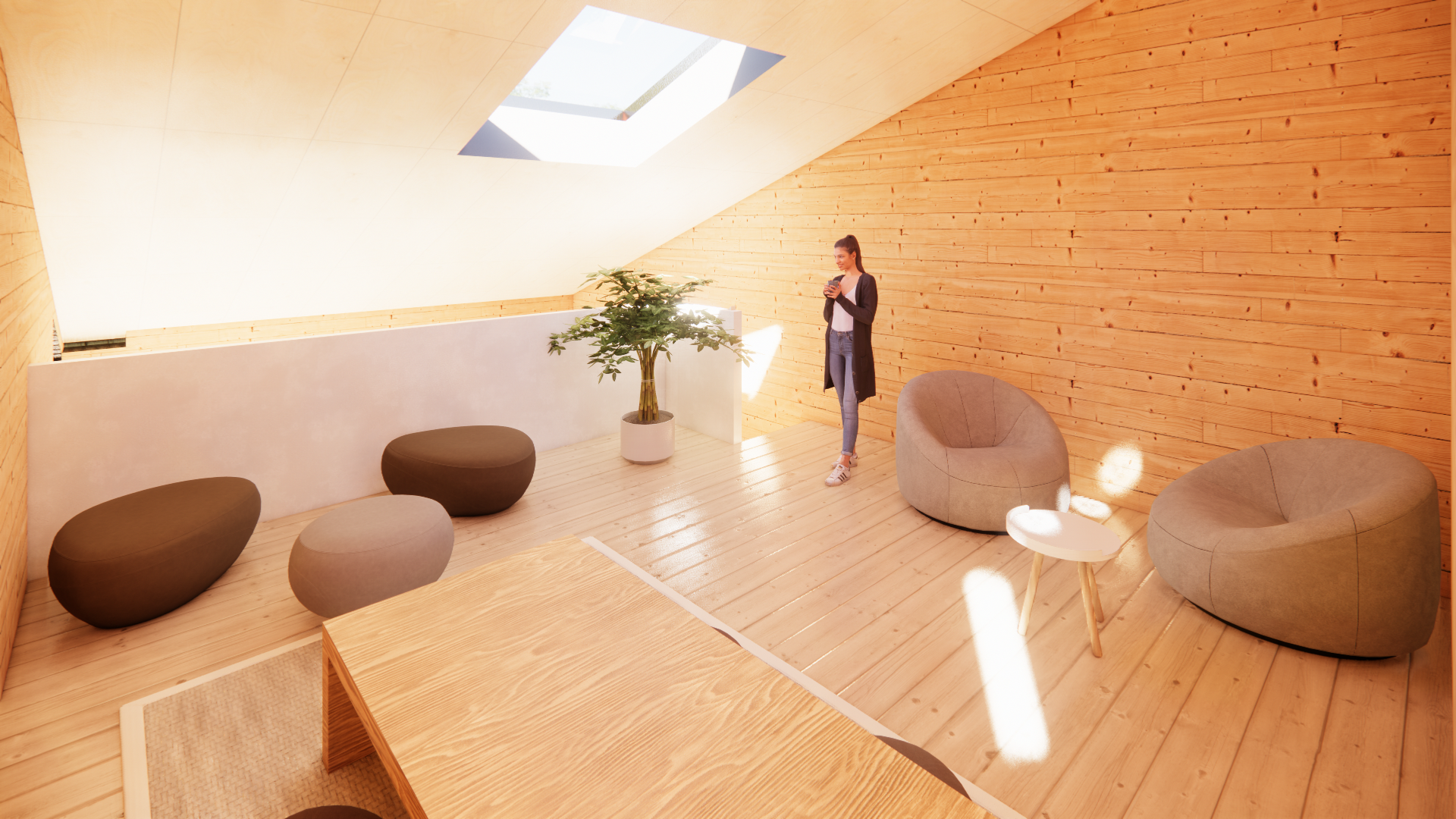
The loft lounge (pictured above and below) brings in ample light while creating a calming place to relax, sketch, and chat.The bar and central seating area was inspired by the idea of a wooden bench that wraps to form both the bar and seating, with a zen-garden with bonsai trees forming the anchor. A window nook with cushions creates place to sketch and relax. The wooden bench that wraps around to form the bar and seating also forms a handy side-table for your tea and books.
A New Environmentally Conscious Condo Building Targeting Passive House Certification
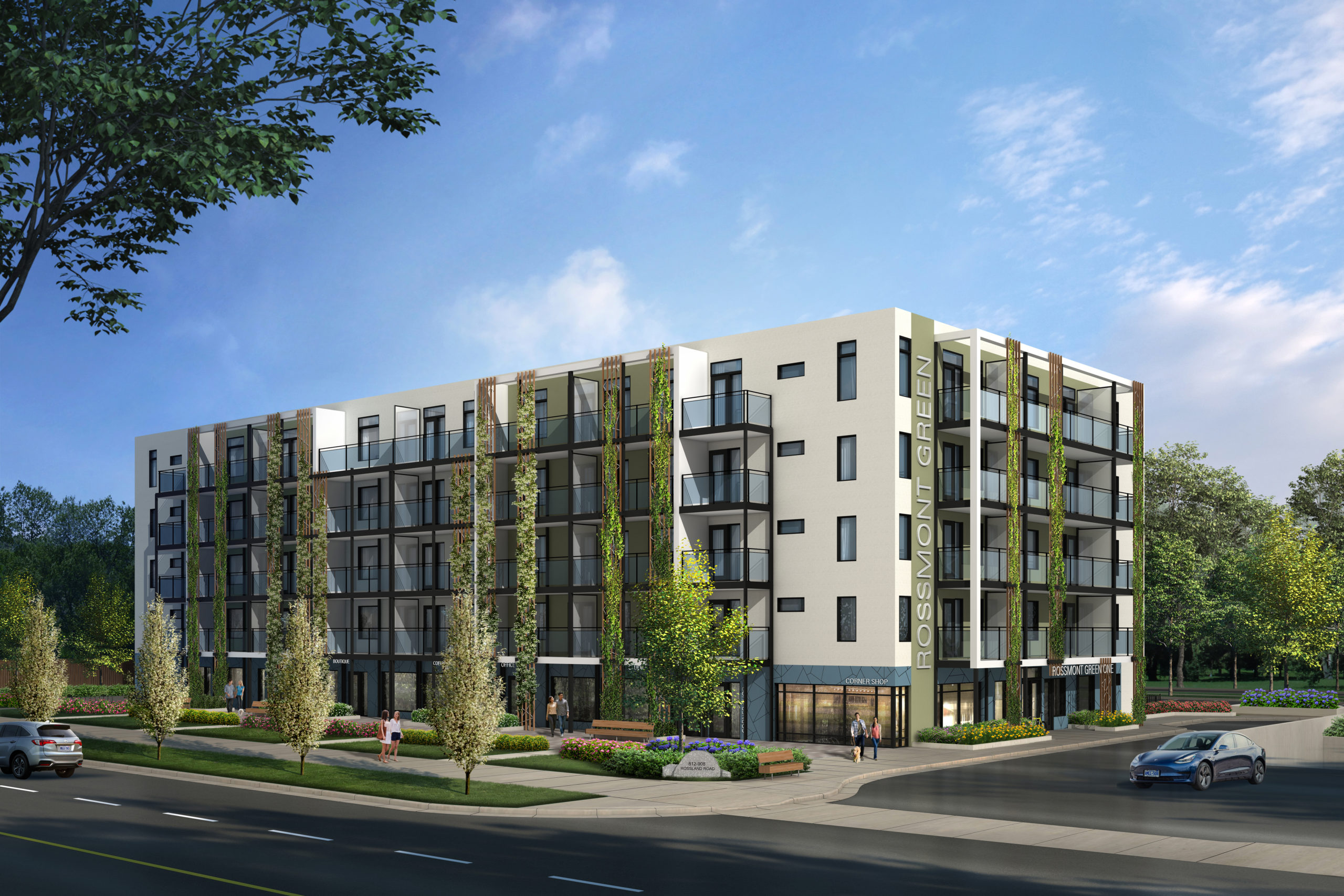
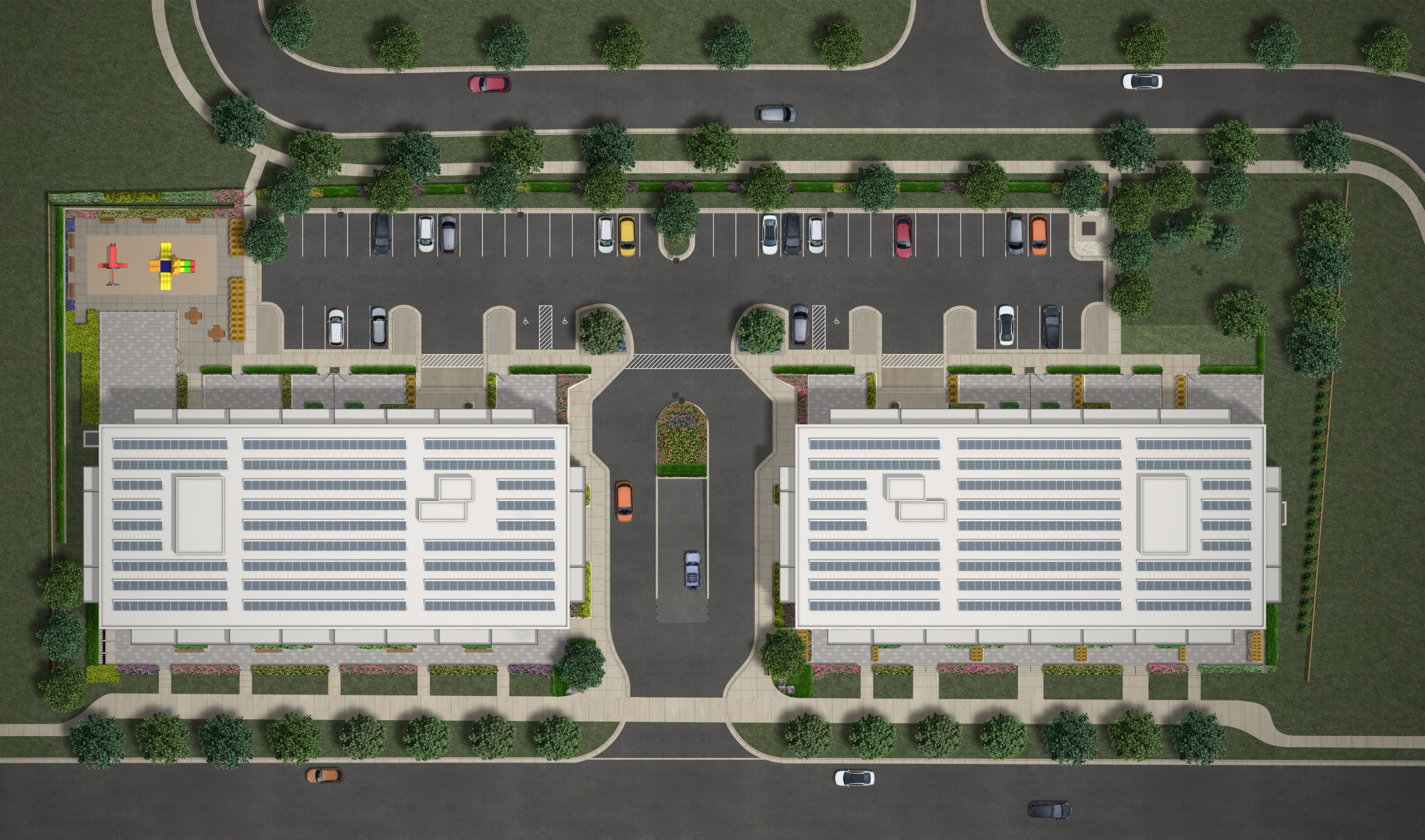
Exterior render of Eco-Joy, the first phase of Rossmont to be built.
Built to achieve the Passive House standards of environmental design, Rossmont condos are setting the bar for what an urban dwelling can and should be in 2022. Eco-concious multi-unit housing!
Rossmont achieves Passive House via a highly energy efficient envelope and windows, air-tight construction, improved air quality and reduced carbon emissions all make for a passive design, while also reducing maintenance and energy bills for the residents.
Residents of the buildings will experience all the features of a “sustainable” and eco-conscious lifestyle without forgoing the conveniences of modern life. The new development includes 1-bedroom 1 den, and 2-bedroom suites that provide all the comforts of home for families and young people. In addition to the private homes, residents will have access to a fitness studio, party room, BBQ area and green space with mature trees. Services available on site include bicycle parking, underground parking, electric vehicle charging station, car wash, pet spa and commercial daycare.
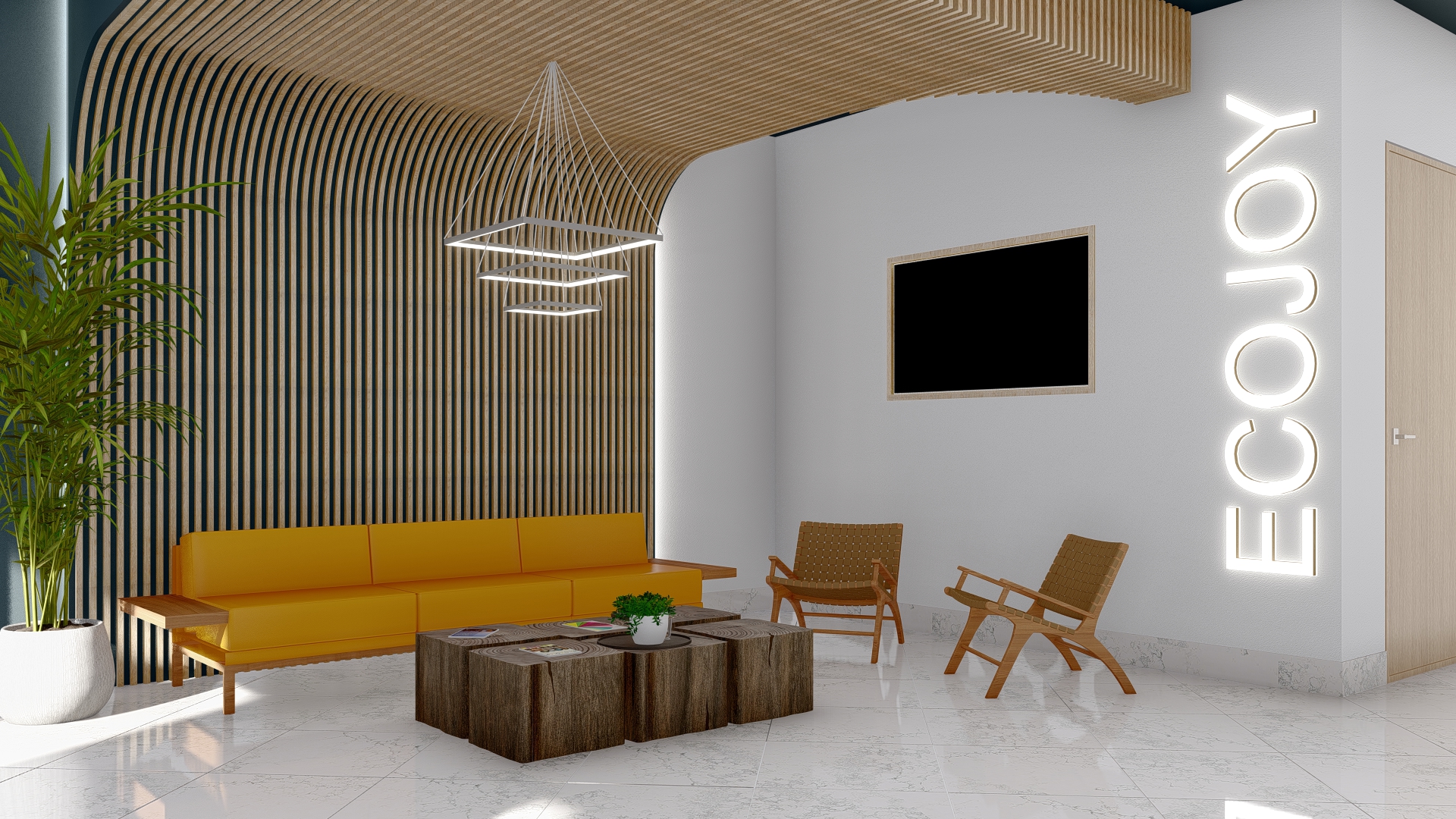
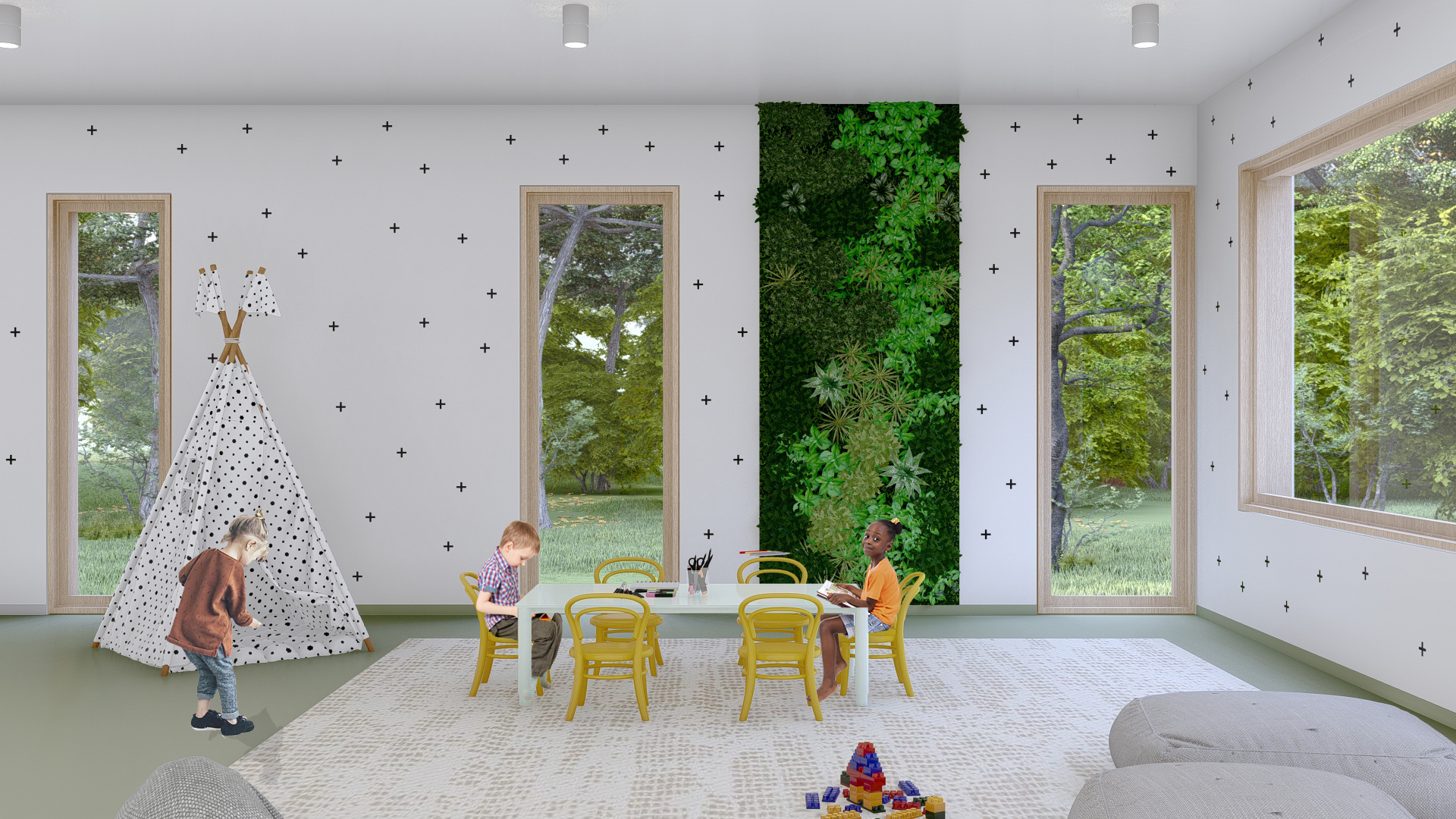
Interior view of the entry area and lobby.The commercial daycare will have plenty of access to the outdoors and natural light with big windows onto the gardens.
The principals of a Passive House design are: a highly insulated envelope, continuous air barrier, lack of thermal bridges, and high-performance glazing. Following these principles can make any condo, multi-unit housing, or even single family residential home into a building that uses very little energy to keep comfortable. A buildings operating energy (the monthly energy use) is far and away the largest contributor to carbon emissions in buildings, therefore a Passive House building can really meaningfully address the climate change targets the world has set.
Sustainability is not about sacrificing comfort, instead it optimizes it and increases it by providing even temperatures, no cool draft, adequate summer shading, and natural ventilation. As Rossmont’s website explains, air-tight barriers not only improve building envelope performance, but control noise pollution between units. Triple glazed windows prevent heat-loss and heat-gain, and offer large amounts of natural light in the suite’s living areas. The thing is, there is a balance between having too many windows and the heat loss in a suite, so we have worked closely to place windows where they are needed, and otherwise we will have very well insulated walls to conserve energy.
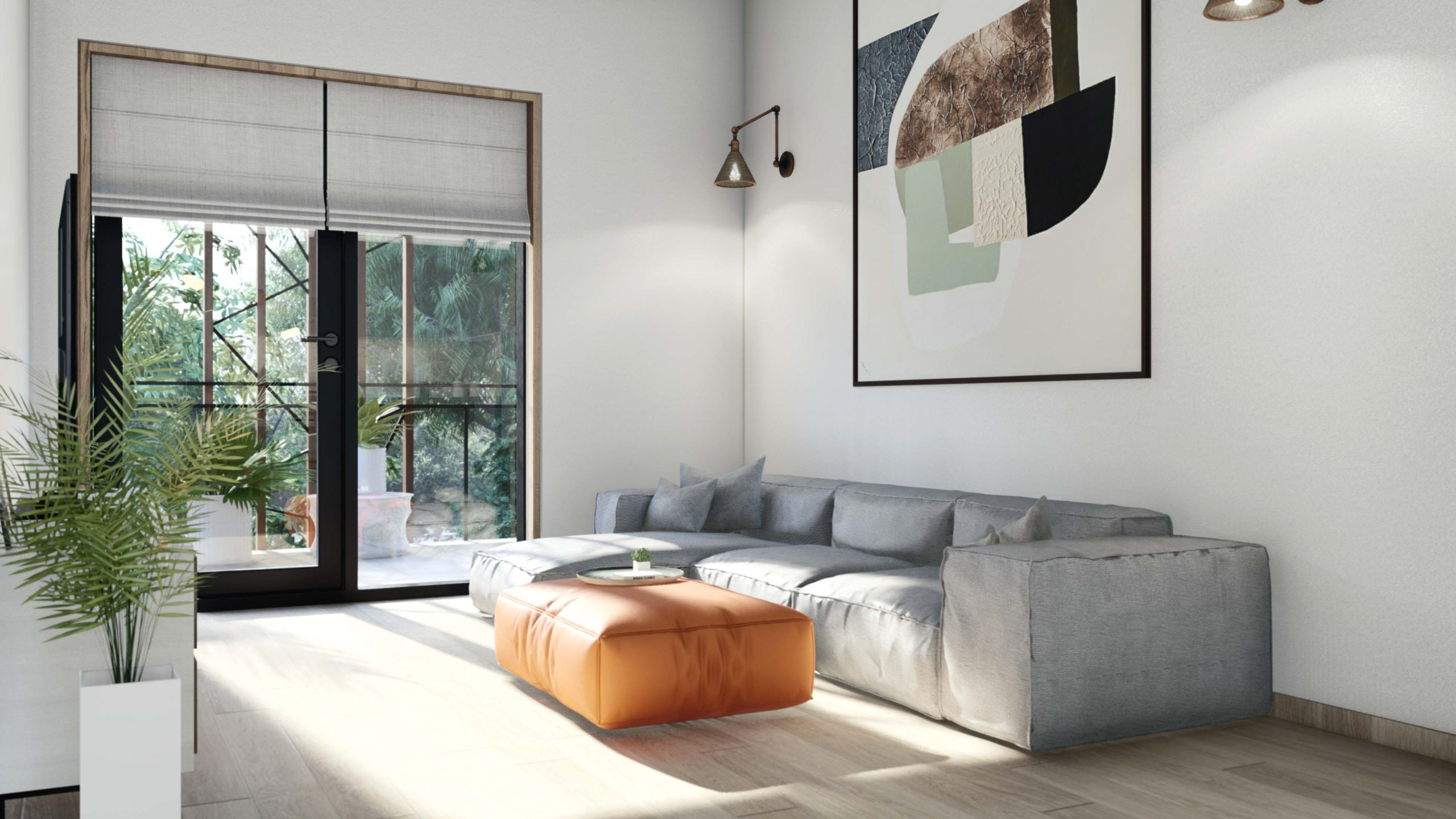
The suites are filled with light, but also use windows wisely to minimize heat loss in winter.
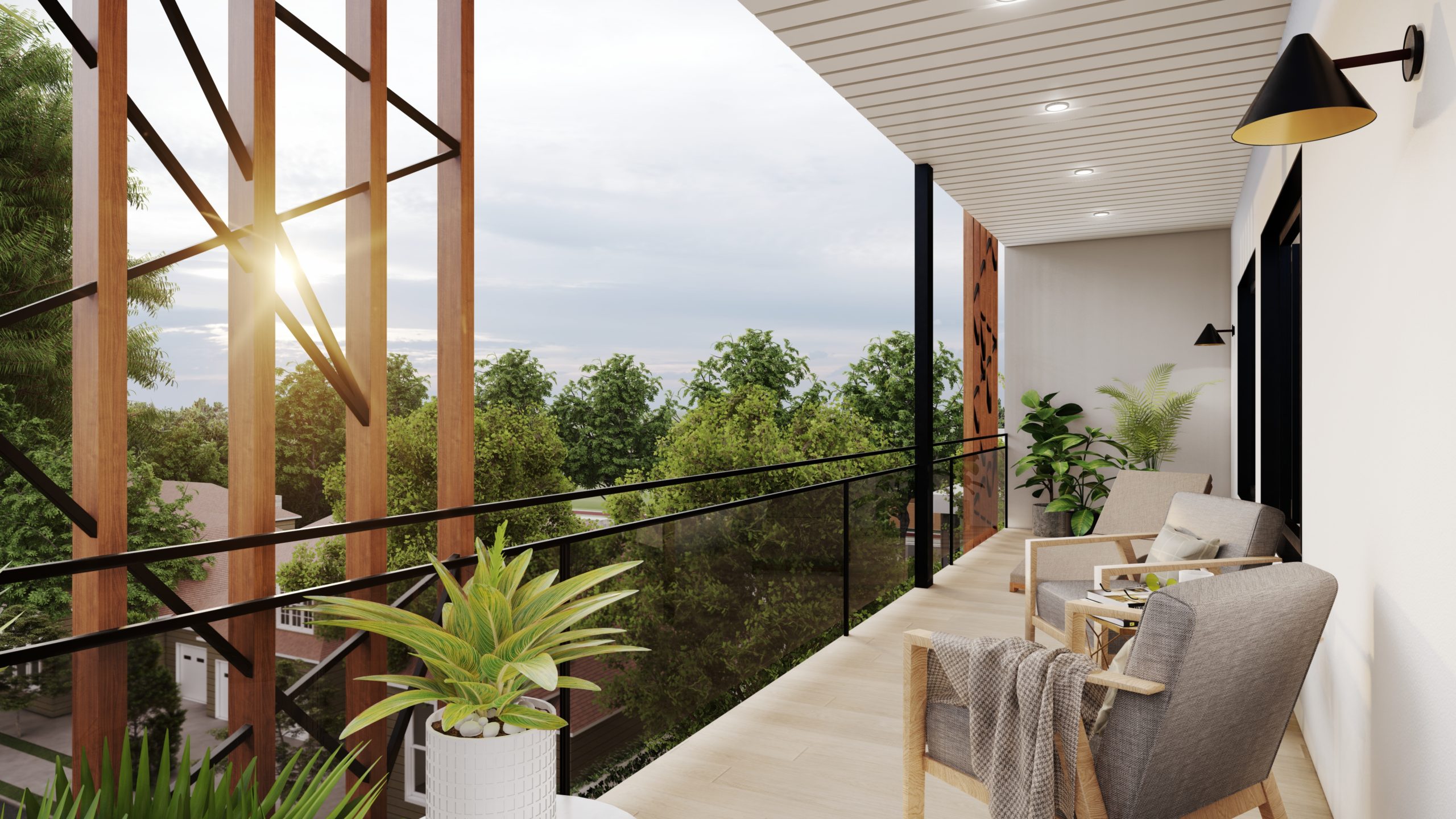
The private balcony’s have wood screens for vines to grow on
For more information, or to register for phase 2 of condo sales, visit https://rossmont.ca/# .
We are excited to announce that a project we have been working on in Prince Edward County is about to begin construction: a high performance rammed earth home. The project is the result of a collaborative integrated design process and exemplifies our goal of working closely with clients and Builders to realize the maximum potential of a project. Construction is about to begin this week, but in the meantime we thought we’d share the latest renderings and views we produced to show the design.
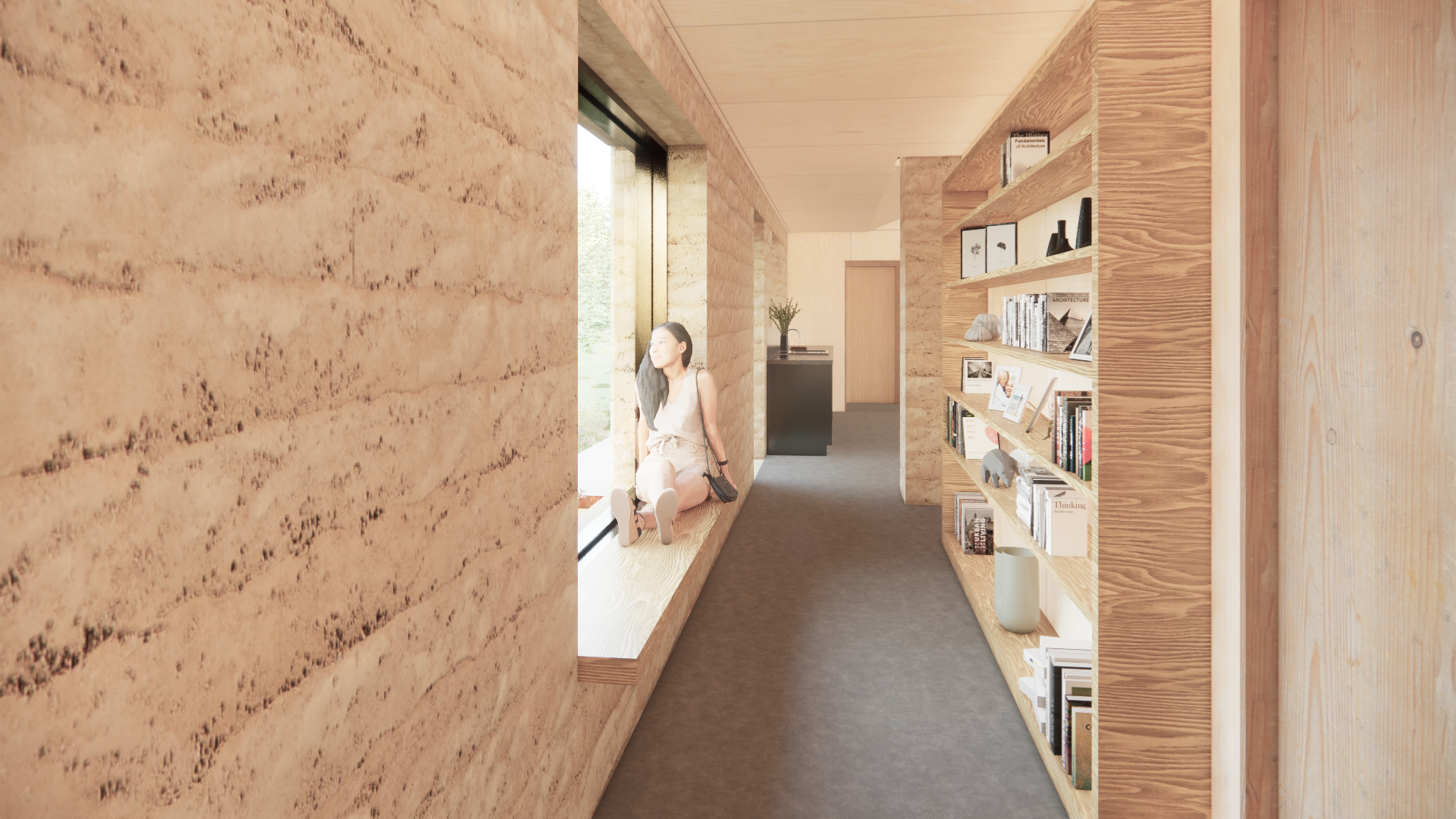
Below is a view of one of our favourite spaces in the project: a reading nook and library with white oak benches and shelves in the hallway leading to the principal bedroom and study’s.
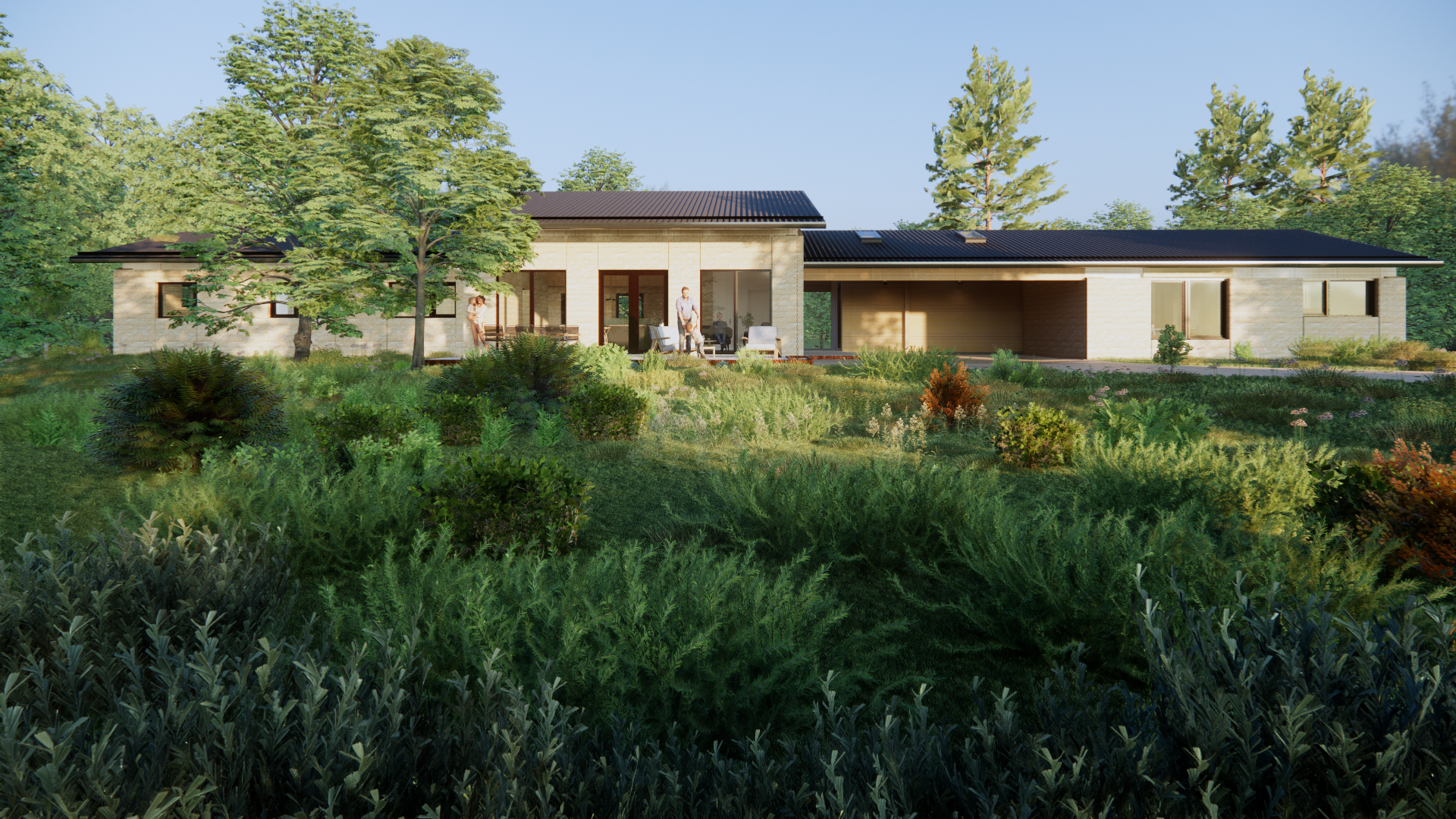
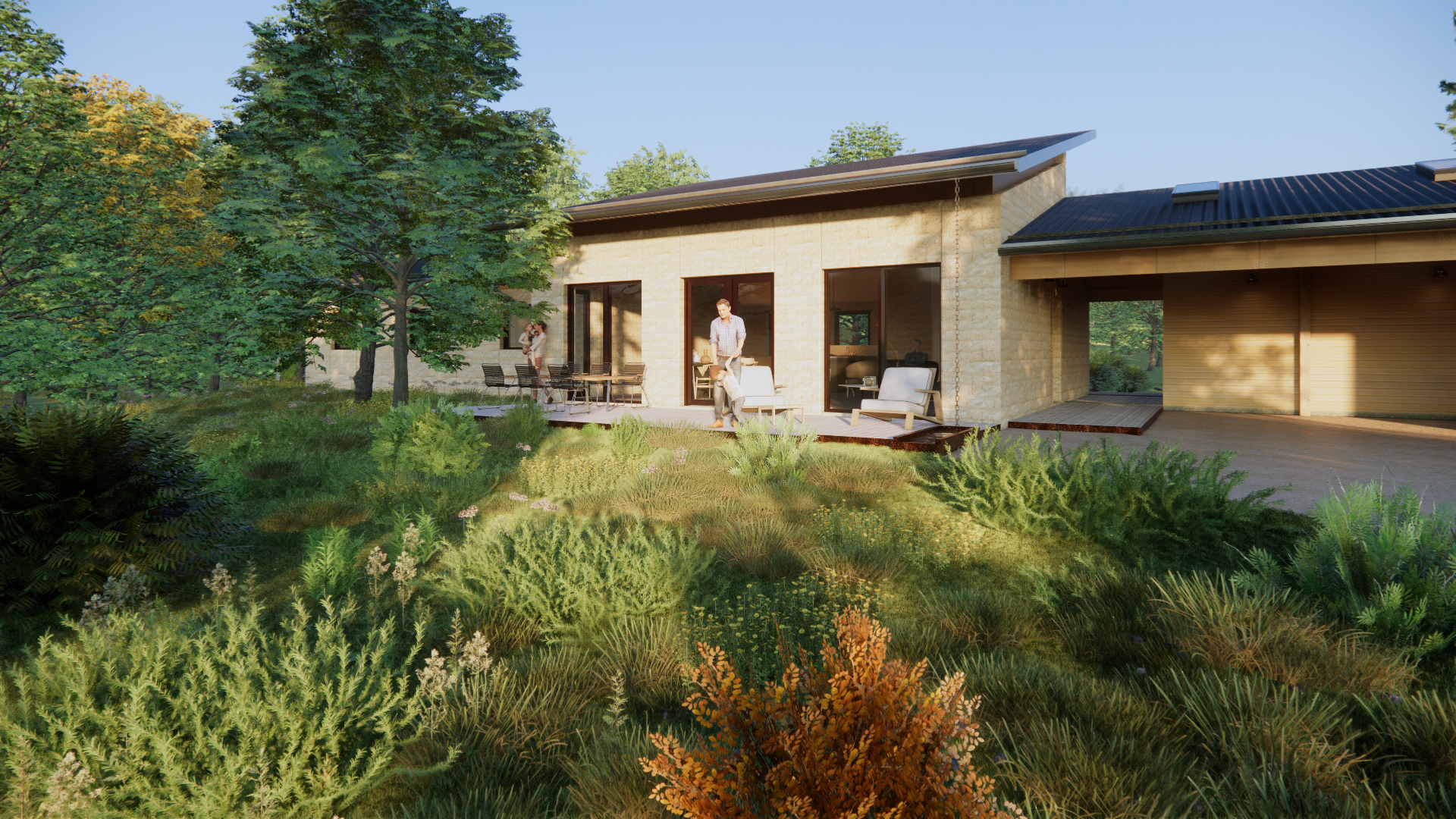
The main house is separated from the guesthouse by a covered breezeway/carport and three-season screened porch. On the south is a perennial herb and flower garden, while on the North is a small fruit fruit and nut tree orchard.
Below is a view of the south-facing front yard showing the main and guesthouses, connected via a covered breezeway, carport and three-season porch. In the foreground you can see the perennial kitchen garden.
The massing and design of the home was inspired by the site (topography, sun and wind direction), the client goals, as well as the ancient stone structures such as from Tiwanaku.
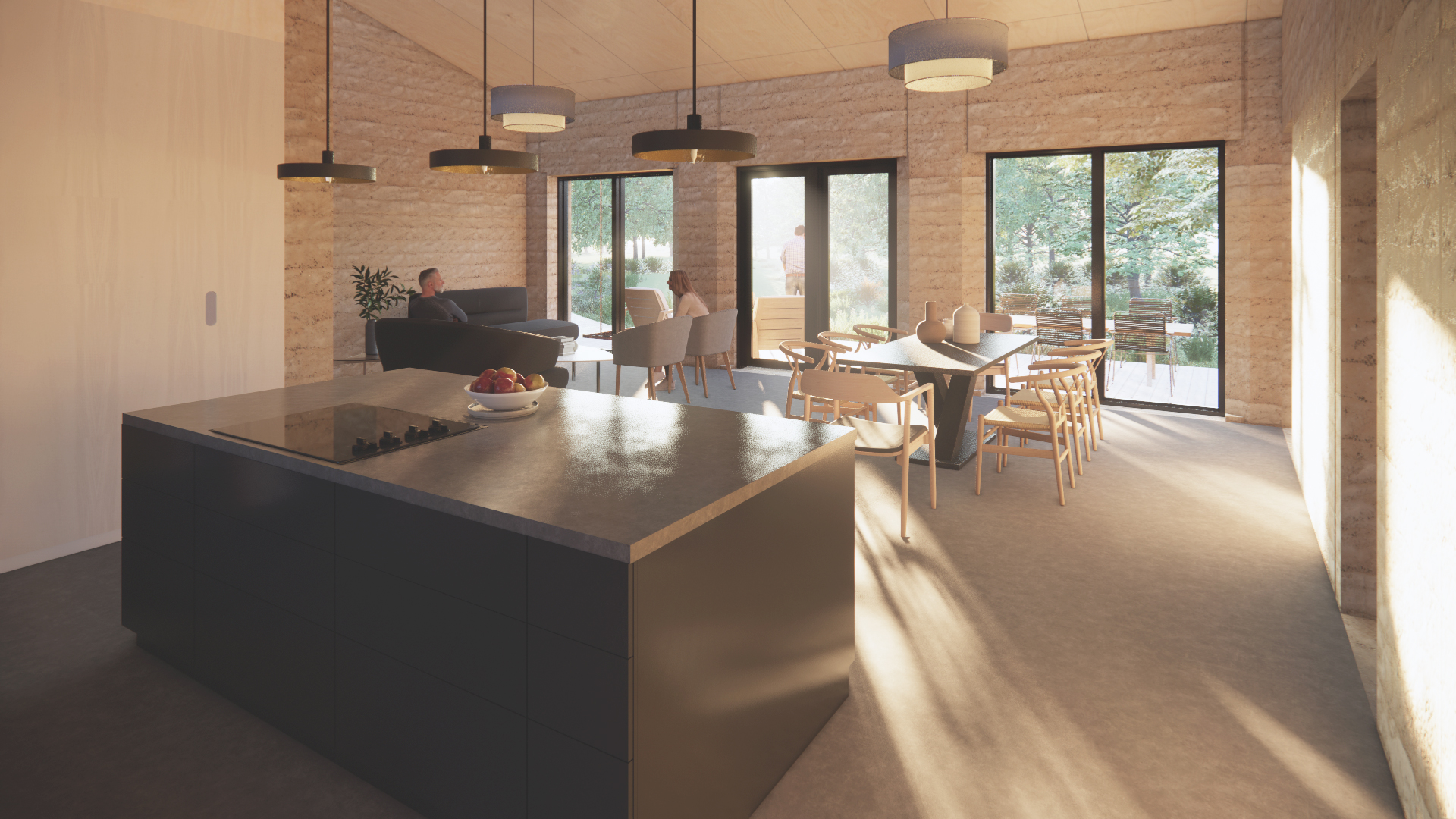
The project is constructed from stabilized rammed earth in variegated light cream colors, and shaped to harvest the sun in winter/fall and shelter the building in the summer from the hot sun. A feeling of massive-ness from the rammed earth walls is offset by plentiful sunlight from windows, skylights, and clerestory’s.
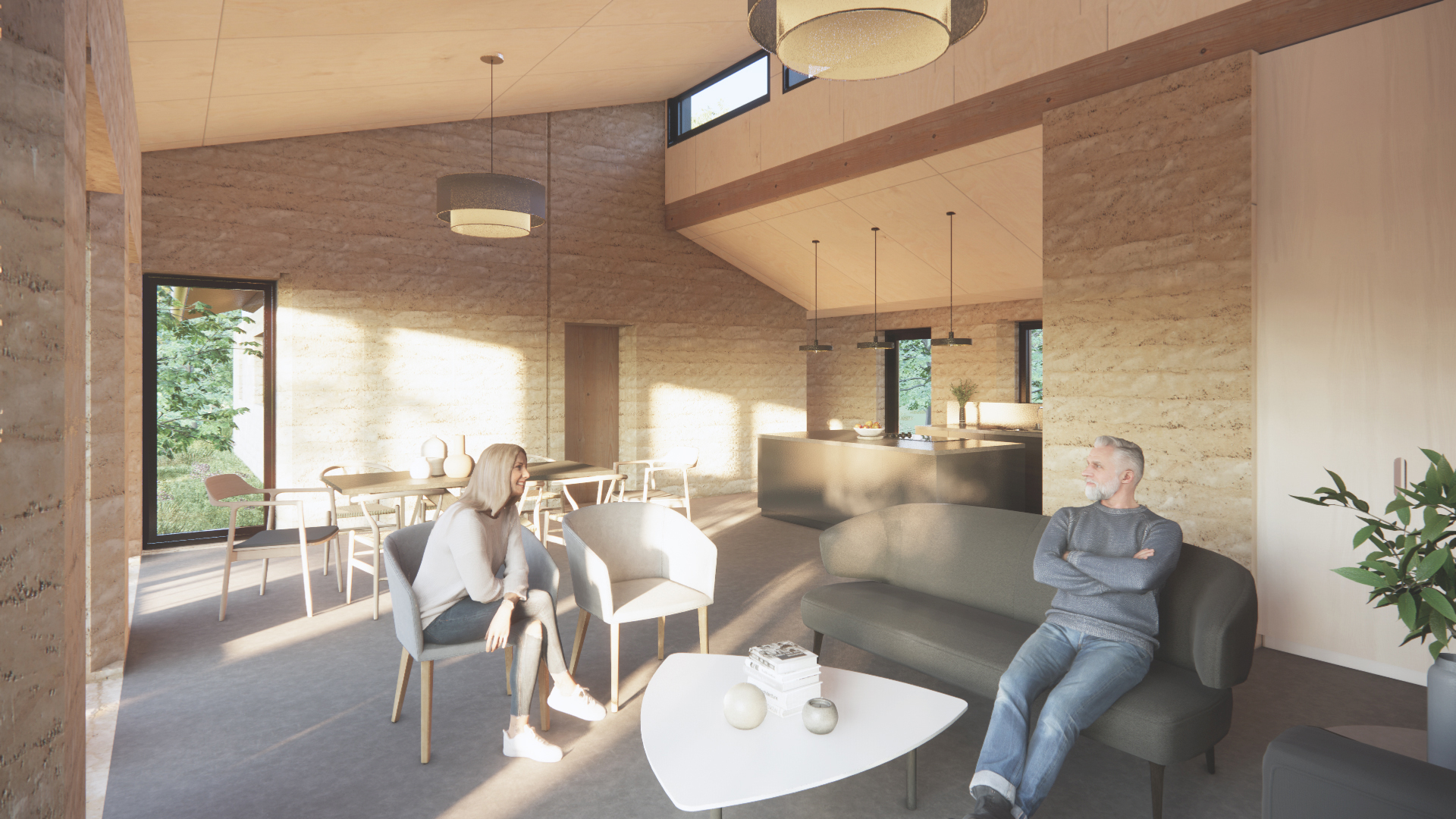
The main living, dining and kitchen area features a wrap-around window on the south-facing wall with subtle chamfers and reveals in the rammer earth walls to evoke the feeling of massive stone blocks and create a rich-palette of light-effects and shades.
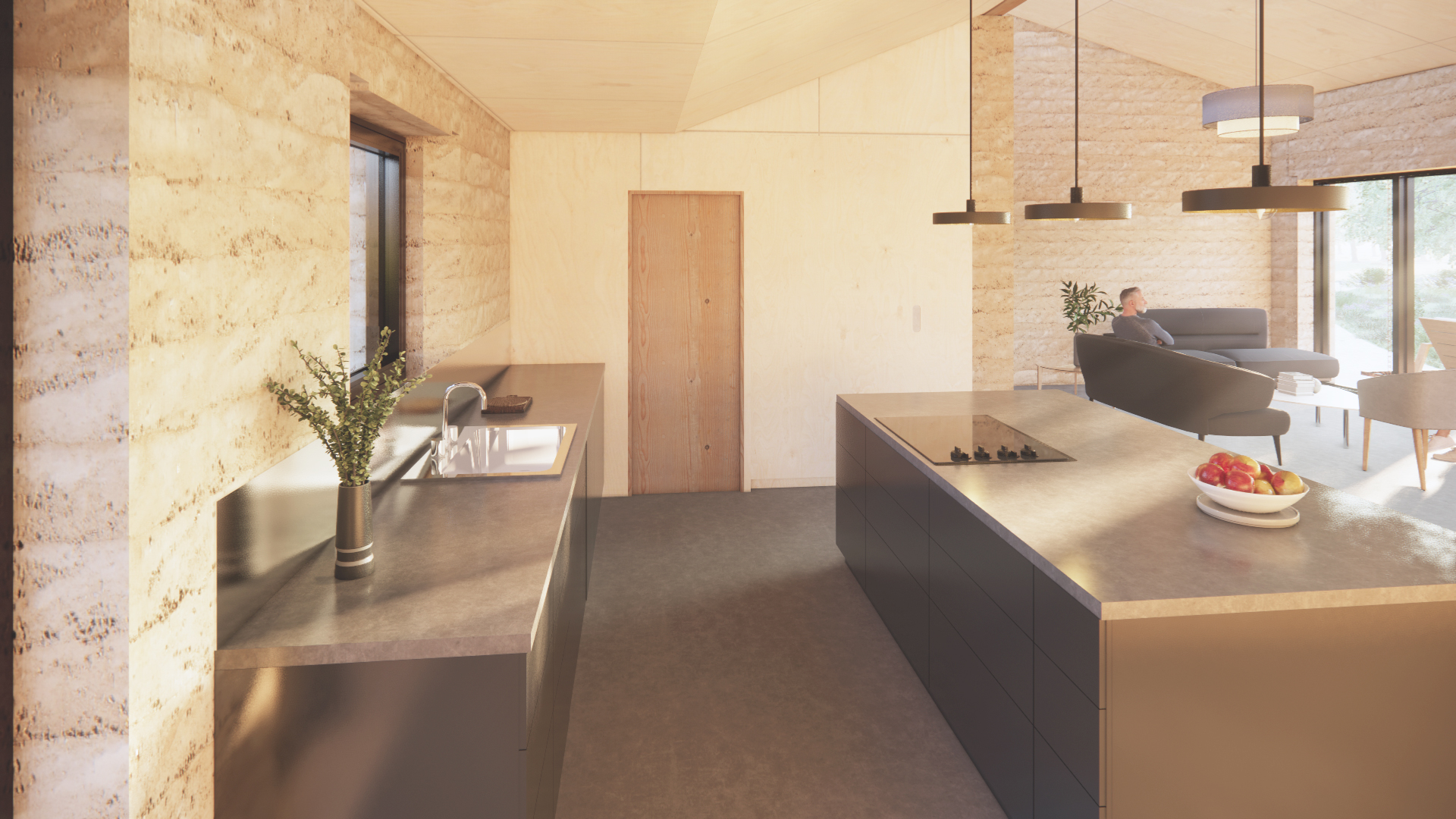
In the view below you can see the the kitchen has a clean and simple design without upper cabinets. The pantry is located behind the wooden door in the background. Because the one of the clients is a chef and foodie, the kitchen is structured to allow for hosting parties and events.
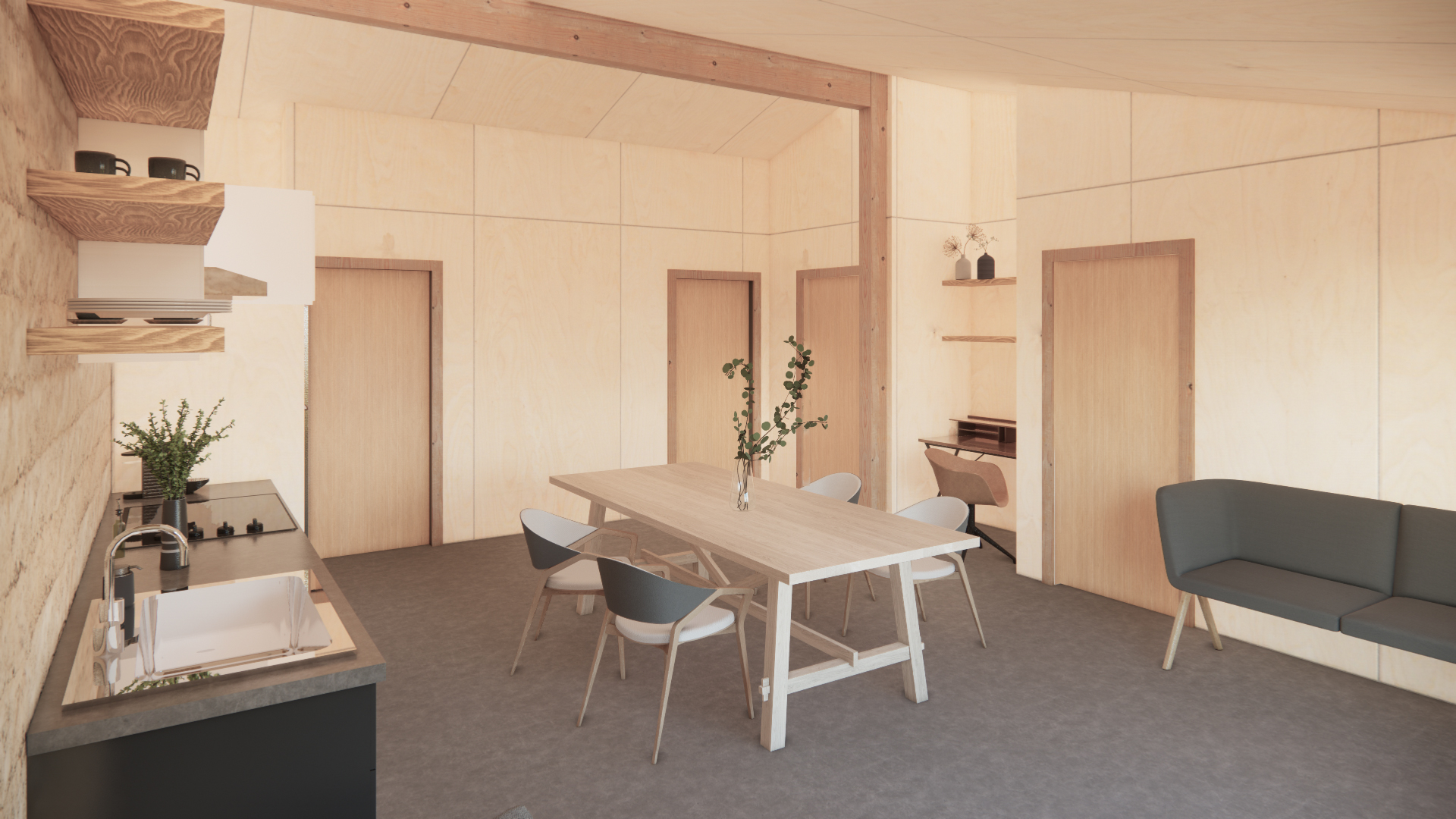
Below you can see a view the living area of the guesthouse, which has rammed earth exterior walls and white oak paneling for the interior walls. The colour palette throughout was inspired by the designs of the Nordic Minimalists found in Sweden and Denmark, who evoke the beauty of simple materials in a calming and minimalist way.
Rammed earth is an extremely durable material, with a lifespan in excess of 200 years. It has a low embodied energy, non-toxic materials, a high thermal mass, and an extremely beautiful and customizable appearance.
We are using made-to-order pre-fabricated roof panels with cellulose insulation that will be craned into place for the roof. The cathedral ceilings on the interior will be clad in white-oak, and the roofing will be dark coloured corrugated metal roofing. One innovative aspect of this project is the use of a plywood slab-on-grade (i.e concrete-free slab) which allows us to lower the projects embodied carbon by avoiding the need for a concrete slab on grade.
The integrated team approach we used on this project lead to a very efficient and timely design and permitting process. Permits where issued and Construction began 1 year after the project was first started, and construction is expected to be completed in one year.
A final note on Rammed Earth, and the future!
For the last few decades stabilized rammed earth has been considered more expensive then traditional wood frame construction. However in the last few months we have noticed a very interesting trend: in light of the COVID pandemic and rising inflation/supply chain issues, rammed earth construction in Ontario is now coming-in nearly on-par with traditional wood frame construction in terms of cost. Because Rammed Earth construction also includes the finishes on the interior and exterior of the project’s main walls, there are numerous cost savings, in terms of not needing paint, interior wallboarding, exterior cladding systems, and the associated Trades and labour. There is also the benefit of simplified supply chains and locally sourced materials.
It is interesting that a building construction solution, Rammed Earth, that is low in embodied carbon, high in durability and beauty, with high thermal mass, and no harmful chemicals, is on par cost-wise with the traditional market standard wood frame home (which lacks most of the aforementioned qualities). If this cost trend holds up, you can expect to see a lot more rammed earth homes getting built in the coming years. Based on the beauty and potential of rammed earth we are very excited to incorporate it into future projects.
If you are interested in having a discussion about how Rammed Earth might be appropriate for your project, feel free to connect with us via email or phone and we can schedule a free consultation.
A Co-signed Letter to the Ontario Association of Architects Housing Affordability Task Force
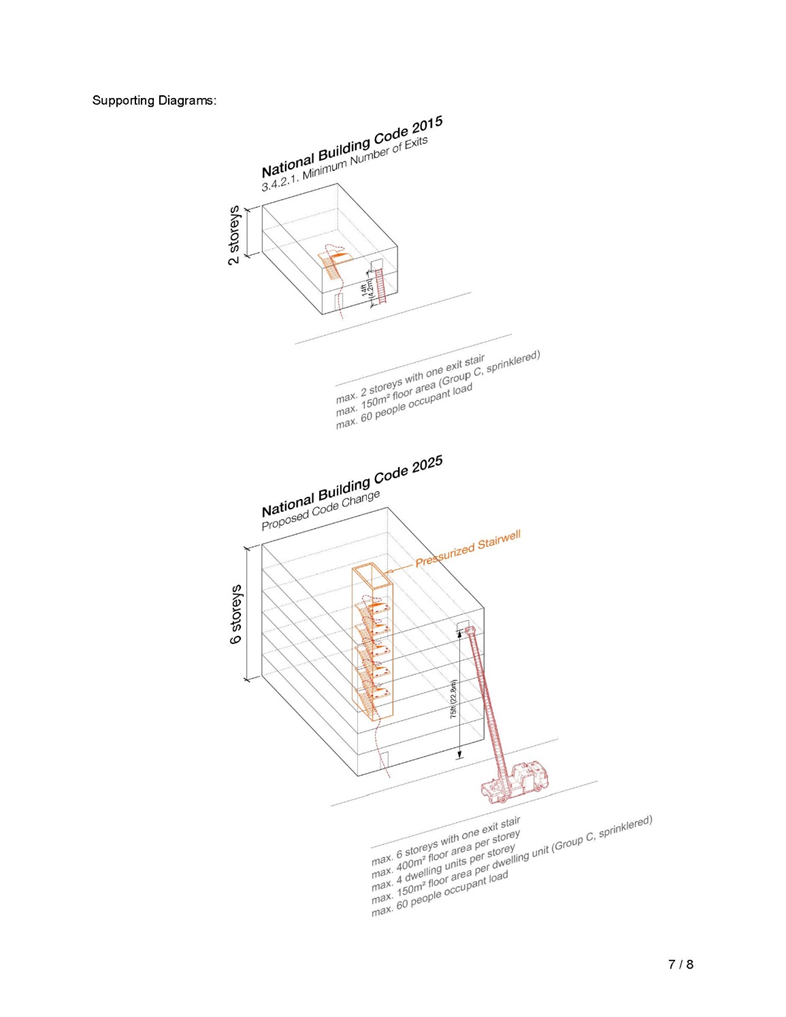
Ontario architects have come together to write an open letter requesting an update to the building code. They ask that the Canadian Commission on Building and Fire Codes permit a single egress stair for residential buildings up to six storeys.
The proposed change would create the “missing middle” low- to mid-rise housing that many Ontario cities are lacking today. These new buildings would include a limit of four dwelling units per floor and sprinklers as an active fire protection measure. Additional safety requirements of fire separation and positive pressurization in the stairwell would be comparable to other modern design solutions in the rest of the world.
Updating the code to create this missing typology would enable more sustainable urban development by densifying in a way that is attractive, affordable and has low embodied carbon. Adding more of these missing dwellings to our cities will balance the housing supply and ameliorate the Ontario housing crisis.
Diagram illustrating proposed changes to the building code.
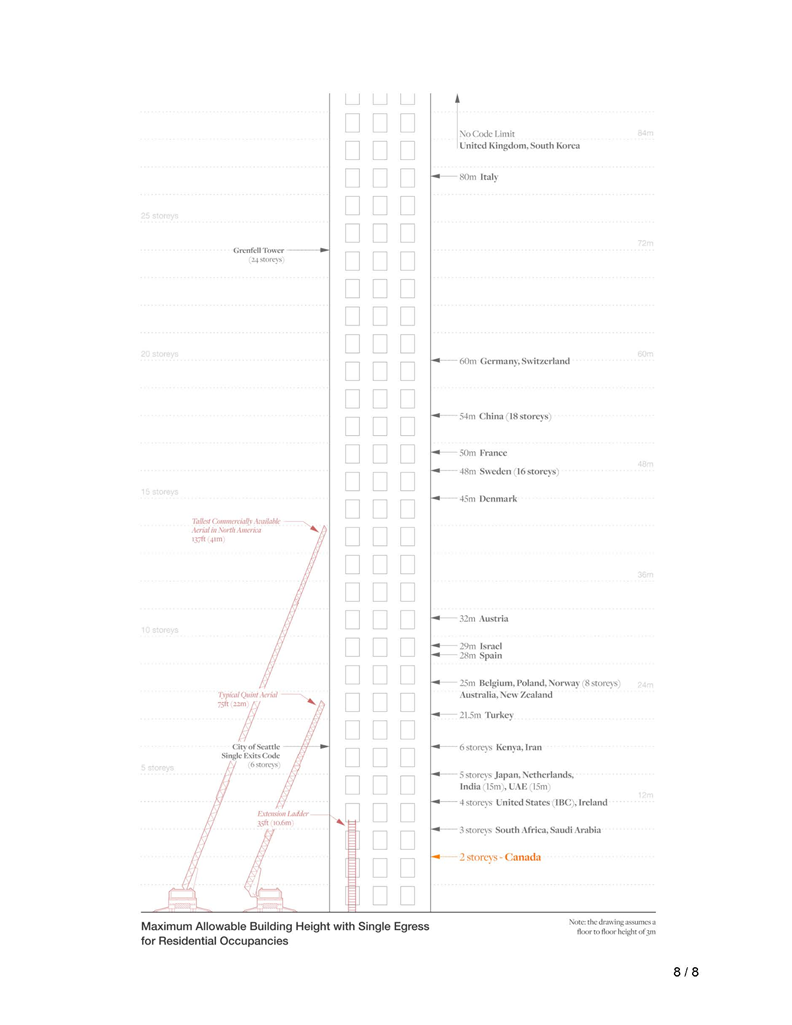
From the 2008 Senez Reed Calder report on the origins of Canada’s building code, the authors noted that the First Edition of the code was based on 1941 US building standards. They also concluded that today’s limits on building area and height were based on the capability of fire services in the early 1900’s. Much has changed in our construction practice and emergency response since that time, but the building code has not kept up with these differences. The requirement for 2 means of egress is one such practice that remains unchanged.
Number of storeys permissible with single exit stair around the world.
The proposed code change is comparable to codes in the US. The US building code permits buildings up to 4 storeys with single exit stairs. The city of Seattle which uses similar methods of wood construction permits six. These rules are quite stringent compared to other codes around the world, of which Canada is the most restrictive.
For more information, please read the supporting documentation included at the bottom of the open letter.