The following editorial was written by Sheena Sharp on February 18th:
Should Canada have an Indigenous Governor General?
As a representative of the Queen?
I have never been an advocate of getting rid of the Queen as our head of state, NOT because of tradition, but because the rest of the system works fairly well (except for first past the post), and so if the Queen was not here, we’d have to invent her, and I think we have other things to do. However, one of those other things is reconciliation.
Not for this GG appointment, but for the next, maybe we should have an indigenous GG, because the GG should be symbolic of the treaty relationship. Maybe all GGs should be indigenous. Maybe not under the current treaty relationship, but under a renewed one.
And about the land. Pretty soon, it may hit collective Canadian consciousness that green house gas emissions are not the only thing that will make the planet uninhabitable to humans: the complete destruction of the natural systems, particularly forest systems, will also independently kill us. And indigenous culture has practical guidance on this.
All Canadians have a shared interest in protecting the land while making a living. And we should start thinking about that.
Construction of the City of Toronto’s new Net-Zero Energy Childcare centre in Mount Dennis is well under way. Right now the contractors are in the ground working on the foundations and basement slabs and it seems like a good time to share a selection of photos showing progress over the last month.
In this photo you can see the foundation being prepared with insulation, as well as the shoring to hold up the surrounding earth. The light-cream panels are the formwork they are erecting to pour the foundation walls. Weston Road is in the background.
Here you can see the formwork for the column’s concrete footing in the basement. Of special note here is the multi-layers of high-compressive strength insulation we are placing BELOW the column footing. In “traditional” construction the footings are not insulated, but because we are targeting Net Zero Energy, we need to minimize all thermal bridges! Sub-footing insulation is something we expect to see a lot more of in the coming years, as it becomes standard practice.Here you can see the four-layers of insulation we have under the basement slab. This works out to an insulative value of almost R-32! We prefer to avoid using EPS-type insulation due to the high Global Warming Potential of the Blowing Agent’s used in their production, but sometimes in sub-grade applications the material qualities of EPS really make it the preferred material. We’d love to move towards alternate insulations for sub-grade, but this will require a lot more testing from manufacturers and suppliers. You can learn more about insulations Global Warming Potential in a blog post we did a while back. Here is a close-up view showing the sub-slab insulation for the basement. Here is a close-up of the foundation walls insulation. You can see how the joints are staggered. Right now the insulation is just dry-fit into place, but will be removed and a waterproof barrier will be added to the outside of the foundation wall. Here you can see the shoring, insulation for below the basement slab, as well as the waterproofing layer for elevator pit.An overall shot of the excavation from a few weeks ago, showing the neighbourhood in the background.
We have been visiting the Mariposa House Hospice over these last few months as construction progresses, and wanted to share a few of the pictures as it near completion.
While COVID did create some delays and difficulties for the team, everyone has pulled together to realize this very important project.
A hospice is almost like a mini-hospital, but we wanted to make this hospice evoke the feeling and proportions of a home or cottage, as opposed to an institutional building or hospital, so that patients and family-visitors would feel welcome.
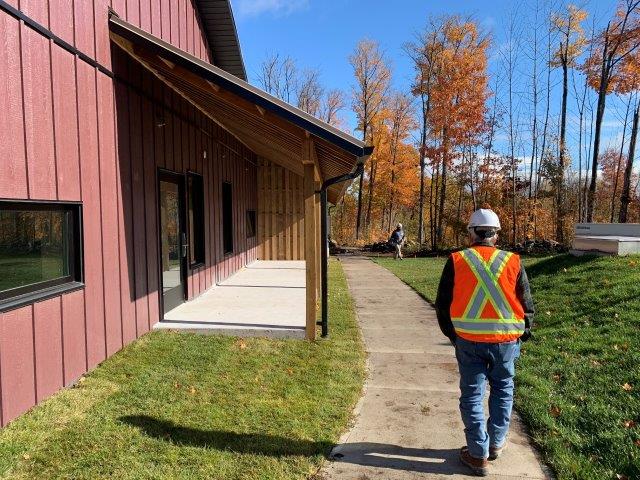
View down the South side of the Mariposa House Hospice showing the staff outdoor patio, grass berm, and concrete path to the rain garden and hiking trails through the property.
A view looking at the South-corner of the building, showing the staff office area with their patio and the grass berm. You can also see the steel butterfly just under the gable-end eaves, which is the logo for the Mariposa House Hospice.
Further south, you can see in-progress views of the patients rooms on the left. Each room has it’s own private porch with a door of suitable width that patients beds can be rolled onto the patio. They will have a view of the forests, and meadow . The glass railing need to be installed, and the dirt seeded with wildflowers as part of the wildflower meadow. The raingarden is just visible at the very end of the building. Eventually the Hospice plans for four-bed additional patient rooms at the rear of the building.
The clients wanted a large parking lot to host all of the cars for large events and gatherings. The rainwater run-off from the parking lot is directed to a naturalized swale and then to a raingarden, so the water is absorbed on-site. In front of the building there will be a garden hedge of forsythia, daylily, wildrose, juniper bushes, and other plants to help soften the transition.
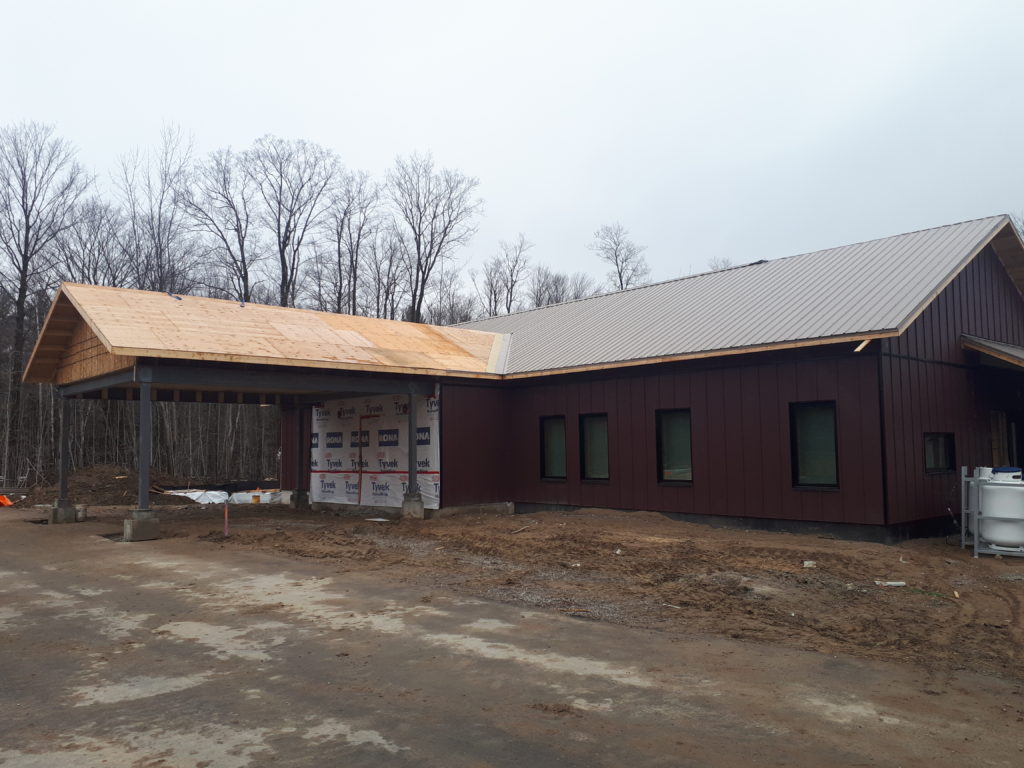
Another view of the front, showing the grass berm, as well as covered entry porch for vehicles and ambulances to access the entry under shelter. In front of the entry porch there is a garden with birch trees, Japanese maple, and other hedges and benches to create a moment of transition and place of reflection for those coming to, or leaving, the hospice. From this view you can see how we designed the building to look like a home or cottage, with traditional pitched roofs, and board-and-batten siding. It is a large institutional building, but with the overall massing and design we tried to make it feel residential.
Having the choice of where to spend the last days of life is a valuable consideration for many of those in palliative care. Hospitals often lack the comfort of a patient’s own home and yet, homes lack the support and ready assistance that a hospital provides. As the first compassionate care home in Orillia, the Mariposa House Hospice will offer 5 residential beds for its residents to receive assistance and support for their last days in a space that feels much like home.
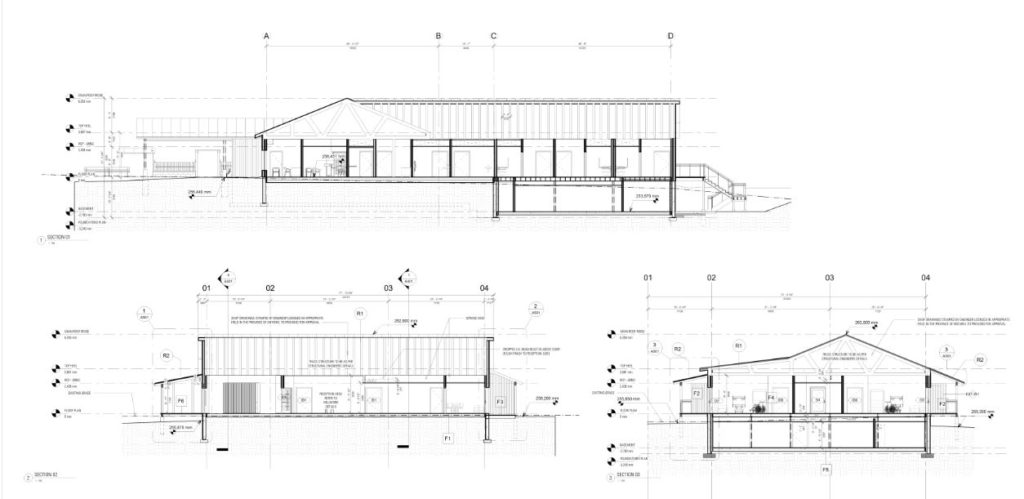
The design was inspired by proportions and shape of traditional Ontario houses and cottages. The aim is to provide a feeling of comfort and evoke memories of past experiences and places. Features such as the “saltbox house” roofline, verandas, materials such as wood and stone, as well as careful massing, assist in evoking those memories. We sought to ensure the building fits within its surroundings while providing privacy to residents and visitors. The building itself is designed to be warm, comfortable, and inviting for residents, visitors, and staff using carefully designed building systems.
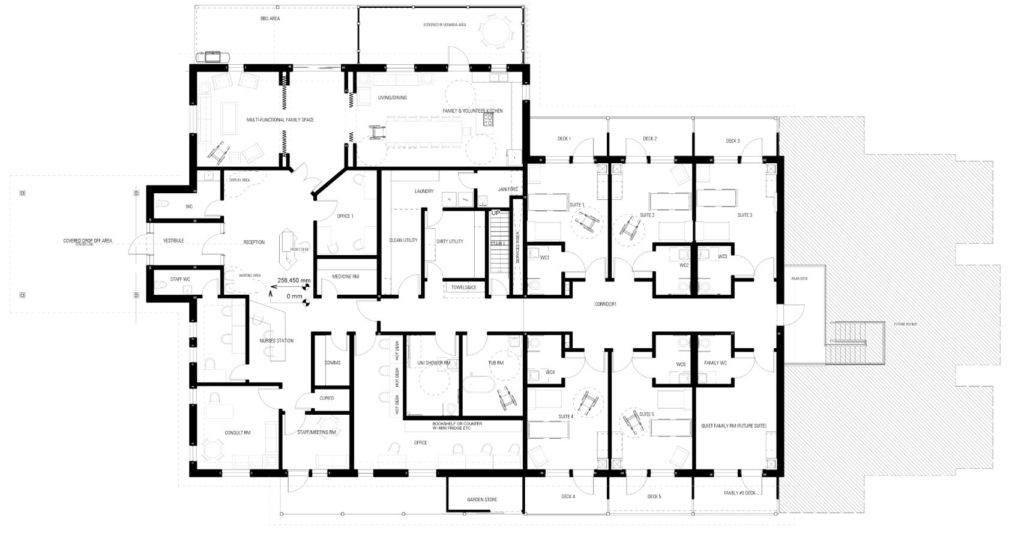
Visitors and Residents are first welcomed to the Hospice from the parking area by a Memorial Garden with benches and seating before passing into the covered entry area. Once inside, they are greeted in the foyer by a reception and gallery space. To their left is the combined Living, Family, Dining, and Kitchen area which includes movable partitions to create more private spaces as required. There is also a large dining table here to allow family meals. The large combined room has windows on three sides to bring in light, allow for ventilation, and to give a sense of openness. This area opens onto a covered and enclosed three-season room with further access to a BBQ area and a Herb and Kitchen Garden. The Herb/Kitchen Garden is designed according to Permaculture principles, and includes a raingarden, pergola, herbs, flowers, and fruit trees to provide beauty as well as food and medicine to residents and visitors.
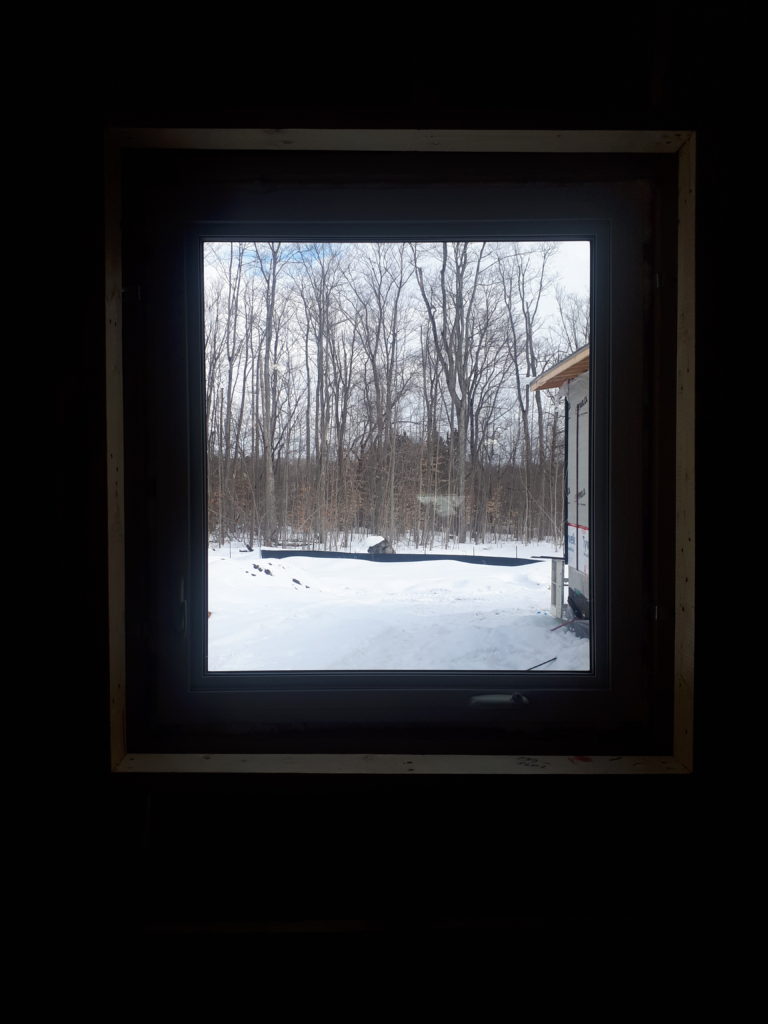
Tracing our steps back to the foyer, Visitors and Residents can pass to the right into the Resident suites area which is designed around a central corridor, or into the consultation, staff, and volunteer rooms. In the corridor leading to the Resident suites, the entry doors are set within niches which allow privacy for Residents while being convenient for staff access and care. At each Resident’s entry door, there is wall sconce lighting that evokes the entrance to a house, providing a sense of comfort and homeliness. Inside each suite, there are large windows looking out into the forest, and a door with access to a covered, private deck for Residents to enjoy the outdoors.
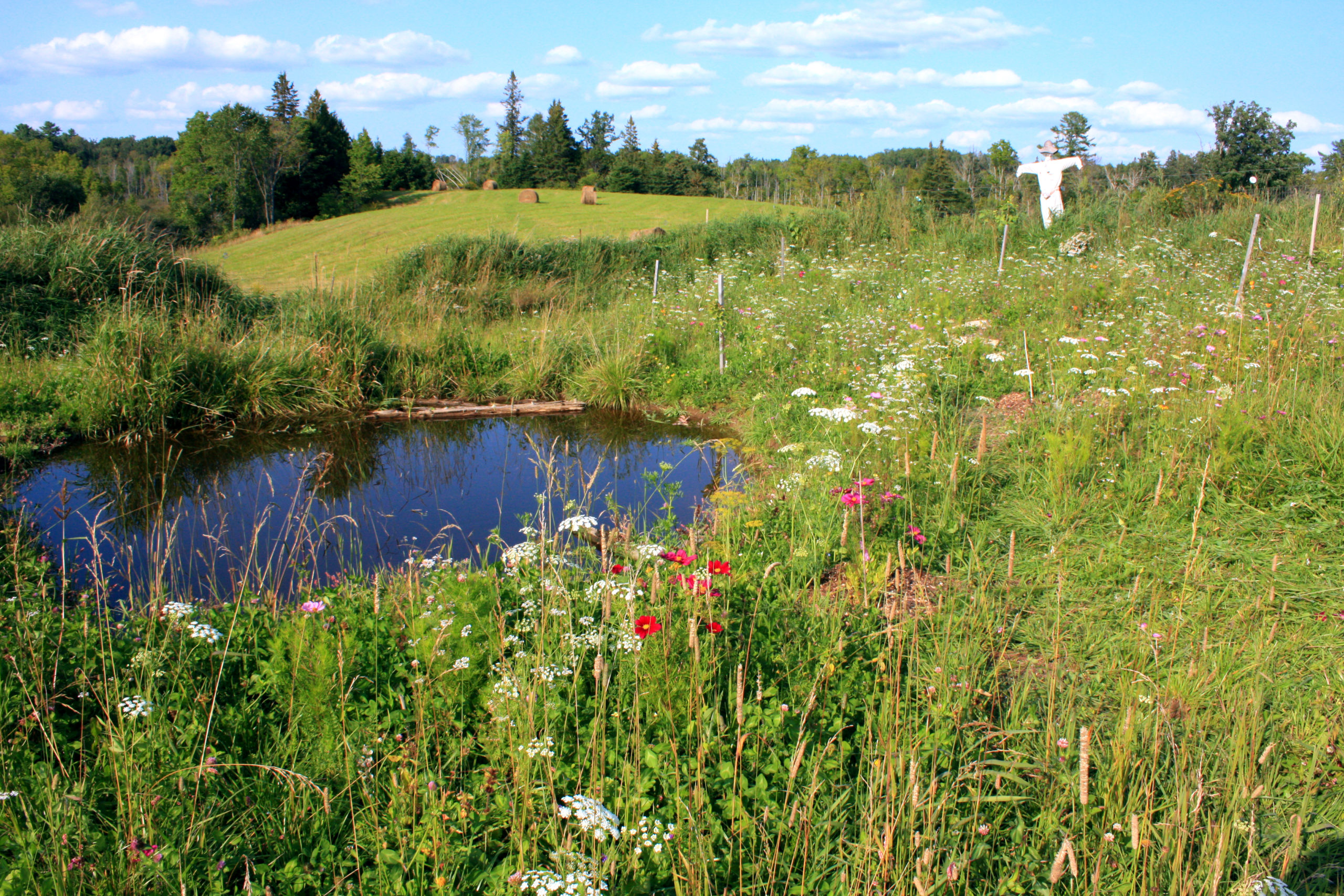
Exterior paths wind through the rear forested area for visitors and family members to enjoy the scenery. A large Rain Garden to the north with rock piles provides areas for diverse wildlife and represents a method of infiltrating stormwater. Benches are sprinkled along the paths in the forest for relaxing and contemplating.
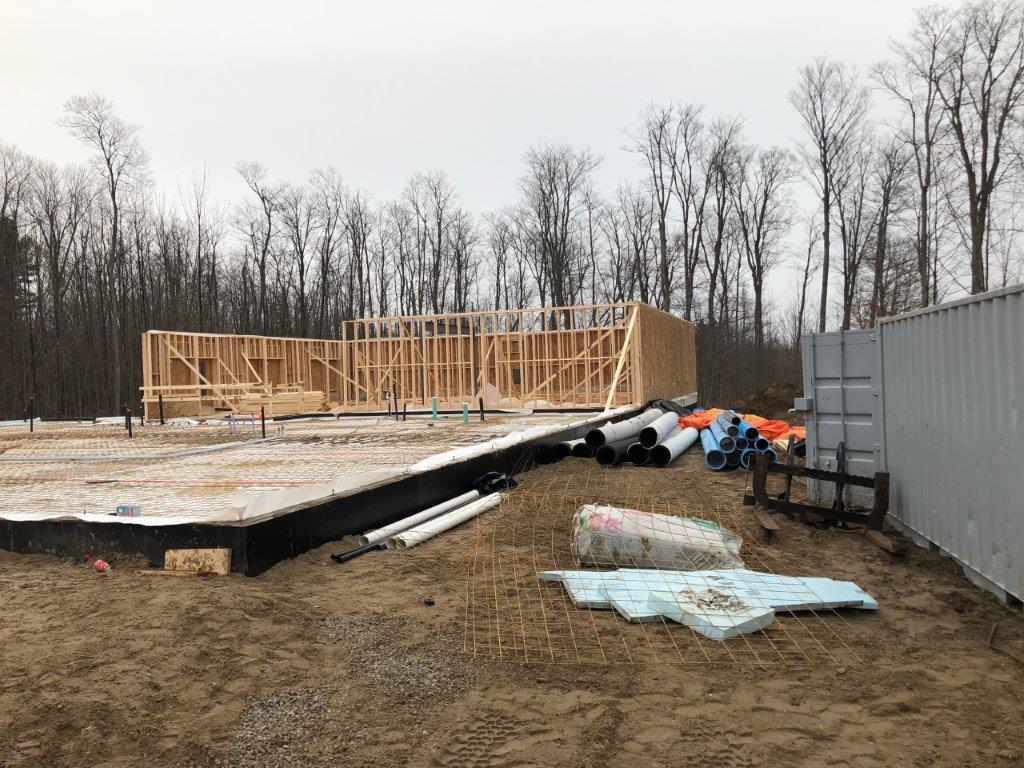
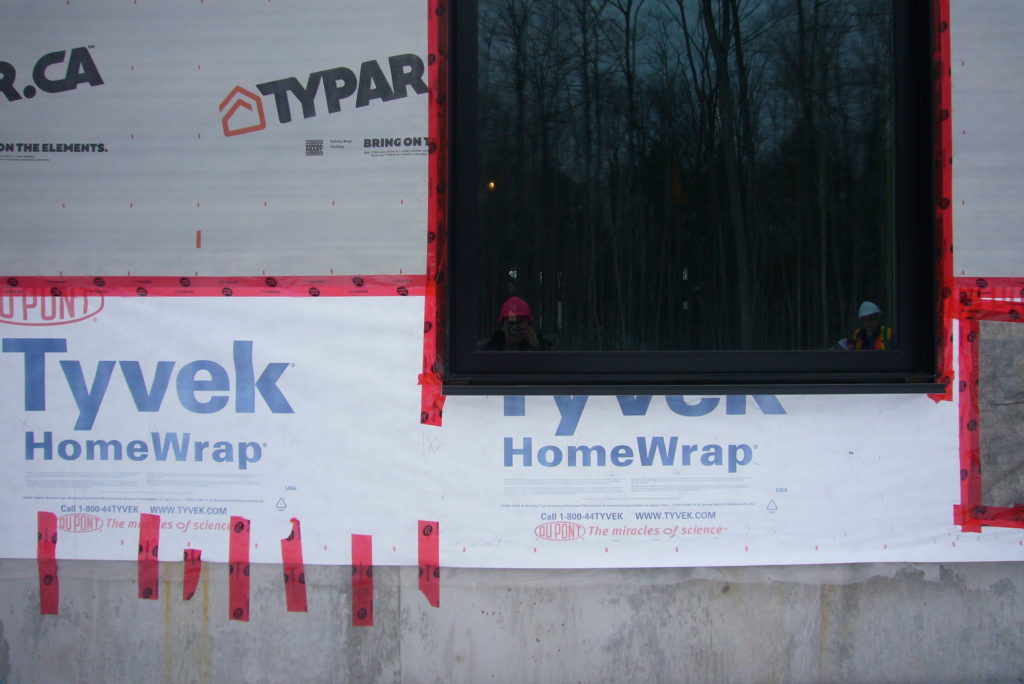
The hospice started construction earlier this year, and is on course for completion this summer. A look above at the importance of weather protection and air tightness for energy efficiency. The dark purple wood siding is nearly complete and drywalls are on their way! Hoping to see this project completed soon to offer those the care they deserve.
Beginning a new custom home or a renovation is a huge undertaking and can be quite overwhelming, especially when money is involved! It is often the biggest purchase in people lives.
We have made this blog post to help potential new custom home clients in Ontario get a sense of how much it will cost to build their dream project.
In order to help people create an accurate Budget for new custom home or Passive House construction or renovation projects, Coolearth has created a simple excel worksheet to make transparent those costs and help create realistic budgets. The worksheet presents, at a high level, different items to consider. It can be used as a quick tool to provide a general understanding of how much a project will cost.
The more you can be informed, the more pleasant your journey of building your dream home will be.
Download a free budgeting worksheet to calculate how much a new custom home in Ontario will cost here.
We also want to include a few key things to keep in mind when preparing a budget or thinking about the cost of your dream home.
HST
HST is charged on new homes. On a $750,000 home HST equates to almost $100,000.
Basements
When you are preparing your budget be sure to include the square footage of a basement in the square footage of the home. For instance, in a 2,000 squre foot home with a 1,000 square foot basement. The square footage of the project is 3,000 sqft.
Contingency Allowance
A further consideration is the need for a contingency allowance. There are many moving parts in any building project, and sometimes unforeseen site conditions such as buried underground structures, extreme weather events, or other things happen which are beyond our control. Therefore we recommend a minimum contingency of 10-20% especially when starting out. As the project progresses you can lessen the contingency allowance as you gain more detailed pricing information and the design is refined.
Architects and Engineers
Be sure to include in the budget the Architect’s and Engineer’s fees, which might amount to 5-10% of the budget.
Some final things to consider:
Net-zero/ passive homes generally price at $350-450/ sq. ft, compared to $250-350/ sq/ ft. for an average home. Different qualities and costs of finishing materials can dramatically impact the cost (i.e marble floor versus engineered wood).
Land costs: Carrying costs for the property, lawyers and agent fees, building permits and property surveys/ reports.
If you are renovating, that might mean finding a secondary, temporary dwelling.
We hope this helps! Please let us know if you have any questions.
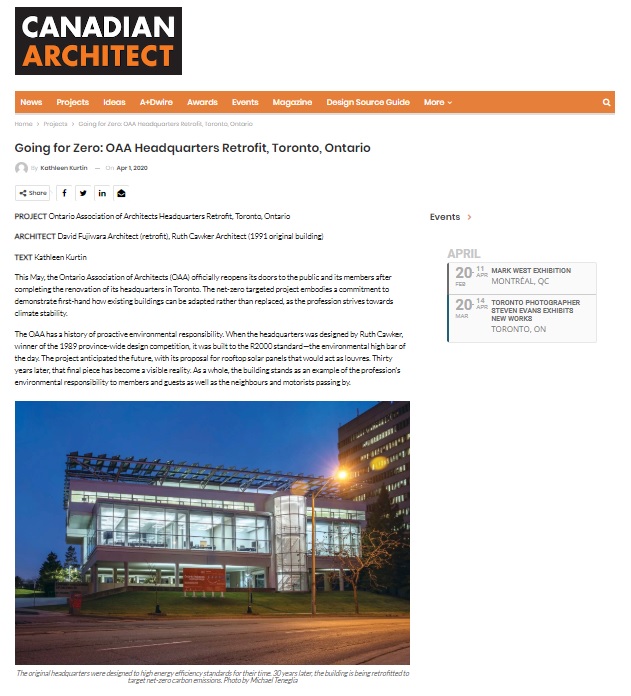
The OAA Headquarters recently underwent a retrofit to make it Net-zero. Canadian Architect has published a new article, written by Kathleen Kurtin about the project.